• Police seek suspects in deadly birthday party shooting
  • Lawmakers launch inquires into U.S. boat strike
  • Nov. 29, 2025, 10:07 PM EST / Updated Nov. 30, 2025,…
  • Mark Kelly says troops ‘can tell’ what orders…

Be that!

contact@bethat.ne.com


Be That ! Menu   ≡ ╳
  • Home
  • Travel
  • Culture
  • Lifestyle
  • Sport
  • Contact Us
  • Politics Politics
☰

Be that!

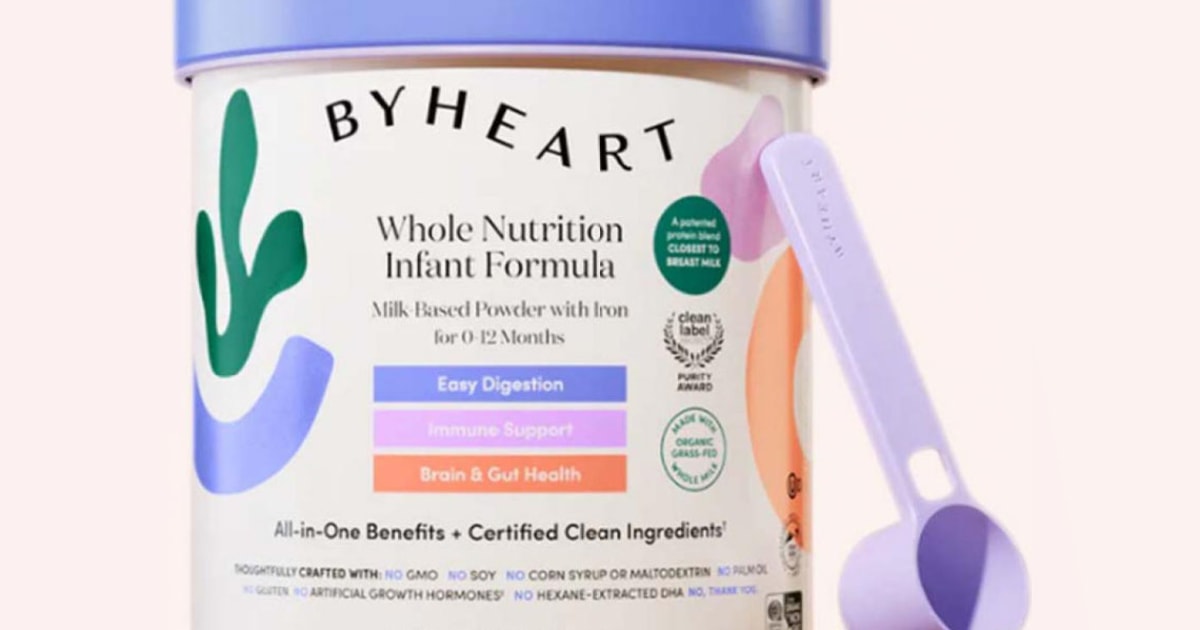
Nov. 11, 2025, 12:52 PM ESTBy Mirna Alsharif, Austin Mullen and Aria BendixBaby formula maker ByHeart is recalling all of its products amid an outbreak of infant botulism likely tied to its powdered formula.Since August, 15 cases have been reported across 12 states, nearly all among babies between 16 days and around 5 months old, according to the Food and Drug Administration.After the FDA announced Saturday that it was investigating the outbreak and its link to ByHeart’s organic Whole Nutrition Infant Formula, the company recalled two lots of the product. ByHeart then expanded the recall Tuesday to include all batches of the formula, both in cans and “anywhere packs” — small, sealed pouches.”The safety and well‑being of every infant who uses our formula is, and always will be, our highest priority,” ByHeart’s co-founder and president, Mia Funt, said in a statement. “This nationwide recall reflects our commitment to protecting babies and giving families clear, actionable information. Alongside this recall, we are conducting a comprehensive investigation to do our part to get the answers parents expect and deserve.”Infant botulism arises when babies ingest food contaminated with Clostridium botulinum bacteria, which produce a toxin that affects the body’s nervous system. The infection can cause constipation, poor feeding, loss of head control and difficulty swallowing. Untreated, it can ultimately lead to paralysis and death, according to the Centers for Disease Control and Prevention. No deaths have been reported in the current outbreak.The FDA said Tuesday that 84 infants nationwide have received treatment for infant botulism since Aug. 1. Of that total, the agency is investigating 15 cases with “suspected or confirmed infant botulism and confirmed exposure to Byheart Whole Nutrition infant formula.” All of those infants were hospitalized.”This information shows that ByHeart brand formula is disproportionately represented among sick infants in this outbreak, especially given that ByHeart represents an estimated 1% of all infant formula sales in the United States,” the FDA said in an update Tuesday. “Investigations remain ongoing but have not identified any other infant formula brands or shared exposures that pose a risk to infants.”The cases linked to ByHeart formula have been reported in Arizona, California, Illinois, Kentucky, Minnesota, North Carolina, New Jersey, Oregon, Pennsylvania, Rhode Island, Texas and Washington, according to the FDA. The agency instructed parents and caregivers to immediately stop using any ByHeart infant formula products and keep a close eye on children who consumed it recently, as botulism can take weeks to develop. If a child does not develop symptoms within 30 days, the agency says to throw the formula away. If a child does develop symptoms, however, the FDA advises that parents or caregivers hold on to the product for testing. Children who consumed ByHeart formula and are exhibiting possible botulism symptoms should receive immediate medical attention. The New York City-based company said it has invited the FDA and other public health agencies to test unopened cans of its formula to “provide reliable evidence that will help bring clarity to families who are understandably concerned, as currently, no U.S. or imported formula is required to be tested for Clostridium botulinum.”The California Public Health Department was first to report the observed increase in infant botulism cases among babies who consumed ByHeart formula. “As the FDA and CDPH continue their investigations, we stand ready to partner with them at every step, providing full access to our facilities and unopened cans, without restriction,” ByHeart said in an open letter issued Tuesday.Most recalls of infant formula in the past few years have occurred because of potential contamination with a different type of bacteria, Cronobacter sakazakii, which can also be life-threatening in infants. In 2022, Abbott Nutrition, one of the country’s top formula producers, recalled several brands of powdered infant formula after complaints of bacterial infections in infants who consumed the products. The recall contributed to a national formula shortage in 2022.The CDC later determined that Cronobacter infections may have contributed to the deaths of two infants in Ohio but was not able to definitively link the illnesses to contamination at an Abbott facility. Abbott said at the time that there was “no evidence” to demonstrate a link.Mirna AlsharifMirna Alsharif is a breaking news reporter for NBC News.Austin MullenAria BendixAria Bendix is the breaking health reporter for NBC News Digital.

admin - Latest News - November 11, 2025
admin
14 views 13 secs 0 Comments


Infant formula maker ByHeart is recalling all of its products amid an outbreak of botulism likely tied to its organic powdered formula.


Source link

TAGS:
PREVIOUS
Researchers in Australia discover the 'Lucifer' bee
NEXT
Nov. 11, 2025, 1:31 PM ESTBy Sahil KapurWASHINGTON — Senate Republicans say they’re open to extending a pot of Affordable Care Act funds that will expire at the end of the year — but only if Democrats acquiesce to stricter abortion restrictions on insurance plans.The demand presents a significant hurdle to reaching a bipartisan deal to extend ACA funding designed to avoid major premium hikes next year for more than 20 million Americans, as Democrats are adamant that existing abortion guardrails under Obamacare are sufficient.If the funds are not extended by the end of the year, some people insured under Obamacare could see their bills rise by thousands of dollars per month, raising concerns that millions will choose to go uninsured.Senate Majority Leader John Thune, R-S.D., said there will be a negotiation about an extension after the government reopens. He said one condition will be stricter rules pertaining to the Hyde amendment, which bars federal funding from being used for abortion.Senate Democrats only got a ‘pink promise’ on health care subsidies, says House Democrat08:00To satisfy Democratic demands to comply with the Hyde amendment when the first law passed in 2010, Obamacare does not allow federal funds to cover abortions. Some states allow people insured under Obamacare to access abortion coverage using state or other funding. Republicans want to change that.“That’s what we’re going to negotiate,” Thune told reporters before the Senate passed the bill to end the government shutdown. “A one-year extension along the lines of what [Democrats] are suggesting, and without Hyde protections — there’s just not even, doesn’t even get close.”Thune’s demand for more stringent abortion limits on Obamacare money is backed by colleagues, including Sen. Mike Rounds, R-S.C., an outspoken proponent of extending the ACA funds, as well as Sens. Steve Daines, R-Mont., and Mike Lee, R-Utah.Rounds warned that “you won’t get any” Republican votes to extend the money without more stringent abortion limitations.“That’s the message that we shared with a lot of our Democratic colleagues is you can’t do it under your existing framework, and you’re never going to get any Republican votes. Because we believe strongly taxpayer dollars should not go to fund abortions,” he said. “They have a different point of view, but it’s pretty clear that Republicans are solid on that particular issue.”But Democrats say there’s no way they’ll agree to that.Sen. Jeanne Shaheen, D-N.H., responded with a flat “no” when asked if there’s any way Democrats agree to stricter abortion limitations in order to extend the ACA funds.“It’s a nonstarter,” Shaheen told NBC News, pointing to existing guardrails on abortion funding built into the ACA. “It’s not an issue. We already dealt with that issue.”Other Democrats share her opposition to changing those rules.Behind the push is a pressure campaign by Susan B. Anthony Pro-Life America, an influential group fighting to ban abortion in the U.S., to condition Republican support for ACA funding on tougher abortion restrictions.“Since Democrat offers to pass a ‘clean’ extension of these ACA subsidies would extend funding of elective abortion coverage through Obamacare, Susan B. Anthony Pro-Life America strongly opposes and will score against any such offers — even for one year,” SBA President Marjorie Dannenfelser told senators in a letter dated Nov. 7 and shared with NBC News. “A vote for this extension is a vote for abortion coverage. Votes will be scored, and double-weighted, in each member’s profile on SBA Pro-Life America’s National Pro-Life Scorecard.”Katie Keith, a Georgetown Law professor and founding director of its Center for Health Policy and the Law, said existing law bans any federal funds from flowing to abortion care through ACA plans, including the premium tax credits and cost-sharing reduction payments, consistent with the Hyde amendment.States have the option to create separate revenue streams where enrollees can pay a surcharge to gain abortion coverage through their plans. 25 states ban abortion coverage through ACA marketplaces entirely. The rest are split between requiring it through additional state funding or deferring to insurers.Still, even for states that allow ACA plans to cover abortion, “there are strict segregation requirements,” Keith said. “Since the law was enacted, no federal funds flow toward abortion care.”She said the same rule applies to Medicaid funding.“What critics of the current policy are arguing is they want Hyde plus-plus. This goes far beyond what Hyde requires,” she added. “It’s not about federal funds flowing toward the care, it’s about federal funds flowing toward coverage, even if it’s financed separately. … They want to knock out abortion coverage fully.”And if the SBA proposal becomes law, it would create a serious conflict with the dozen blue states that use their own funds to permit abortion coverage through the ACA marketplaces.“It could knock out federal subsidies for coverage altogether in those states if those funds cannot flow,” said Keith, who worked a stint in the Biden administration before returning to Georgetown.Daines, who sits on the Finance Committee that oversees health policy, said additional Hyde protections have “got to be in there, absolutely” — in any ACA deal.“We’ve got the language for it, the Hyde language,” he said. “Hyde has been a longstanding principle here of not allowing the federal taxpayers to be used for abortion.”Shaheen, a moderate Democrat who is not seeking re-election next year, is the author of a permanent ACA funding extension. She also helped craft the deal to reopen the government. She said she’s open to other reforms to the enhanced ACA tax credits, such as income-based limits, but going beyond existing abortion limitations is a red line.Other Democrats take a similar view.“I don’t think you’re going to get Democratic votes talking about abortion,” said Sen. Chris Murphy, D-Conn. “But there are conversations you can have about the structure of the subsidies once you get into a negotiation. I’ve heard their concerns about income caps and no-premium plans.”Sen. Brian Schatz, D-Hawaii, said the GOP’s abortion demand seems like a smokescreen to disguise the party’s unwillingness to continue that money, which was first passed during the Covid pandemic in 2021 and extended the following year. The subsidies limit premiums to 8.5% of an enrollee’s income.“At that point, they’re just unserious about extending the ACA [funds],” he said. “Once they get into restrictions on abortion, everyone knows what that means. It means that they would like to say they’re for extending ACA, but that they don’t have the votes to do it right now.”Schatz indicated that President Donald Trump, who softened his position on abortion during the 2024 campaign and said it should be left up to states, can steer his party to a viable solution.“This is solved in 10 seconds if Donald Trump wants it solved,” Schatz said.Sahil KapurSahil Kapur is a senior national political reporter for NBC News.Frank Thorp V and Scott Wong contributed.
Related Post
November 26, 2025
Russia says leaked U.S. call is attempt to disrupt peace talks, warns no deal is near
September 22, 2025
Marco Rubio gives speech at Charlie Kirk memorial
November 28, 2025
Maasai leader files lawsuit over luxury safari camp
October 23, 2025
Oct. 23, 2025, 9:00 AM EDTBy Aria BendixResearchers have identified a surprising cause of some urinary tract infections: contaminated meat.A four-year study found that nearly 1 in 5 UTIs detected among a group of patients in Southern California were most likely caused by the consumption of chicken, turkey, pork or beef that carried E. coli bacteria.The common understanding is that most UTIs are caused by improper hygiene or sexual contact. Around 6 million to 8 million cases are recorded in the United States every year, and around 80% are caused by E. coli bacteria. But the strains responsible for the majority of UTIs are not the ones typically associated with foodborne illnesses, which cause diarrhea and vomiting.The new research, published Thursday in the journal mBio, hints at the prevalence of foodborne UTIs, which were largely unknown to scientists two decades ago.“This is the latest in a long series of studies that have shown that we’re getting some of our urinary tract infections from food,” said Dr. Martin Blaser, a microbiologist at Rutgers University, who was not involved in the research.“A study like this allows people to draw inferences, to understand what’s going on,” he added. “If somebody develops a urinary tract infection, they’re now wondering, ‘Well, was it the hamburger I ate three days ago or five days ago?’”When E. coli bacteria from food wind up causing a UTI, they first enter the gut after people touch contaminated meat in the cooking process or eat undercooked meat. From there, the bacteria can get into the urethra as a result of poor hygiene or improper wiping in the bathroom, then ascend into the urinary tract.One of the study’s authors, Lance Price, a professor of environmental and occupational health at George Washington University, said he was inspired to investigate the link between UTIs and contaminated meat about 15 years ago, when he noticed that most of the chicken and turkey he tested carried the bacterium. “For some reason, that was basically being ignored. If it didn’t cause diarrhea, it was being ignored. And so that started me on this path,” he said.Price’s previous research estimated, based on modeling, that foodborne E. coli could account for up to 640,000 UTIs in the United States every year — around 8% of the total. His new findings come from a collaboration with researchers at Kaiser Permanente, who collected more than 2,300 urine samples that were positive for E. coli in Southern California from 2017 to 2021. They also took more than 3,300 samples from meat sold in major grocery stores in the area over the same period.A lab at George Washington University then analyzed the genetic material to determine the origins of people’s infections.“Strains have different DNA signatures, and you can see whether the strains in the animals and the strains in the people match up or not. And they found a number of matches,” Blaser said.Among the meat sampled, contamination rates were highest in chicken and turkey products. The study also found that low-income neighborhoods in Southern California had a 60% higher risk of foodborne UTIs than wealthier neighborhoods. Price and his co-authors suggested that grocery stores in those areas might not have proper storage temperatures or that they may keep products out for too long. Price said he has seen poorly packaged meat sold in some stores in Washington, D.C.“I would buy these packages of chicken that were just bloated, just so full of saline that when I put it on the conveyor belt … it would just be wet,” he said. “And I know what’s in that liquid: It’s bacteria, and often drug-resistant bacteria, that’s spilling onto these conveyor belts.”Urinary tract infections can cause painful and frequent urination, and if they are left untreated, they can lead to serious or life-threatening complications, so people with suspected UTIs should seek treatment right away.“The bladder is a major gateway to the bloodstream for E. coli. And when you get these E. coli in your blood, they can kill you,” Price said.Doctors treat UTIs with the same antibiotics regardless of whether the E. coli originated from contaminated meat or another source. (Doctors and patients rarely know the source of an infection, Price said.)Although thoroughly cooking meat and poultry can kill bacteria, Price said, the transmission of foodborne E. coli is mostly due to cross-contamination in the kitchen, so it is important to keep raw meat separate from other items and wash your hands thoroughly after you prepare food.His study also recommends that meat producers and regulatory agencies consider stricter measures to limit E. coli contamination, such as making sure packages are sealed tightly and do not contain excess liquid. “Everybody should have leak-proof packaging in the United States,” he said.Aria BendixAria Bendix is the breaking health reporter for NBC News Digital.

Comments are closed.
Scroll To Top
  • Home
  • Travel
  • Culture
  • Lifestyle
  • Sport
  • Contact Us
  • Politics
© Copyright 2025 - Be That ! . All Rights Reserved