• Suspect in Custody in Brown University Shooting: What…
  • Dec. 14, 2025, 8:11 AM ESTBy Andrew GreifSome…
  • Special Report: Officials confirm suspect in custody in…
  • Video shows Bondi Beach shooter disarmed

Be that!

contact@bethat.ne.com


Be That ! Menu   ≡ ╳
  • Home
  • Travel
  • Culture
  • Lifestyle
  • Sport
  • Contact Us
  • Politics Politics
☰

Be that!

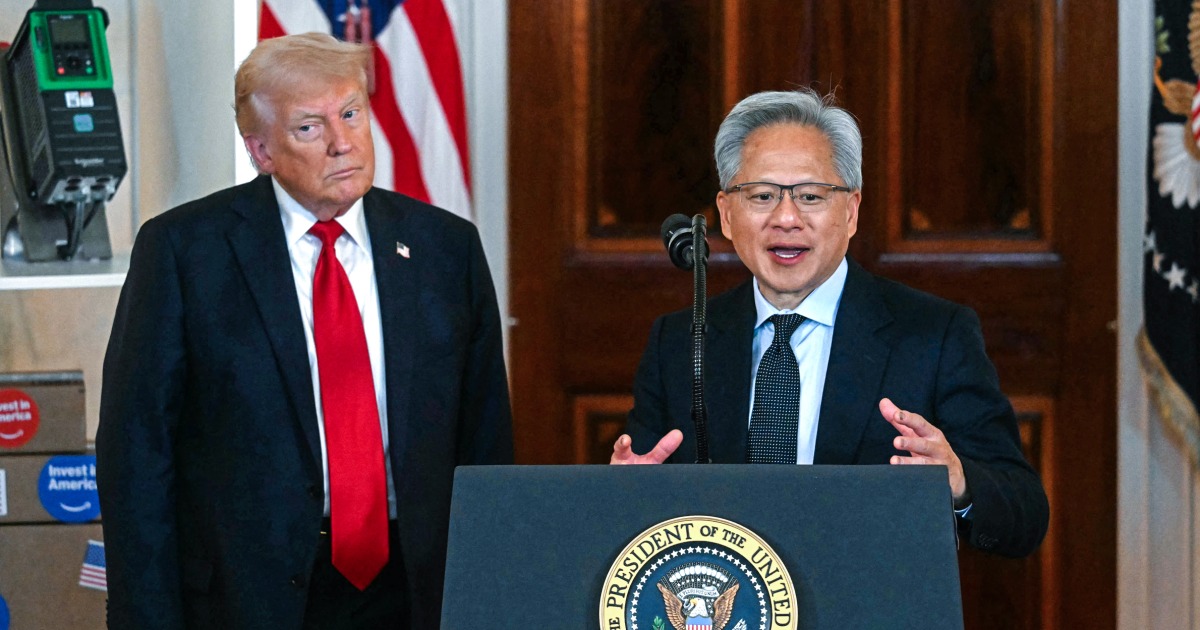
By Steve KopackPresident Donald Trump said on Monday that he has informed President Xi Jinping of China that “the United States will allow NVIDIA to ship its H200 products to approved customers in China.” Nvidia’s H200 is a generation behind its latest “Blackwell” chip, which is considered among the most advanced and high-powered AI chips available anywhere.Trump said the “Blackwell” chip would not be part of this deal.Still, the move could be worth billions of dollars for Nvidia, the world’s most valuable company. Nvidia says it currently has more than $500 billion worth of orders for its best AI chips to fulfill this year and next — and that’s before factoring in any buyers in China.The president said he will also allow Intel, AMD “and other great American companies” to sell similar chips to customers in China. “The Department of Commerce is finalizing the details,” he said.Monday’s announcement would end what was effectively a ban on sales of AI chips from U.S. companies to China.The president wrote on Truth Social that the U.S. government would take a 25% cut of sales of the approved chips, up from a previously-announced 15%. However, it remains to be seen whether China will allow imports of the chips. After the U.S. said it would allow an even older generation of Nvidia chip to be sold in China, known as the H20, Xi’s government essentially said it did not want them.In his social media post, Trump said: “President Xi responded positively!””We applaud President Trump’s decision to allow America’s chip industry to compete to support high paying jobs and manufacturing in America,” Nvidia told NBC News in a statement.”Offering H200 to approved commercial customers, vetted by the Department of Commerce, strikes a thoughtful balance that is great for America,” the company said.For months, Nvidia CEO Jensen Huang has been lobbying the White House to permit Nvidia to sell some chips to customers in China. But Trump’s approval does not mean the issue is a done deal in Washington. A bipartisan group of lawmakers in Congress has expressed serious concerns about allowing Chinese customers to buy American AI chips.Huang visited Republican senators on Capitol Hill earlier this month to discuss artificial intelligence-related policies.Sen. John Kennedy, R-La., didn’t attend the meeting because he said he did not consider Huang to be “an objective, credible source about whether we should be selling chips to China.”Kennedy said Huang wants to sell to Chinese customers for financial gain. Others, like Sen. Mike Rounds of South Dakota, said it was a “healthy discussion to have.” Republican Sen. Pete Ricketts of Nebraska said in a statement last week that “denying Beijing access to these AI chips is essential to our national security.” Democrats have also expressed concerns. Ricketts joined with Sen. Chris Coons of Delaware to introduce a “Safe Chips Act.” “Just as the American dollar is the world standard that economies are built on, we want the American tech stack for the world’s technology and industries to be built on, and that includes China,” Huang said on Yahoo Finance in August. AMD did not immediately respond to a request for comment. Intel declined to comment.The easing of export controls on China would come just as relations thaw between Washington and Beijing. China recently started accelerating its purchases of American soybeans, and gave the green light to exports of many rare earth minerals to American buyers.Speaking during a White House event with farmers earlier on Monday, Trump said he believed China might buy even more soybeans than it had originally agreed to. Within minutes after the president’s post, Nvidia shares rose nearly 3% in after-hours trading. Steve KopackSteve Kopack is a senior reporter at NBC News covering business and the economy.

admin - Latest News - December 8, 2025
admin
8 views 15 secs 0 Comments


President Donald Trump said the United States would permit NVIDIA to ship its H200 AI chips to approved customers in China, effectively ending an export ban.


Source link

TAGS:
PREVIOUS
Camera shows over a dozen ICE agents raid Minnesota home
NEXT
Trump reverses on video of alleged drug vessel strike
Related Post
October 23, 2025
Eric Adams endorses Andrew Cuomo for NYC mayor
September 22, 2025
April 3, 2023 Trump indictment news
October 31, 2025
Mamdani explains how he would protect New Yorkers from a potential Trump immigration enforcement
October 31, 2025
Savewith a NBCUniversal ProfileCreate your free profile or log in to save this articleOct. 30, 2025, 1:15 PM EDT / Updated Oct. 31, 2025, 12:05 PM EDTBy Jane C. TimmOhio Republican and Democratic lawmakers unanimously approved a new congressional map that would give a slight, but not overwhelming, boost to the GOP ahead of next year’s midterm elections.At a meeting Friday morning, members of the state’s bipartisan redistricting commission approved the proposed map, which was released on Thursday as part of an unexpected deal. The map shifted two Democratic-held districts to the right and one to the left while also maintaining 10 districts that favor Republicans and two that are Democratic strongholds. Punchbowl News was first to report details of the deal.Suzan DelBene, the chair of the Democratic Congressional Campaign Committee, said “this is not a fair map for Ohio voters,” but praised Democratic legislators for “negotiating to prevent an even more egregious gerrymander.”“This compromise keeps us on the path to taking back the House Majority and we’ll continue to win across Ohio because voters know it’s House Democrats who are fighting for them,” DelBene said in a statement. The new map came as a surprise to many observers. Democrats largely expected the constitutionally mandated redistricting commission to reach a stalemate, as it did in 2021. If the commission failed to settle on a new map ahead of the 2026 elections, responsibility for setting congressional boundaries would have fallen back to the Republican-controlled Legislature, which could have drawn an aggressively gerrymandered map. If that happened, Democrats had threatened to pursue a statewide referendum that could have resulted in voters blocking the map from going into effect.The map won’t be subject to a referendum, while Democrats avoided the worst-case scenario map. In negotiations, a source familiar with the negotiations said, Republicans showed Democrats a map that had the GOP controlling 13 of the state’s 15 districts. A voter referendum on such a map would have required Democrats to gather nearly 250,000 signatures in just 90 days, a difficult feat under any scenario, let alone during the holidays and Ohio’s winter months. Lawmakers on the redistricting commission faced some protests at Friday’s meeting. “Shame, shame on you all,” said members of the public who attended the meeting to offer comment. “You sold us out!”Ohio is represented in Congress by 10 Republicans and five Democrats. Democratic Reps. Greg Landsman and Marcy Kaptur would face more competitive districts under the new map, while Rep. Emilia Sykes’ district would become slightly more Democratic.After the bipartisan commission approved the map Friday, Kaptur and Sykes said they would run for re-election under the news district lines.”Let the Columbus politicians make their self-serving maps and play musical chairs, I will fight on for the people and ask the voters for their support next year,” Kaptur said in a post on X.Under the current lines, the Cook Political Report with Amy Walter rated Kaptur’s and Sykes’ seats as “toss ups” and Landman’s as “likely Democratic.”The emergence of Ohio’s new map proposal comes amid an unusually aggressive mid-decade redistricting cycle, kicked off by President Donald Trump, who has asked Republican-led states to draw new maps in an effort to shore up the party’s narrow U.S. House majority. Texas, Missouri and North Carolina have all drawn maps boosting Republicans, while California Democrats are asking voters to approve new district lines next week. Virginia Democrats took the first major step this week towards modifying their redistricting commission to allow them to redraw their state’s map next year, while Indiana GOP lawmakers are expected to soon consider a redistricting effort. Other states, including Louisiana, await a Supreme Court ruling they hope could open the door to redrawing their congressional maps next year, too.Jane C. TimmJane C. Timm is a senior reporter for NBC News.
Comments are closed.
Scroll To Top
  • Home
  • Travel
  • Culture
  • Lifestyle
  • Sport
  • Contact Us
  • Politics
© Copyright 2025 - Be That ! . All Rights Reserved