• Police seek suspects in deadly birthday party shooting
  • Lawmakers launch inquires into U.S. boat strike
  • Nov. 29, 2025, 10:07 PM EST / Updated Nov. 30, 2025,…
  • Mark Kelly says troops ‘can tell’ what orders…

Be that!

contact@bethat.ne.com


Be That ! Menu   ≡ ╳
  • Home
  • Travel
  • Culture
  • Lifestyle
  • Sport
  • Contact Us
  • Politics Politics
☰

Be that!

Syrian refugee elected mayor of German town, years after fleeing war

admin - Latest News - September 22, 2025
admin
42 views 5 mins 0 Comments


CNN
 — 

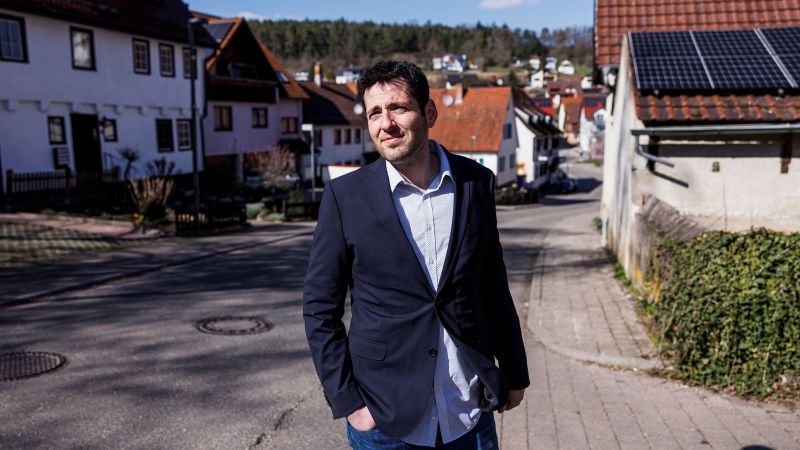
A Syrian who arrived in Germany as a refugee in 2015 has won a mayoral election in the southwestern German state of Baden-Württemberg.

Ryyan Alshebl, who left his hometown of As Suwayda in Syria eight years ago, ran as an independent in the municipality of Ostelsheim. He won 55.41% of the votes on Sunday, beating two German candidates, Marco Strauss and Mathias Fey.

Locals cheered the 29-year-old when he welcomed his win, a victory he described as “sensational,” German local broadcaster SWR reported Monday.

“Today, Ostelsheim sent an example for broad-mindedness and cosmopolitanism for the whole of Germany,” he said, according to to German public broadcaster ZDF. “That’s not something that can be taken for granted in a conservative, rural area.”

Alshebl’s first call after his victory was to his mother in Syria, who was thrilled with the news, SWR reported.

The Association of Municipalities of Baden-Württemberg said Alshebl is the first man with Syrian roots to run for and win a mayor’s office. He will start his role in June.

Ostelsheim residents have welcomed their incoming mayor. “The fairy tale has come true, and the right man has become our mayor,” Annette Keck, who lives in the village, told SWR.

Strauss, one of his opponents, congratulated Alshebl. “I wish you good luck and at the same time ask for support for Mr. Alshebl, for our shared Ostelsheim,” he said on Facebook.

The state’s Integration Minister Manne Lucha said that Alshebl’s victory showed that diversity is a natural part of Baden-Württemberg. “I would be very pleased if Ryyan Alshebl’s election encourages more people with a migration history to run for political office,” he said.

Not everyone has been so warm to the 29-year-old. ZDF reported the Syrian received hateful comments on the campaign trail.

The young politician went from house to house, promoting his election program, and “the experiences were predominantly positive,” but there was also a minority of far-right fringe voters in Ostelsheim that did not want to accept him due to his Syrian roots, Alshebl told ZDF.

Born to a schoolteacher and agricultural engineer in Syria, Alshebl described his life as carefree until the age of 20, according to his campaign website.

At the time, protests against the Syrian government that began in 2011 soon devolved into chaotic war. The fighting and later rise of ISIS forced 10.6 million people from home by late 2015 – about half of Syria’s pre-war population.

Alshebl faced the dilemma of being drafted for military service with the Syrian army or leaving the country, according to his website.

While many Syrians were displaced internally or fled to countries in the region, others like Alshebl made the dangerous journey to Europe. He was 21 years old at the time, and said he crossed from Turkey to the Greek island of Lesbos in a rubber dinghy.

Former German Chancellor Angela Merkel had implemented a brief open-door policy in 2015 that saw the country take in about 1.2 million asylum seekers in the following years, including Alshebl.

The move sparked a backlash in Germany and the sudden growth of the far-right, anti-immigration Alternative for Germany (AfD) in the wake of summer 2015.

Once in Germany, Alshebl lived close to Ostelsheim and said at the time he felt “there is only one thing you can do: get back on your feet quickly and start investing in your own future quickly.”

For the last seven years he worked in the administration of Althengstett town hall, in a neighboring town. He drew from his experience, he said in his campaign, and made digital access to to public administration services one of priorities. Flexible childcare and climate protections are also on his agenda.

Alshebl, who is a member of the Green Party and now has German citizenship, pledged during his campaign that once elected as mayor he would move to Ostelsheim.

Source link

TAGS:
PREVIOUS
Haberman reveals why Trump attacked judge and his family in speech
NEXT
Kwame Brathwaite, photographer of ‘Black is Beautiful’ movement, dies at 85
Related Post
September 25, 2025
Vance: TikTok will be valued around $14 billion
October 24, 2025
Savewith a NBCUniversal ProfileCreate your free profile or log in to save this articleOct. 24, 2025, 9:39 AM EDTBy Arata Yamamoto and Jay GanglaniTOKYO — As Japan tries to placate President Donald Trump amid contentious trade talks, officials may be eyeing an icon of American manufacturing that has virtually no presence there: The Ford F-150 pickup truck.Trump, who is visiting the key U.S. ally next week as part of his first trip to Asia since returning to office, has long criticized the lack of American vehicles sold in Japan, citing what he believes are non-tariff barriers.Japanese auto brands such as Nissan, Honda, Mitsubishi and Subaru are ubiquitous in the United States, where Japan exported over 1.37 million vehicles last year, according to the Japan Automobile Manufacturers Association (JAMA). Cars are Japan’s top export to the U.S., though according to JAMA most Japanese cars sold there are actually assembled in North America.By contrast, Japanese brands account for more than 90% of new cars sold in Japan, which imported fewer than 17,000 American vehicles last year, according to the Japan Automobile Importers Association. The Trump administration has been pushing Japan to buy more American cars, including as part of a trade deal announced in July that imposed a 15% tariff on Japanese autos and auto parts. A joint statement on the agreement published last month said Japan would allow vehicles built and certified for safety in the U.S. to be sold in the country without additional testing. In August, Trump suggested that there would soon be a market in Japan for American cars, specifically the Ford F-150.“They’re taking the very beautiful Ford 150, which does very well and I’m sure will do very well there,” he told CNBC. The model has long been the best-selling vehicle in America, according to industry outlets.Reuters reported this week that Ford F-150s were part of a purchase package being finalized to present to Trump during talks in Tokyo next week, citing two sources with knowledge of the preparations. It said the trucks might be used in Japan as snow plows. Local media in Japan have also said the government is considering buying the trucks.Japanese officials have not confirmed the reports, and the new trade minister, Ryosei Akazawa, was not asked about them at his first news conference on Friday.Akazawa, who was previously Japan’s lead trade negotiator with the U.S., said earlier this month that while Trump’s frequent mentions of the Ford F-150 suggested they were a “favorite” of his, he did not have information to share on any potential purchases by the Japanese government.Despite the advocacy by Trump, large, expensive American cars have long been a hard sell in Japan, where roads are typically smaller and narrower than their American counterparts. “Fully-sized pickups simply wouldn’t fit on Japanese roads and into the standard pay parking lots,” Mike Smitka, a member of GERPISA, an international network dedicated to the global automobile industry, told NBC News. Many of the vehicles sold in Japan are mini or “kei” cars that are far smaller and more fuel efficient than the ones produced by American automakers. They are required by law to be no more than about 11.2 feet long and 4.9 feet wide, compared with the F-150 which is typically more than 17 feet long and 6.6 feet wide. Nissan kei cars for sale in Yokohama, Japan in 2022.Stanislav Kogiku / SOPA via Getty Images fileEuropean vehicles are also far more popular in Japan than American ones, accounting for more than 200,000 imports last year. The top-selling European car brand in Japan is Mercedes-Benz. “Unlike European car companies, Ford and General Motors (GM) don’t have dedicated port facilities or dealerships,” Smitka said in emailed comments. “They’d be very expensive to import, expensive to market, and because there’s no network, expensive to service.” Ford did not respond to an emailed request for comment. In 2016, the company said that it would close all operations in Japan, saying it had struggled to gain market share and saw “no reasonable path to profitability.”“They don’t try to sell pickups because they understand the market,” Smitka said. Arata Yamamoto reported from Tokyo, and Jay Ganglani from Hong Kong.Arata YamamotoArata Yamamoto has been an NBC News producer in Tokyo since 1993.Jay GanglaniJay Ganglani is NBC News’s 2025-26 Asia Desk Fellow. Previously he was an NBC News Asia Desk intern and a Hong Kong-based freelance journalist who has contributed to news publications such as CNN, Fortune and the South China Morning Post.
November 13, 2025
Newly released emails bring Trump's relationship with Epstein back into spotlight
October 31, 2025
Trump administration says members of the military will get paid Friday despite the government shutdown
Comments are closed.
Scroll To Top
  • Home
  • Travel
  • Culture
  • Lifestyle
  • Sport
  • Contact Us
  • Politics
© Copyright 2025 - Be That ! . All Rights Reserved