• Police seek suspects in deadly birthday party shooting
  • Lawmakers launch inquires into U.S. boat strike
  • Nov. 29, 2025, 10:07 PM EST / Updated Nov. 30, 2025,…
  • Mark Kelly says troops ‘can tell’ what orders…

Be that!

contact@bethat.ne.com


Be That ! Menu   ≡ ╳
  • Home
  • Travel
  • Culture
  • Lifestyle
  • Sport
  • Contact Us
  • Politics Politics
☰

Be that!

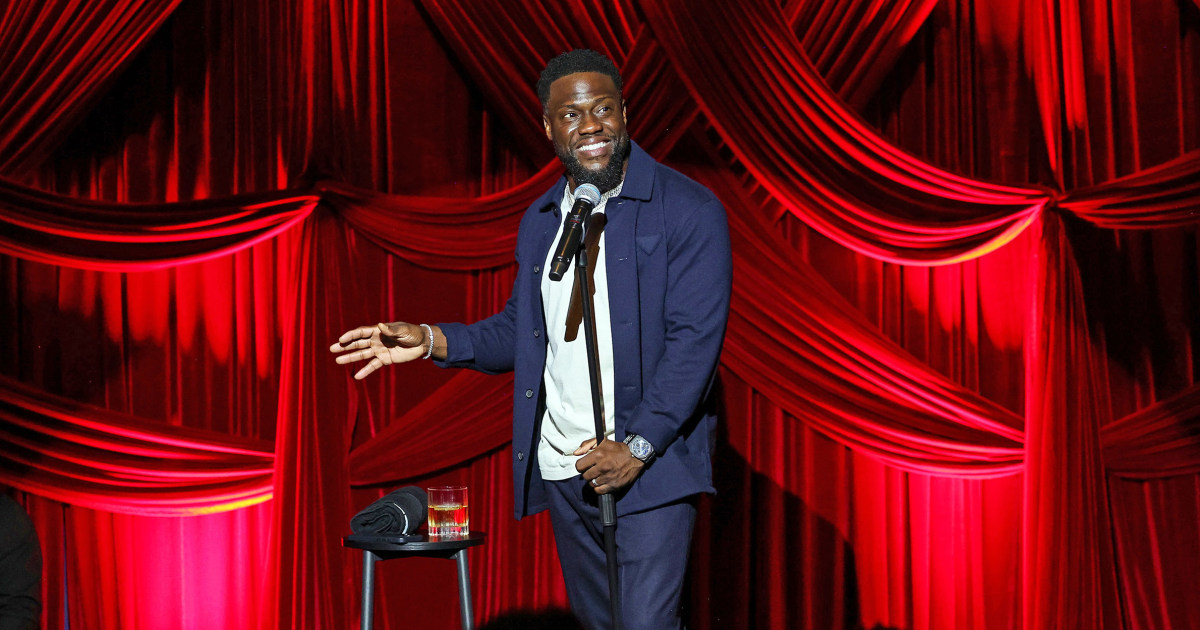
Sept. 29, 2025, 1:52 PM EDTBy Angela YangA comedy festival in the capital of Saudi Arabia has become a cultural flash point as major comedians face criticism for accepting seemingly lucrative deals to perform in a country that was virtually impossible to visit until 2019 and a pariah in much of the West for its human rights record.The Riyadh Comedy Festival, which began Friday and runs through Oct. 9, features a variety of big names such as Dave Chappelle, Kevin Hart, Aziz Ansari, Pete Davidson, Andrew Schulz, Jo Koy, Bill Burr, Jessica Kirson, Jimmy Carr and Louis C.K.These comedians, most of them American, are now encountering resistance from some fans, human rights advocates and fellow comics in the industry.Marc Maron, host of the “WTF” podcast, blasted the festival in a recent stand-up clip, joking that it was easy for him to “take the high road on this one” considering he was not invited to perform.“I mean, how do you even promote that?” Maron said. “Like, ‘From the folks that brought you 9/11, two weeks of laughter in the desert. Don’t miss it.’ I mean, the same guy that’s gonna pay them is the same guy that paid that guy to bone-saw Jamal Khashoggi and put him in a f—ing suitcase.”The Saudi Embassy in Washington, D.C., declined to comment. Saudi Arabia’s General Entertainment Authority, which announced the festival in July, did not immediately respond to a request for comment.“The festival is the largest of its kind globally, bringing together a selection of award-winning comedy stars known for their outstanding performances on international stages and streaming platforms,” the Saudi Press Agency wrote in its announcement for the General Entertainment Authority. “It reflects the efforts to amplify Riyadh’s status as a leading destination for major cultural and artistic events.”Saudi Arabia, the oil-rich home of Islam’s two holiest sites, was for years among the most socially conservative nations on Earth with a morality police enforcing a strict interpretation of Shariah. In recent years under the rule of de facto leader Crown Prince Mohammed bin Salman, the country expanded its cultural and political influence by diversifying its economy and investing in sports, entertainment and tourism to improve its global image. Along with this, the crown prince oversaw a sweeping crackdown on dissent — imprisoning disgruntled royals, women’s rights advocates, and reforming clerics as well as adherents to previously government-sanctioned proponents of strict Wahhabi Islam.Celebrities and influencers have often been criticized for performing in the country or participating in tourism campaigns, and FIFA drew condemnation last year for selecting Saudi Arabia to host the 2034 World Cup.Shane Gillis, who said he was offered an invite, claimed that the organizers “doubled the bag,” or the amount of money offered, after he declined to participate.“It was a significant bag, but I’d already said no,” Gillis said on his podcast. “I took a principled stand.”On TikTok and Instagram, verified accounts that appeared to belong to Turki Al-Sheikh, a royal court adviser who has emerged as a powerful figure in sports and entertainment as part of Saudi Arabia’s push into the global culture industry, posted videos of Chappelle and Hart.In a news release last week, Human Rights Watch wrote that the Saudi government is using the festival “to deflect attention from its brutal repression of free speech and other pervasive human rights violations” and called on the performers “to publicly urge Saudi authorities to free unjustly detained Saudi dissidents, journalists, and human rights activists.”The nonprofit watchdog organization noted that some of the events land on the seventh anniversary of the assassination of Washington Post columnist Jamal Khashoggi, who was killed at the Saudi Consulate in Istanbul by intelligence operatives with close ties to the crown prince. The festival also takes place just months after Saudi authorities executed Turki al-Jasser, a journalist known for exposing corruption within the Saudi royal family.“The seventh anniversary of Jamal Khashoggi’s brutal murder is no laughing matter,” Joey Shea, Saudi Arabia researcher at Human Rights Watch, said in a statement. “And comedians receiving hefty sums from Saudi authorities shouldn’t be silent on prohibited topics in Saudi like human rights or free speech.”Other listed performers for the festival include: Sebastian Maniscalco, Maz Jobrani, Tom Segura, Whitney Cummings, Jimeoin, Russell Peters, Andrew Santino, Bobby Lee, Chris Distefano, Mark Normand, Gabriel Iglesias, Hannibal Buress, Sam Morril, Jeff Ross, Omid Djalili, Ali Siddiq, Zarna Garg, Chris Tucker and Ben Hart.These performers did not respond to requests for comment.The Saudi government has been censured by dozens of countries, and in 2024 it was denied a second attempt at scoring a seat on the United Nations Human Rights Council. In the U.S., relatives of victims of the Sept. 11 terror attacks have accused the Saudi government of having potential ties to the attack. (A direct link has not been proven.)But it has also made significant inroads with some powerful figures in the West, most notably the Trump family. President Donald Trump’s son-in-law Jared Kushner worked with the Saudis to secure a $2 billion investment in his firm and recently partnered with the country’s public investment fund to strike a $55 billion deal to take the video game giant Electronic Arts private. Trump has maintained a close relationship with the crown prince throughout the Saudi royal’s fraught tenure. View this post on Instagram A post shared by TURKI ALALSHIKH تركي آل الشيخ (@turki) The festival and subsequent fallout has also provided a rare window into these events and, in particular, the money and self-censorship often involved.One comedian, Atsuko Okatsuka, posted screenshots to Threads of what she said was her invite to the festival, including a section on “Content Restrictions” that prohibited the artists from performing material that “may be considered to degrade, defame, or bring into public disrepute, contempt, scandal, embarrassment, or ridicule” the country, its royal family or any religion.“A lot of the ‘you can’t say anything anymore!’ Comedians are doing the festival 😂” Okatsuka wrote. “they had to adhere to censorship rules about the types of jokes they can make.”Mike Birbiglia and Leslie Liao were among the comics who responded to her post, sharing that they had rejected the offer as well.Stavros Halkias similarly revealed in a podcast episode with Distefano, who did agree to perform, that he didn’t take the deal. Distefano told Halkias that while he “didn’t want to do it either,” his fiancée had ultimately urged him to “take that f—ing money.”At least one comedian, however, appears to have changed his mind despite initially agreeing to perform. Nimesh Patel, who was slated to get on stage Sunday, posted a TikTok video over the weekend sharing that he recently canceled his appearance after “having a change of heart.” That video has since become unavailable.“I’ll just do 40 shows that I had not planned on doing here in the perfectly clean, moral, above-everyone-else, United States of America — I’m tired just thinking about it — to make up for the lost bag,” Patel said.Meanwhile, comedian and podcaster Tim Dillon said in an episode of his podcast that he was dropped from the festival for making a joke about the country “having slaves.”“I’m gonna get fired again from people that are not even Saudis. I’m gonna get fired by people who don’t chop hands off. I’m gonna get fired by reasonable people. I’m gonna get fired by people that don’t practice Shariah law,” Dillon said. “This is the most controversial the people who fire me will ever be. Let me relish in this. Let’s take this win.”The Saudi Embassy did not immediately respond to a request for confirmation about the cancellation of Patel’s and Dillon’s shows.Angela YangAngela Yang is a culture and trends reporter for NBC News.Natasha Lebedeva contributed.

admin - Latest News - September 29, 2025
admin
33 views 27 secs 0 Comments


A comedy festival in the capital of Saudi Arabia has become a cultural flash point as major comedians face criticism for accepting seemingly lucrative deals to perform in a country that was virtually impossible to visit until 2019 and a pariah in much of the West for its human rights record


Source link

TAGS:
PREVIOUS
Sept. 29, 2025, 8:00 AM EDT / Updated Sept. 29, 2025, 9:23 AM EDTBy Lawrence HurleyWASHINGTON — The Supreme Court justices are scheduled to meet in private on Monday to discuss hundreds of appeals that piled up during their summer recess, including Ghislaine Maxwell’s challenge to her criminal convictions for recruiting and grooming teenage girls for Jeffrey Epstein.The court only takes up a tiny percentage of appeals and will likely announce a list of those it has agreed to hear later in the week. Four of the nine justices have to vote in favor of hearing a case for it to be taken up.A wide array of other cases are also scheduled to be discussed by the justices at what is known as the “long conference.” They include such issues as gun rights, social media company immunity and Covid-19 era vaccine disputes.Monday also marks 20 years since John Roberts became Chief Justice. The new nine-month Supreme Court term, when the court will begin hearing cases, officially starts on Oct. 6. Maxwell’s lawyers say that a deal Epstein made with prosecutors in Florida, in which the then-U.S. attorney agreed not to prosecute potential co-conspirators, should apply to one of the three counts in her case.Newly public emails reveal Epstein and Maxwell planned fertility procedure01:53The legal question is whether the terms of a so-called nonprosecution agreement apply only in the district where it was negotiated or also bind federal prosecutors nationwide. While the agreement with Epstein was made in Florida, Maxwell was prosecuted in New York.The Justice Department has urged the Supreme Court not to hear the case, with Solicitor General D. John Sauer noting, among other things, that under internal policies, the U.S. attorney would have needed to obtain permission from superiors if the agreement were to apply outside his district. There is no evidence that occurred, Sauer added.Epstein’s long history of abuse has surged back into the headlines this year as the Trump administration, in response to pressure from some of President Donald Trump’s own supporters, pledged to release new information about the episode.But the Justice Department and the FBI then said there was no Epstein “client list” or evidence he was blackmailing famous men. The government also said it is clear that Epstein killed himself in 2019, pushing back on unfounded conspiracy theories suggesting he was killed.This prompted a backlash against the Trump administration’s handling of the issue, including from Trump supporters. Trump himself was friendly with Epstein for many years before the two had a falling out. The U.S. attorney who oversaw the nonprosecution agreement with Epstein was Alex Acosta, who served as labor secretary in Trump’s first term.Deputy Attorney General Todd Blanche, who was previously a personal lawyer for Trump, this summer met with Maxwell for hours in an encounter that, at the time, was shrouded in secrecy.Maxwell was subsequently moved from a low-security prison in Florida to a lower, minimum-security prison camp in Texas. The Bureau of Prisons did not say why she was transferred.The Justice Department later released a full transcript and audio of Blanche’s interview with Maxwell.Maxwell was convicted in 2022 of three counts relating to her role in assisting Epstein in recruiting and grooming his victims, some of whom were as young as 14 years old. She would befriend the victims and then assist in transporting them to Epstein’s residences. She would also sometimes be present when the abuse took place, prosecutors alleged.Maxwell was sentenced to 20 years in prison.Lawrence HurleyLawrence Hurley is a senior Supreme Court reporter for NBC News.
NEXT
‘Israel would have my full backing’ to destroy Hamas
Related Post
October 5, 2025
Oct. 4, 2025, 6:00 AM EDTBy Jared PerloEarly last week in the Chinese tech hub of Hangzhou, a slick, larger-than-life video screen beamed out four words that would drive tech giant Alibaba’s stock to historic levels and signal a shift in China’s approach to artificial intelligence: “Roadmap to Artificial Superintelligence.”During his 23-minute keynote address at the flagship Alibaba Cloud conference, Alibaba CEO Eddie Wu charted out a future featuring artificial general intelligence (AGI) and artificial superintelligence (ASI). These terms point to a theorized era in which AI becomes roughly as smart as humans (AGI) and then much, much smarter (ASI).While these terms have been tossed around Silicon Valley for years, Wu’s presentation was notable: Alibaba is now the first established Chinese tech giant to explicitly invoke AGI and ASI.“Achieving AGI — an intelligent system with general human-level cognition — now appears inevitable. Yet AGI is not the end of AI’s development, but its beginning,” Wu said. “It will march toward ASI — intelligence beyond the human, capable of self-iteration and continuous evolution.”“ASI will drive exponential technological leaps, carrying us into an unprecedented age of intelligence,” Wu said, highlighting ASI’s ability to help cure diseases, discover cleaner sources of energy and even unlock interstellar travel.The U.S. and China are the world’s leading AI powers, each with immense computing capabilities and top-tier researchers developing cutting-edge systems. Yet observers have framed the countries as having different approaches to AI, with perceptions that China focuses more on real-world AI applications.For example, commentators recently argued that Beijing is currently “winning the race for AI robots” against the U.S., as China is home to much of the world’s most advanced robotics supply chains and a growing network of robotics, or embodied AI, labs.“There’s been some commentary in Western media recently about how the U.S. is missing the point by pushing for AGI, while China is focusing solely on applications,” said Helen Toner, interim executive director of Georgetown’s Center for Security and Emerging Technology. “This is wrong.”“Some Chinese researchers and some parts of the Chinese government have been interested in AGI and superintelligence for a long time,” Toner said, though she noted this view was primarily held by smaller startups like DeepSeek.China’s push for global AI dominance04:44Afra Wang, a researcher focusing on China’s tech scene, said Alibaba’s invocation of AGI and ASI was remarkable.“This ASI narrative is definitely something new, especially among the biggest tech companies in China,” she told NBC News.Alibaba’s “roadmap to artificial superintelligence” seems to scramble mainstream perceptions. Any number of California techno-optimists, like Anthropic’s Dario Amodei or xAI’s Elon Musk, might have delivered Wu’s speech, selling a technology-enabled utopia while largely sidestepping darker questions about how humanity would co-exist with or survive an era of digital superintelligence.The concept of superintelligence has long been on the minds of — if not explicitly guiding — prominent American AI companies. For example, OpenAI released an article focused on the safe development of superintelligent AI models in May 2023. “Now is a good time to start thinking about the governance of superintelligence — future AI systems dramatically more capable than even AGI,” the statement said.The possibility of superintelligence is now even being acknowledged in Congress. On Monday, Sen. Josh Hawley, R-Mo., and Sen. Richard Blumenthal, D-Ill., announced a draft bill that would, among other actions, “assist Congress in determining the potential for controlled AI systems to reach artificial superintelligence.”To some, ASI might seem like an outlandish concept when today’s AI systems fail to understand basic tennis rules, hallucinate or fabricate basic information, or do not seem to actually comprehend how the external world functions.At the same time, AI systems continue to approach and sometimes surpass human capabilities in many domains, from driving cars safely to winning international coding competitions, leaving many experts to say it’s a matter of when, not if, humans develop digital superintelligence.As the idea of superintelligence gradually enters mainstream debates, many American politicians have announced that the U.S. is in an AI race with China. The White House’s current AI manifesto is titled “Winning the AI Race: America’s AI Action Plan,” while Sen. Ted Cruz, R-Texas, proclaimed that “as a matter of economic security, as a matter of national security, America has to beat China in the AI race.”Yet charges of an AI race are muddied by a lack of an agreed end goal and swirling definitions of AGI. At worst, experts think an unfettered race toward AGI or ASI could lead to widespread catastrophe or even the end of humanity.But there’s also plenty of skepticism around talk of AGI and ASI and whether it’s primarily for marketing purposes.Alibaba is one of China’s largest tech companies, known for providing powerful, free AI models — also called open-source models — for download. Alibaba’s Qwen model series, a competitor to models like OpenAI’s GPT-5 or Anthropic’s Claude, is the most popular open-source AI system in the world.OpenAI launches Sora 2 wth AI social media app05:48Wu announced a new series of Qwen models in his speech last week, including a model that combines text, images, video and audio capabilities.Many observers point out that narratives about a U.S.-China AI race and a resulting sprint to build AI infrastructure serve AI investors by propping up company valuations and increasing their soft power. Alibaba’s stock has soared since Wu’s speech last week, part of a larger $250 billion comeback this year that has made it China’s hottest AI company.To unlock a powerful, superintelligent future, Wu predicted that large AI models will replace existing operating systems as the link between users, software and computational power. This future network of large AI models will run on cloud computing networks like Alibaba Cloud, he said.Irene Zhang, a researcher on China’s AI ecosystem and an editor of ChinaTalk, noted the business undertones of Wu’s announcement.“This is a vision of AGI and ASI that’s directly based on Alibaba’s business model,” she said.“Alibaba Cloud dominates China’s cloud computing market, and its global market share is now bigger than Oracle’s,” she said. “Alibaba’s commercial strategy and its publicly stated views on ASI/AGI are symbiotic.”Matt Sheehan, a senior fellow at the Carnegie Endowment for International Peace, agreed.“ASI is the ultimate frontier, as far as the discourse goes on AI,” Sheehan said. “It’s notable that Alibaba set this grandiose goal, but in reality, they’re selling cloud services.”Jared PerloJared Perlo is a writer and reporter at NBC News covering AI. He is currently supported by the Tarbell Center for AI Journalism.
November 19, 2025
Plane carrying mining minister crashes in Congo
October 15, 2025
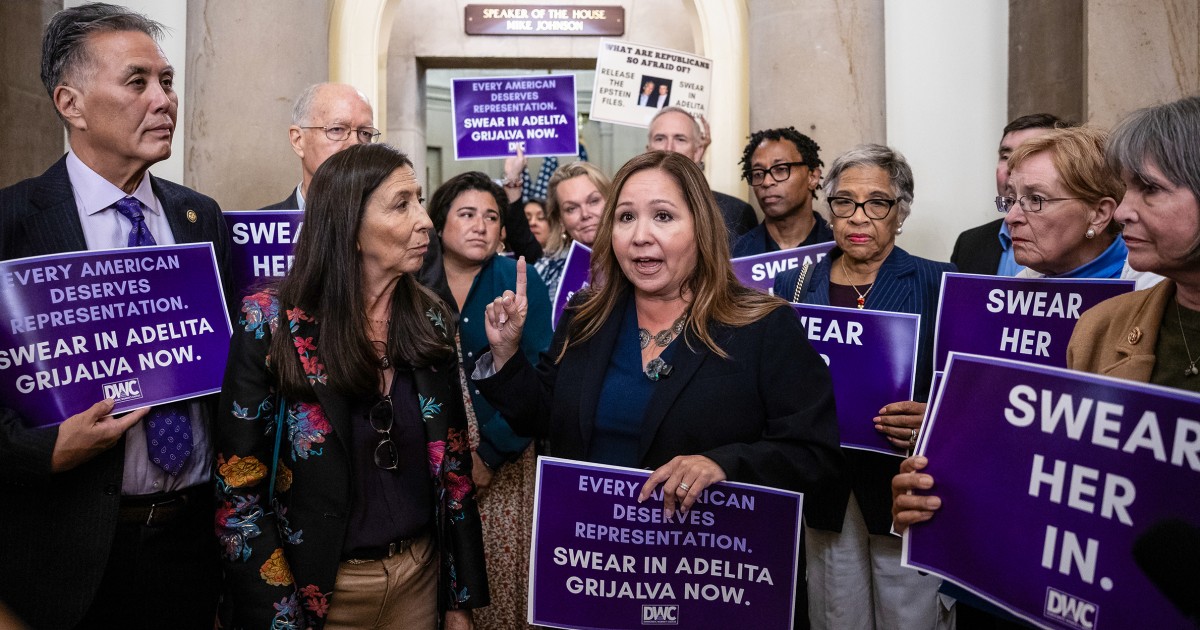
Savewith a NBCUniversal ProfileCreate your free profile or log in to save this articleOct. 15, 2025, 2:11 PM EDTBy Scott Wong, Gabrielle Khoriaty and Kyle StewartWASHINGTON — Democrats are ramping up pressure on House Speaker Mike Johnson to seat Rep.-elect Adelita Grijalva, staging a protest at his office, holding news conferences and threatening a lawsuit to try to get him to swear in the newest Democratic member of Congress.Grijalva won the Arizona House seat of her father, the late progressive leader Rep. Raul Grijalva, in a Sept. 23 special election. But the House has not been in session since her election as part of the stalemate over the government shutdown.While Grijalva has been in and around the Capitol complex waiting to take the oath, Johnson, R-La., has said for the past two weeks he won’t swear her in until the government reopens.House Dems march to demand Johnson swear in Grijalva00:56Once she is seated, Grijalva would bring the House to 219 Republicans and 214 Democrats. She is also expected to be the final signature needed to force a House vote to release the Justice Department’s Jeffrey Epstein files.Now, Democrats are trying new, more aggressive tactics to force Johnson to reverse course.On Tuesday night, Grijalva and members of the Democratic Women’s Caucus marched to Johnson’s office, chanting “Swear her in!” A U.S. Capitol Police officer briefly tried to stop lawmakers and could be seen on video getting into a short verbal altercation with Rep. Nanette Barragán, D-Calif. She claimed that the officer grabbed her, but a video only shows her pushing past an officer into the speaker’s foyer. Capitol Police did not immediately respond to a request for comment.In remarks outside Johnson’s office, Grijalva said she has heard “not one word” from the speaker.“I am a woman of color from Arizona, and 700,000 people deserve to have their voice heard, …” Grijlava said. “Let’s just be really clear, if I were a Republican, I would have already been sworn, and that is not acceptable. They’re afraid of me signing and being the 218th signer to the Epstein petition.”Johnson was not in the Capitol during the protest. But Arizona’s two Democratic senators — Ruben Gallego and Mark Kelly — verbally sparred with Johnson in the same spot just last week over his refusal to immediately seat Grijalva.Tuesday night’s protest came on the same day that top Arizona state officials certified the results of Grijalva’s election victory. And on Tuesday, Arizona Attorney General Kris Mayes, a Democrat, sent a letter to Johnson threatening to sue if he did not seat Grijalva or set a date to do so.“Failing to seat Ms. Grijalva immediately or to otherwise provide a reasonable explanation as to when she will be seated will prompt legal action,” Mayes wrote.She added: “You and your staff have provided ever-shifting, unsatisfactory, and sometimes absurd stories as to why Ms. Grijalva has not been sworn in. In a particularly worrisome comment, an aide connected the swearing-in and admission to the ongoing budget fight, suggesting that the House is trying to use Arizona’s constitutional right to representation in the House as a bargaining chip.”When asked about Mayes’ letter, Johnson said in a short statement, “The House will follow customary practice by swearing in Rep-elect Grijalva when the House is in legislative session.”Speaking to reporters Wednesday, Johnson accused Democrats of “playing political games” and disrespecting police by protesting at his office. “They stormed my office. Maybe you saw some of the video online that they themselves shared. … They berated a Capitol Police officer, screamed at him. He was just merely standing his post. It shows, again, their disdain for law enforcement, as we see all around the country … and it shows their desperation.”House Minority Leader Hakeem Jeffries, D-N.Y., Grijalva and other Democrats have pointed out that Johnson, in April, swore in two Florida Republicans — Rep. Jimmy Patronis and Randy Fine — shortly after their special elections, while the House was out of town.Johnson has argued it was because the pair of Floridians had family in Washington at the time, so he did it as a courtesy to accommodate visiting family members. He also told reporters Tuesday he wants to ensure Grijalva has “all the pomp and circumstance” of having a full chamber in session to witness her being sworn in.And the speaker has repeatedly said the delay has nothing to do with the effort to force a vote on the Epstein files.Following the Tuesday protest, Democrats in both the Arizona delegation and the Congressional Hispanic Caucus on Wednesday stood in front of the Capitol and again demanded he administer the oath of office.“I don’t need bells and whistles,” Grijalva said, rejecting the speaker’s explanation. “I don’t need pomp and circumstance. I just need to get to work for southern Arizona.”Kelly, the Arizona senator, noted he and his family live in Grijalva’s district, which extends along the southern border from Yuma to Tucson.“We currently do not have representation in the U.S. House of Representatives,” Kelly said, “and that is wrong.”Scott WongScott Wong is a senior congressional reporter for NBC News. Gabrielle KhoriatyGabrielle Khoriaty is a desk assistant in the NBC News Washington bureau.Kyle StewartKyle Stewart is a producer and off-air reporter covering Congress for NBC News, managing coverage of the House.Frank Thorp V contributed.
October 22, 2025
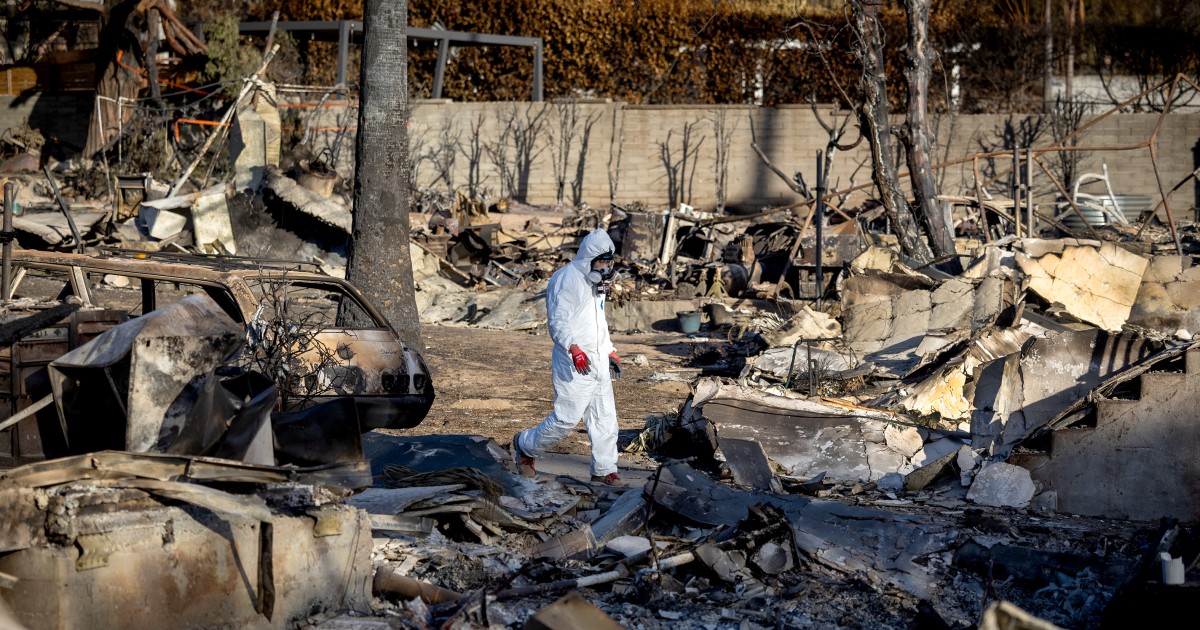
Savewith a NBCUniversal ProfileCreate your free profile or log in to save this articleOct. 22, 2025, 10:00 AM EDTBy Evan BushThe first half of this year was the costliest ever recorded for weather and climate disasters in the United States, according to an analysis published Wednesday by the nonprofit organization Climate Central.It is information that the public might never have learned: This spring, the Trump administration cut the National Oceanic and Atmospheric Administration program that had tracked weather events that caused at least $1 billion in damage. The researcher who led that work, Adam Smith, left NOAA over the decision. Climate Central, a research group focused on the effects of climate change, hired Smith to redevelop the database, which includes records back to 1980. According to the organization’s new analysis, 14 weather events exceeded $1 billion in damages in the first six months of 2025. The January wildfires in Los Angeles were, by far, the most expensive natural disaster so far this year — they caused more than $61 billion in damage. That also makes them the most expensive wildfire event on record.Suspect arrested in connection with deadly Palisades Fire02:09The findings show how the costs of weather and climate disasters continue to escalate as extreme weather grows more frequent and intense, and as populations spread into areas prone to costly destruction from wildfires and flooding. The report itself is also an example of the way nonprofit groups are increasingly taking over federal projects that once tracked and quantified the effects of climate change as the Trump administration makes cuts to climate science. President Donald Trump has called climate change a “con job.” His administration has cut funding for clean energy projects and is trying to remove the Environmental Protection Agency’s ability to regulate the greenhouse gas pollution that is causing global warming. Jennifer Brady, a senior data analyst and research manager at Climate Central who worked on the project, said the shuttering of NOAA’s billion-dollar disasters database upset staff at the nonprofit, who decided to take matters into their own hands. “This has always been one of our favorite datasets. It’s told so many different stories. It tells the climate change story. It tells the story of where people are living, how they’re living at risk,” Brady said. “We’re happy to bring it back.”Kim Doster, a NOAA spokesperson, said the agency “appreciates that the Billion Dollar Disaster Product has found a funding mechanism other than the taxpayer dime.”“NOAA will continue to refocus its resources on products that adhere to the President’s Executive Order restoring gold standard science, prioritizing sound, unbiased research,” Doster said in an email. The database was a politically polarizing project. House Republicans complained to NOAA’s administrator in 2024 about the program, voicing concerns about what they described as “deceptive data.” Last month, Senate Democrats introduced legislation that would require NOAA to publish the dataset and update it twice a year, saying that lawmakers used the reports to inform disaster funding decisions. But the bill remains in committee and stands little chance of passing in the Republican-controlled Senate.Last month, a Trump administration official told NBC News that NOAA had ended the database project because of uncertainties in how it estimated the costs of disasters. The official said that the project cost about $300,000 annually, that it required substantial staff hours and that the data “serves no decisional purpose and remains purely informational at best.”“This data is often used to advance the narrative that climate change is making disasters more frequent, more extreme, and more costly, without taking into account other factors such as increased development on flood plains or other weather-impacted spots or the cyclical nature of the climate in various regions,” the official said at the time.Brady, however, said the database has always acknowledged changes in population and climate variability as important factors in the cost of disasters. Climate Central’s work uses the same methodology and data sources that NOAA’s database did, she said. Those sources include National Flood Insurance Program claims, NOAA storm events data and private property insurance data, among others. The analysis captures the “direct costs” of disasters, such as damage to buildings, infrastructure and crops. It doesn’t factor other considerations, including loss of life, health-related costs of disasters or the economic losses to “natural capital” such as forests or wetlands. The data is adjusted to account for inflation. The new analysis of the first half of 2025 indicates that this year is on pace to be one of the costliest on record, even though no hurricanes have made landfall in the continental U.S.Last year, NOAA counted 27 billion-dollar disasters, with costs that totaled about $182.7 billion. That was the second highest number of billion-dollar disasters in the report’s history, after 2023. Climate Central is not the only group stepping in to re-create work the federal government used to do as the Trump administration makes cuts to climate science.A group of staffers laid off from NOAA has launched climate.us, a nonprofit successor to climate.gov, a federal website that once provided data and analysis to explain climate issues to the broader public. The site went dark this summer. Rebecca Lindsey, who edited climate.gov before she was laid off in February, said she and the other NOAA employees who co-founded the nonprofit have raised about $160,000. They plan to host the climate.gov archives on the new site and start publishing new articles about climate change in the next few weeks. “We’re rescuing this information and making sure when people need answers about what’s happening with the climate, they’ll be able to find them,” Lindsey said.The American Geophysical Union and American Meteorological Society also announced that they plan to publish a special collection of research focused on climate change, after the Trump administration told scientists volunteering to work on the National Climate Assessment — a comprehensive synthesis of research about climate change and its effects in the U.S. — that they were no longer needed. The administration laid off staffers in the U.S. Global Change Research Program, which organized the National Climate Assessment and coordinated climate research programs across different federal agencies. Walter Robinson, publications commissioner for the American Meteorological Society, said the National Climate Assessment had been “effectively canceled” by the administration’s decisions, which he viewed as an “abrogation” of the federal government’s responsibility. The new collection can’t replace the assessment, he added, but it aims to organize the latest science on the effects of climate change in the U.S. in one place. The research will be released across several scientific journals on a rolling basis. “People are stepping in,” Robinson said of his group’s efforts. “As scientists, we do what we can.” Evan BushEvan Bush is a science reporter for NBC News.
Comments are closed.
Scroll To Top
  • Home
  • Travel
  • Culture
  • Lifestyle
  • Sport
  • Contact Us
  • Politics
© Copyright 2025 - Be That ! . All Rights Reserved