• Police seek suspects in deadly birthday party shooting
  • Lawmakers launch inquires into U.S. boat strike
  • Nov. 29, 2025, 10:07 PM EST / Updated Nov. 30, 2025,…
  • Mark Kelly says troops ‘can tell’ what orders…

Be that!

contact@bethat.ne.com


Be That ! Menu   ≡ ╳
  • Home
  • Travel
  • Culture
  • Lifestyle
  • Sport
  • Contact Us
  • Politics Politics
☰

Be that!

Oct. 18, 2025, 7:00 AM EDTBy Carlo AngererRIGA, Latvia — They’re dotted on dozens of buildings across the Latvian capital: signal green signs with white stick figures of a family and the word “patvertne,” which means shelter.Installed everywhere from art deco buildings to wooden gates, the signs alert people to places to hide in the event of an attack — and have become one of many symbols of war preparedness in this charming city, which is crisscrossed with canals and looks nervously east at its Russian neighbor.After a string of recent aircraft incursions along NATO’s eastern flank and suspicious drones shutting down airports in several European countries including Germany, Denmark and Norway, fears about Russian aggression are growing in Latvia and its fellow Baltic nations, Estonia and Lithuania, already spooked by Moscow’s war in Ukraine.“We are on the front line. We are the eastern flank countries. We are neighboring Russia, an aggressive country,” Andris Sprūds, Latvia’s defense minister, told NBC News earlier this month at the Riga Conference, a meeting of international political and military leaders.A building marked “patvertne,” the Latvian word for “shelter,” in the capital, Riga.Carlo Angerer / NBC NewsHe added that Latvia, which launched a drone initiative earlier this year, had to some extent “already developed some resilience” in the face of any Kremlin aggression.Other attendees openly talked about a direct conflict between NATO and Russia. In an onstage discussion at the conference, Matthew Whitaker, the U.S. ambassador to the organization, publicly theorized with his fellow panelists about weapons systems, including long-range missiles and strategic bombers, that could be used against the Kremlin’s forces.But he also emphasized that modern warfare begins before troops and military hardware are deployed.“The first shot of the next war is not going to be tanks through the Suwalki Gap,” he said in a separate interview with NBC News, referring to the narrow land bridge between Poland and the Baltic states, seen as a potential attack point in a Russian invasion. “It’s going to be a cyberattack. It’s going to be knocking out airports or critical infrastructure.”Latvia and other Baltic countries have been very receptive to recent NATO initiatives and are on track to reach defense spending targets soon, he said, adding that they were “investing in things that are going to field more capabilities for our defense and deterrence.”Emergency services have identified hundreds of existing shelters in Riga and authorities are planning to build new ones.Carlo Angerer / NBC News“The investments that make each individual ally stronger and therefore the collective alliance stronger are the important investments, and a country like Latvia is certainly doing it best in class right now,” he added.Adm. Rob Bauer, who chaired NATO’s military committee from June 2021 until January, also suggested that a new conflict with Russia would be fought “in a different way.”Ukraine, he said, lacked air power and strong naval assets, adding that NATO fighter jets had been carrying out missions over the Baltics from the USS Gerald Ford after it was deployed to the North Sea earlier this year.Others, like Roberta Metsola, the president of the European Parliament, openly acknowledged that it took “way too long” for other nations to listen to Latvia, Estonia and Lithuania, which were occupied by the Soviet Union for decades and more recently have been at the forefront of pushing NATO allies to take the Russian threat seriously.Airis Rikveilis, the national security adviser to Latvia’s Prime Minister Evika Silina, said his country was not only focusing on increasing military capabilities, but also on preparing civil society for conflict.“This is not going to be 1940,” he said, referring to the first Soviet occupation, when the Red Army was able to take over within weeks. “Should that battle start tomorrow, we’ll be ready to fight tomorrow with what we have,” he added.After Russian President Vladimir Putin launched his invasion of Ukraine in February 2022, there have been visible changes across Latvia, which has installed a fence along its 176-mile border with Russia. It has also cut itself off from the shared power grid with Russia and Kremlin ally Belarus, which sits to Latvia’s south, and is now relying on energy from its other neighbors.Ukrainian flags fly outside the Russian Embassy in Riga, Latvia.Carlo Angerer / NBC NewsIn Riga, officials have demolished the 260-foot victory memorial dedicated to the Soviet army and renamed the road where the Russian Embassy is located to Ukrainian Independence Street.The blue street sign sits at the corner building next to the embassy’s CCTV cameras and under its large flag. Dozens of Ukrainian flags fly in the square just across the road.Linda Ozola, who served as Riga’s deputy mayor for five years until this summer, oversaw the rebuilding of the shelter network, among other civil protection measures. She said her staff had to scout museums and archives for old documents, as well as reinspect old shelter spaces, some of which had fallen into disrepair.Emergency services have identified hundreds of existing shelters, and updated legislation has cleared the way to build new ones. Their locations are available on a website and cellphone app.Some of them will likely be funded by an 85 million euro ($99.4 million) deal signed on the sidelines of the Riga Conference by Arvils Ašeradens, Latvia’s finance minister, and European allies. The majority of that funding will be used to enhance the civil protection infrastructure, and some will also be used to install generators at health care facilities.Ozola said the city has also started to build up a stock of emergency supplies including canned food and sleeping cots. Riga has been an example for the other regions of Latvia and could also be one for cities across Europe, she said.“The truth is not good because we have a crazy neighbor who wants to destroy our country. And the neighbor is not hiding that, really,” she said. “They haven’t physically crossed the border, but they have crossed the airspace and they have cut our critical infrastructure in the Baltic Sea.”Carlo AngererCarlo Angerer is a multimedia producer and reporter based in Mainz, Germany. 

admin - Latest News - October 18, 2025
admin
22 views 17 secs 0 Comments


RIGA, Latvia — They’re dotted on dozens of buildings across the Latvian capital: signal green signs with white stick figures of a family and the word “patvertne,” which means shelter


Source link

TAGS:
PREVIOUS
Oct. 18, 2025, 7:00 AM EDTBy Mustafa FattahAfter a rough, record-setting flu season, doctors and health officials are bracing for another wave of fever, misery and respiratory distress. In the U.K., health officials are warning about an early rise in flu levels among children and young adults. In Japan, health officials recently declared a flu epidemic and closed schools after experiencing an unusually high number of flu cases early in the season. What does that mean for the U.S.? Typically, flu cases start to rise in November, along with RSV (respiratory syncytial virus) and enteroviruses, and peak in February. But job-cut chaos at the Centers for Disease Control and Prevention and the government shutdown could make it hard to know how the virus is playing out this fall, experts worry. The CDC’s last influenza report for the U.S. was for the week ending Sept. 20, when there was minimal activity. Angela Rasmussen, a virologist at the University of Saskatchewan, is concerned about the possibility of limited flu surveillance by the CDC, leaving the U.S. blind to the scale and scope of flu outbreaks.“Everything from outreach campaigns to more logistical efforts to actually get vaccines out” could be affected, Rasmussen said. “That information just may not be available, so it will be very difficult to coordinate a national response,” she said.Last year’s flu was harsh. There were about 1.1 million hospitalizations associated with the flu, the highest rate in 14 years, according to the CDC. And there were the highest number of doctor visits for flu-like illnesses in more than a decade. An estimated 38,000 to 99,000 deaths were associated with the 2024-2025 flu season, according to a preliminary assessment by the CDC. For kids, it was one of the deadliest years on record: 280 children died from flu. At least three of those children died this June and July, far outside of the typical flu season.How bad will the flu be? Flu is notoriously hard to predict, and this year, things are already looking a little different. The CDC predicted at the end of August that this flu season will be more moderate than last year’s. However, there’s the possibility that some age groups could be hit hard, especially if people don’t get their flu shots. The main strains of flu currently circulating are similar to those that caused the severe outbreaks last season: H1N1 and H3N2 for flu A, as well as flu B. “It’s a little early to know which strains will predominate this year for flu season, but certainly there is risk that similar very virulent strains could circulate again this year,” said Dr. George Diaz, a fellow of the Infectious Diseases Society of America, and chief of medicine at Providence Regional Medical Center in Everett, Washington. “This prediction for a moderate season could be off, and it could be another severe flu season,” he said.“We’re still very early in the flu season in North America, and it’s a little hard to know with certainty,” he added. Even if someone got the flu last year, they’ll still be vulnerable to the new version because immunity wanes over time, especially in older people and the immunocompromised, experts say. When is the best time to get the flu shot? The strain is only one factor in how bad it could be this year. Vaccine hesitancy and a weakened public health infrastructure in the U.S. could contribute to flu spread. “It’s going to be largely driven more by social and policy changes than it is going to be driven by virologically related ones,” Rasmussen said.Last flu season, less than half of kids were vaccinated against the flu, a decline of over 20 percentage points from the 2019-2020 season. This year, that trend is expected to continue, said Rasmussen.Dr. William Schaffner, a professor of infectious diseases at Vanderbilt University Medical Center, said that it’s difficult to know how severe it will be this year in the U.S, but that it’s very unusual to have “two ultra-severe seasons back to back.” So, even though the virus hasn’t changed much, getting vaccinated is the best way to protect against the worst of the season.“October is the ideal time to get vaccinated,” he said. “That ought to provide quite reasonable protection throughout what we consider the influenza season, through February and into March.”Mustafa FattahMustafa Fattah is a medical fellow with the NBC News Health and Medical Unit. 
NEXT
Officer pulls woman from a burning car in Texas
Related Post
November 12, 2025
House Set to Vote on Bill That Could End Longest-Ever Shutdown
October 10, 2025
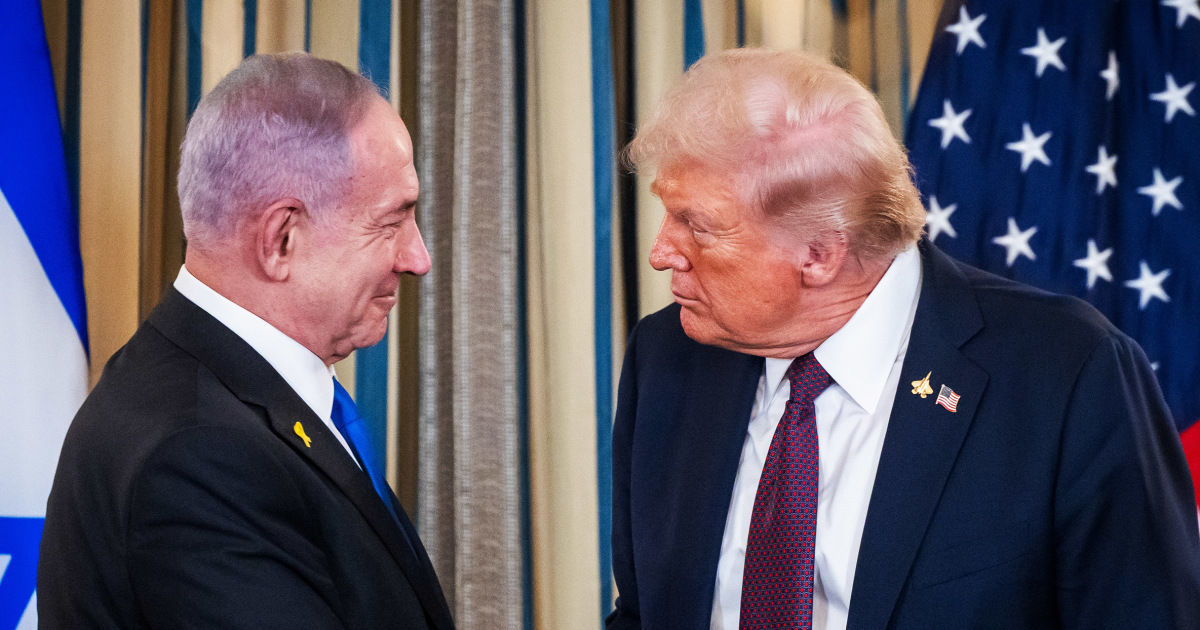
Sept. 29, 2025, 5:02 PM EDTBy Rebecca ShabadWASHINGTON — President Donald Trump on Monday unveiled a comprehensive peace proposal to end the war in Gaza, nearly two years after Hamas’ Oct. 7, 2023, attack on Israel.During his visit with Trump at the White House, Israeli Prime Minister Benjamin Netanyahu publicly backed the 20-point plan, but Trump acknowledged that Hamas had not agreed to it.The key components of the proposal include the release of all living and dead hostages in Gaza, a requirement for Hamas to lay down its arms, a withdrawal of Israeli troops from the territory, the delivery of humanitarian aid and the installation of a civilian governing authority for Palestinians.Trump said that if Hamas rejects the deal, he would back Netanyahu in dismantling and destroying Hamas.Here is the full text of the plan:Gaza will be a deradicalized terror-free zone that does not pose a threat to its neighbors.Gaza will be redeveloped for the benefit of the people of Gaza, who have suffered more than enough.If both sides agree to this proposal, the war will immediately end. Israeli forces will withdraw to the agreed upon line to prepare for a hostage release. During this time, all military operations, including aerial and artillery bombardment, will be suspended, and battle lines will remain frozen until conditions are met for the complete staged withdrawal.Within 72 hours of Israel publicly accepting this agreement, all hostages, alive and deceased, will be returned.Once all hostages are released, Israel will release 250 life sentence prisoners plus 1700 Gazans who were detained after October 7th 2023, including all women and children detained in that context. For every Israeli hostage whose remains are released, Israel will release the remains of 15 deceased Gazans.Once all hostages are returned, Hamas members who commit to peaceful co-existence and to decommission their weapons will be given amnesty. Members of Hamas who wish to leave Gaza will be provided safe passage to receiving countries.Upon acceptance of this agreement, full aid will be immediately sent into the Gaza Strip. At a minimum, aid quantities will be consistent with what was included in the January 19, 2025, agreement regarding humanitarian aid, including rehabilitation of infrastructure (water, electricity, sewage), rehabilitation of hospitals and bakeries, and entry of necessary equipment to remove rubble and open roads. Entry of distribution and aid in the Gaza Strip will proceed without interference from the two parties through the United Nations and its agencies, and the Red Crescent, in addition to other international institutions not associated in any manner with either party. Opening the Rafah crossing in both directions will be subject to the same mechanism implemented under the January 19, 2025 agreement.Gaza will be governed under the temporary transitional governance of a technocratic, apolitical Palestinian committee, responsible for delivering the day-to-day running of public services and municipalities for the people in Gaza. This committee will be made up of qualified Palestinians and international experts, with oversight and supervision by a new international transitional body, the “Board of Peace,” which will be headed and chaired by President Donald J. Trump, with other members and heads of State to be announced, including Former Prime Minister Tony Blair. This body will set the framework and handle the funding for the redevelopment of Gaza until such time as the Palestinian Authority has completed its reform program, as outlined in various proposals, including President Trump’s peace plan in 2020 and the Saudi-French proposal, and can securely and effectively take back control of Gaza. This body will call on best international standards to create modern and efficient governance that serves the people of Gaza and is conducive to attracting investment.A Trump economic development plan to rebuild and energize Gaza will be created by convening a panel of experts who have helped birth some of the thriving modern miracle cities in the Middle East. Many thoughtful investment proposals and exciting development ideas have been crafted by well-meaning international groups, and will be considered to synthesize the security and governance frameworks to attract and facilitate these investments that will create jobs, opportunity, and hope for future Gaza.A special economic zone will be established with preferred tariff and access rates to be negotiated with participating countries.No one will be forced to leave Gaza, and those who wish to leave will be free to do so and free to return. We will encourage people to stay and offer them the opportunity to build a better Gaza.Hamas and other factions agree to not have any role in the governance of Gaza, directly, indirectly, or in any form. All military, terror, and offensive infrastructure, including tunnels and weapon production facilities, will be destroyed and not rebuilt. There will be a process of demilitarization of Gaza under the supervision of independent monitors, which will include placing weapons permanently beyond use through an agreed process of decommissioning, and supported by an internationally funded buy back and reintegration program all verified by the independent monitors. New Gaza will be fully committed to building a prosperous economy and to peaceful coexistence with their neighbors.A guarantee will be provided by regional partners to ensure that Hamas, and the factions, comply with their obligations and that New Gaza poses no threat to its neighbors or its people.The United States will work with Arab and international partners to develop a temporary International Stabilization Force (ISF) to immediately deploy in Gaza. The ISF will train and provide support to vetted Palestinian police forces in Gaza, and will consult with Jordan and Egypt who have extensive experience in this field. This force will be the long-term internal security solution. The ISF will work with Israel and Egypt to help secure border areas, along with newly trained Palestinian police forces. It is critical to prevent munitions from entering Gaza and to facilitate the rapid and secure flow of goods to rebuild and revitalize Gaza. A deconfliction mechanism will be agreed upon by the parties.Israel will not occupy or annex Gaza. As the ISF establishes control and stability, the Israel Defense Forces (IDF) will withdraw based on standards, milestones, and timeframes linked to demilitarization that will be agreed upon between the IDF, ISF, the guarantors, and the Unites States, with the objective of a secure Gaza that no longer poses a threat to Israel, Egypt, or its citizens. Practically, the IDF will progressively hand over the Gaza territory it occupies to the ISF according to an agreement they will make with the transitional authority until they are withdrawn completely from Gaza, save for a security perimeter presence that will remain until Gaza is properly secure from any resurgent terror threat.In the event Hamas delays or rejects this proposal, the above, including the scaled-up aid operation, will proceed in the terror-free areas handed over from the IDF to the ISF.An interfaith dialogue process will be established based on the values of tolerance and peaceful co-existence to try and change mindsets and narratives of Palestinians and Israelis by emphasizing the benefits that can be derived from peace.While Gaza re-development advances and when the PA reform program is faithfully carried out, the conditions may finally be in place for a credible pathway to Palestinian self-determination and statehood, which we recognize as the aspiration of the Palestinian people.The United States will establish a dialogue between Israel and the Palestinians to agree on a political horizon for peaceful and prosperous co-existence.Rebecca ShabadRebecca Shabad is a politics reporter for NBC News based in Washington.
September 22, 2025
Zohran Mamdani pulls out of local ABC town hall over Jimmy Kimmel suspension
October 6, 2025
Supreme Court rejects Epstein associate Ghislaine Maxwell’s appeal of her criminal conviction
Comments are closed.
Scroll To Top
  • Home
  • Travel
  • Culture
  • Lifestyle
  • Sport
  • Contact Us
  • Politics
© Copyright 2025 - Be That ! . All Rights Reserved