• Police seek suspects in deadly birthday party shooting
  • Lawmakers launch inquires into U.S. boat strike
  • Nov. 29, 2025, 10:07 PM EST / Updated Nov. 30, 2025,…
  • Mark Kelly says troops ‘can tell’ what orders…

Be that!

contact@bethat.ne.com


Be That ! Menu   ≡ ╳
  • Home
  • Travel
  • Culture
  • Lifestyle
  • Sport
  • Contact Us
  • Politics Politics
☰

Be that!

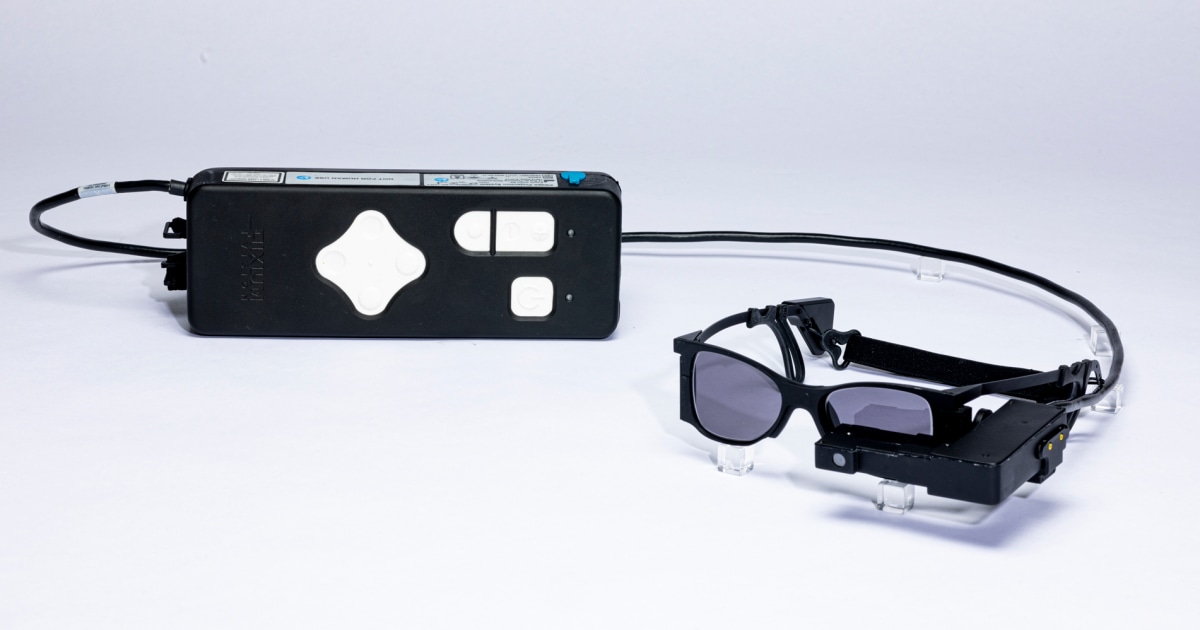
Oct. 20, 2025, 1:45 PM EDTBy David CoxPeople with a leading cause of blindness were able to read again thanks to a tiny wireless chip implanted in the back of the eye and specialized augmented glasses, according to study results published Monday in the New England Journal of Medicine. The trial involved 38 European patients, all of whom had an advanced stage of dry age-related macular degeneration (AMD) known as geographic atrophy. There is no cure for AMD, which is driven by changes in a part of the retina called the macula and caused by inflammation and a build-up of waste. The photoreceptor cells in the macula are responsible for producing sharp, detailed and colored vision. When the disease has progressed to the geographic atrophy stage, these cells deteriorate and die, and people lose their central vision — meaning that an object straight ahead may appear blurry or covered up with a dark blotch. Roughly 22 million people in the U.S. have AMD, and about 1 million have geographic atrophy, according to the American Macular Degeneration Foundation.In the study, the participants, who had an average age of 79, were fitted with the “PRIMA device,” a system meant to replicate vision. Patients wear augmented reality glasses embedded with a camera that captures their visual field. What the camera “sees” is transmitted to the chip implanted in their eye in the form of infrared light. The chip converts the light into an electrical current, which stimulates the remaining healthy cells in the macula in a realistic way, enabling signals these cells send to be interpreted by the brain as vision. An image processor, which the user must carry, lets patients zoom in and magnify the images they see, which appear in black and white.The image on the right shows what the camera sends to the user’s implanted microchip.Science Corporation With the help of the PRIMA device, 80% of the 32 patients who returned for a reassessment one year after the chip implantation had achieved clinically meaningful visual improvements. Patients did experience side effects, predominantly related to the surgical procedure: The study reported that 26 serious adverse events occurred in 19 of the patients, ranging from elevated blood pressure in the eye to an accumulation of blood around the retina. The majority of the adverse events resolved within two months of the implantation. “It’s the first ever therapeutic approach that has led to an improvement in visual function in this group of patients,” said Dr. Frank Holz, the trial’s lead investigator and chair of the department of ophthalmology at the University Hospital of Bonn in Germany. “Late-stage age-related macular degeneration is a dismal disease. Patients are no longer capable of reading, driving a car, watching TV or even recognizing faces. So [these results] are a game-changer in my mind.”One patient, Sheila Irvine, 70, who was fitted with the PRIMA device at Moorfields Eye Hospital in London, said in a statement provided by the hospital that her life before receiving the implant was akin to “having two black discs in my eyes, with the outside distorted.” A self-described “avid bookworm” before losing her vision, Irvine said she was now able to do crosswords and read prescriptions.Dr. Sunir Garg, professor of ophthalmology at the retina service of Wills Eye Hospital in Philadelphia, who was not involved in the study, said the results represent a breakthrough for patients with geographic atrophy. All doctors have been able to offer, he said, are visual aids, like magnifiers, and emotional support.“Even with new medical therapies, the best that we can do is slow it down,” said Garg, who works with several drugmakers involved in treatments for AMD, including Apellis Pharmaceuticals, the maker of pegcetacoplan. That drug, which slows the progression of geographic atrophy, was recently approved in the U.S. and must be injected into the eye every 1 to 2 months. “We can’t stop it, and we can’t do anything to bring back lost vision.” An actor wearing the PRIMA system glasses.Science CorporationDr. Demetrios Vavvas, director of the retina service at Mass Eye and Ear in Boston, who was also not involved in the study, said that the PRIMA system is not without limitations. Vavvas noted that the surgery required to implant the chip in the eye requires a high level of surgical skill and is not without risk. “You have to lift the retina off its normal position to implant this device, which increases the atrophy,” said Vavvas, who is a consultant to Sumitomo Pharmaceuticals, a company working on stem cell therapies for patients with other forms of vision loss. Vavvas said it was important to note that the device isn’t restoring normal vision, as patients were only able to see in black and white rather than color, and the trial participants had to undergo a significant amount of training in order to learn how to see with the PRIMA device. He also said that it wasn’t clear whether the enhancements in visual ability had significantly improved the patients’ quality of life.But at the same time, Vavvas was also optimistic about its future potential, describing the current iteration of PRIMA as a key stepping stone in the field of vision restoration. “Think of this device as the pre-release iPhone,” he said. “The limitations are clear. We shouldn’t oversell that the quality of life really improved. But there were certain [visual] tasks at which the patients were clearly better. So it shows to us that there is potential in this approach. It is still in some ways, a prototype. They’re working on iterations of this device that will be better.”New upgrades to the PRIMA device could be coming in the next couple of years. The PRIMA system was invented by Stanford University ophthalmology professor Daniel Palanker and is being developed by the California-based neural engineering company Science Corporation.Palanker said technical improvements are being made to increase the number of pixels in the chip from 400 to 10,000. The new chips have already been tested in rats, and the upgraded chips are being manufactured for future human trials. With the aid of the camera’s zoom function, Palanker said that this could theoretically enable patients to achieve 20/20 visual resolution.The microchip shown next to a penny.Science Corporation“We are also working on next generation software that will allow patients to perceive not just black-and-white text, but also grey-scale natural images, such as faces,” Palanker said.Palanker suggested that the technology could be trialed in other retinal diseases that cause blindness, such as Stargardt disease, which has similar symptoms to age-related macular degeneration but is genetic and usually affects younger people. Garg and Vavvas are eager to see larger trials that provide more details about how the device improves patients’ ability to function on a day-to-day basis. Vavvas suggested that future trials should include a control arm to understand the extent to which the device yields real-world benefits, for example compared to existing electronic magnifiers. “Is it something that is good enough for patients to say, ‘Well, I’ve regained my independence because I can now do my credit card bills myself, stamp and address my envelopes myself, and look at grocery store labels?’” Garg said. “Those kinds of practical things I would like to know more about.”“This is a chronic disease that you will have for life, so we need more than one year of follow-up to see other risks, other problems,” Vavvas said. “Does that signal of efficacy that we see at 12 months, remain two years later?”While Vavvas said he would not call the device a complete panacea for blindness, the study showed that brain-computer interfaces can represent an important approach to tackling different kinds of severe visual impairment. “As the iterations of this device become better and better, it could become a real solution for a cohort of patients,” he said. David CoxDavid Cox is a freelance journalist focusing on all aspects of health, from fitness and nutrition to infectious diseases and future medicines. Prior to becoming a full-time journalist, he was a neuroscientist attempting to understand how and why the brain goes wrong.

admin - Latest News - October 20, 2025
admin
21 views 23 secs 0 Comments


People with a leading cause of blindness were able to read again thanks to a tiny wireless chip implanted in the back of the eye and specialized augmented glasses, according to study results published Monday in the New England Journal of Medicine.


Source link

TAGS:
PREVIOUS
Oct. 20, 2025, 12:33 PM EDTBy Rebecca CohenThe news is out and the internet is thrilled: Colman Domingo will voice the Cowardly Lion in “Wicked: For Good.” “Wicked” director Jon M. Chu teased the news in a Thursday interview with Deadline, saying that it will be “wild” when the actor who is voicing the part — a major Hollywood star, per Chu — steps on the red carpet. But the news was instead revealed Monday, when the “Wicked” movie Instagram account posted a video of Domingo playing with and surrounded by a number of stuffed toy lions. “See you in Oz,” Domingo says in the video with a wink. Users on social media spent the weekend speculating who might be playing the part, with rumors centering on former late-night host and musical theater actor James Corden. When the news was announced Monday, those same users celebrated the casting — and the fact that the role didn’t go to Corden. “James Corden isn’t the lion in wicked! We won,” one X user posted. In order to book Domingo in the part originally made famous by Bert Lahr in the 1939 film adaptation of “The Wizard of Oz,” Chu told Deadline he sent the “Sing Sing” actor a direct message on Instagram. “I was like, ‘It’s not a ton of lines, but maybe you have a little time. I know you’re busy. I’ll come to you,'” Chu recalled saying in the message, according to Deadline. Chu said Domingo responded “‘Why the f— not, let’s go!’ And then we went ahead and recorded the lines.”Domingo joins an already star-studded cast, including Ariana Grande as Glinda, Cynthia Erivo as Elphaba and Jonathan Bailey as Fiyero. “Wicked: For Good,” the second in a two-part series, releases in theaters on Nov. 21. It will continue the story told in last year’s “Wicked.” The film is produced and will be distributed by Universal Pictures, which is owned by NBCUniversal, the parent company of NBC News.Rebecca CohenRebecca Cohen is a breaking news reporter for NBC News Digital.
NEXT
Oct. 20, 2025, 3:37 PM EDT / Updated Oct. 20, 2025, 4:19 PM EDTBy Dareh Gregorian and Gary GrumbachA federal appeals court ruling on Monday will allow the Trump administration to send National Guard troops into Oregon against the state’s wishes, hitting pause on a lower court’s order that had barred the deployment.”After considering the record at this preliminary stage, we conclude that it is likely that the President lawfully exercised his statutory authority,” the panel of 9th U.S. Circuit Court of Appeals judges wrote in a 2-1 ruling. Justice Department attorneys had argued in a court filing that U.S. District Judge Karen Immergut’s ruling temporarily halting the deployment “improperly impinges on the Commander in Chief’s supervision of military operations, countermands a military directive to officers in the field, and endangers federal personnel and property.” Hundreds of cyclists strip down for anti-ICE protests in Portland01:05Immergut, a Trump nominee, said in her order that it appeared the president was acting in bad faith with exaggerated claims of violence in the city, including that it was “war ravaged” with “ICE Facilities under siege from attack by Antifa” and “crazy people” who “try to burn down buildings, including federal buildings” every night.”The President’s determination was simply untethered to the facts,” the judge wrote.The two appeals court judges — also Trump nominees — said the president’s position was entitled to more deference. “Rather than reviewing the President’s determination with great deference, the district court substituted its own determination of the relevant facts and circumstances. That approach is error,” the opinion by Judges Ryan D. Nelson and Bridget S. Bade said. “Even if the President may exaggerate the extent of the problem on social media, this does not change that other facts provide a colorable basis to support the statutory requirements,” they wrote.The dissenting judge, Susan P. Graber, ripped her colleagues’ ruling.”Given Portland protesters’ well-known penchant for wearing chicken suits, inflatable frog costumes, or nothing at all when expressing their disagreement with the methods employed by ICE, observers may be tempted to view the majority’s ruling, which accepts the government’s characterization of Portland as a war zone, as merely absurd,” Graber wrote.The ruling, she wrote, “is not merely absurd. It erodes core constitutional principles including sovereign States’ control over their States’ militias and the people’s First Amendment rights to assemble and to object to the government’s policies and actions.”Immergut, the lower court judge, had found that while there had been some protests that turned violent back in June, federal and state law enforcement now seem to have the situation well in hand. “On September 26, the eve of the President’s directive, law enforcement ‘observed approximately 8-15 people at any given time out front of ICE. Mostly sitting in lawn chairs and walking around. Energy was low, minimal activity,’” Immergut’s order noted.During a hearing before the 9th Circuit earlier this month, a lawyer for the Justice Department argued the mobilization was necessary. He said federal officials were repeatedly forced to call in backup to combat chaos outside the immigration processing facility in the city, and that protesters had blocked cars, spit on authorities and in one instance lit a fire outside the facility.”These are violent people,” DOJ attorney Eric McArthur told the panel. The Trump-appointed judges indicated during the hearing that they believed that the state and the lower court judge were not showing enough deference to the president’s decision making. “It just seems a little counterintuitive to me that the City of Portland can come in and say no, you need to do it differently,” Judge Ryan D. Nelson, one of the Trump nominees, said.The 9th Circuit blocked a similar restraining order this year involving National Guard troops in Los Angeles and held then that the president’s judgment about whether troops are needed should get “a great level of deference.”Immergut referenced the California decision in her ruling, but added that “’a great level of deference’ is not equivalent to ignoring the facts on the ground.”The appeals court ruling only gives the green light to Oregon National Guard troops being deployed. The judge issued a separate restraining order barring National Guard troops from other states being sent into Portland, which the government has yet to appeal.The majority decision said that order would meet the same fate because Immergut used the same legal reasoning. At the hearing last week, McArthur said the administration would ask the judge to reconsider that order if the appeals court ruled in its favor on the Oregon troops. A federal judge in Chicago last week issued a temporary restraining order barring National Guard troops from being deployed there. The administration is appealing that order as well.Dareh GregorianDareh Gregorian is a politics reporter for NBC News.Gary GrumbachGary Grumbach is an NBC News legal affairs reporter, based in Washington, D.C.
Related Post
October 4, 2025
Oct. 3, 2025, 1:44 PM EDT / Updated Oct. 3, 2025, 8:19 PM EDTBy Alicia Victoria LozanoThe Trump administration activated 200 National Guard troops in Portland on Friday as Oregon officials waited for a court ruling on their request to prevent the deployment.Lawyers for the city and state had asked a federal judge to grant a temporary restraining order blocking the mobilization. U.S. District Judge Karin J. Immergut, an appointee of President Donald Trump, said after a two-hour hearing Friday that she would make a decision by the end of the day or Saturday.But U.S. Northern Command announced hours later, before Immergut issued her ruling, that the troops had been activated by Secretary of Defense Pete Hegseth to support and protect federal personnel and property in the Portland area.That includes the Immigration and Customs Enforcement detention center, which has drawn protests from opponents of Trump’s immigration policies.In an emailed statement, Gov. Tina Kotek said she “will continue to hold the line on Oregon values” while her office waits for Immergut’s ruling. Kotek did not directly address the mobilization of troops ahead of Immergut’s decision. “I know Oregonians want to know what happens next but right now, we need to be patient,” the statement read in part. “I ask that Oregonians who want to speak out about the recent actions do so peacefully and remain calm.”During Friday’s hearing, lawyers representing the city and state said the president’s plan to deploy the National Guard to Portland was counterproductive and could lead to increased civil unrest. They called Trump’s rhetoric about the protests “hyperbole and political posturing” that does not reflect the reality on the ground. “We ultimately have a perception-versus-reality problem,” said Caroline Turco, senior deputy city attorney. “The perception is that it is World War II out here. The reality is that this is a beautiful city with a sophisticated resource that can handle the situation.”Deputy Assistant Attorney General Eric Hamilton countered that the troops are necessary to defend against “cruel radicals who have laid siege” to Portland’s ICE facility. He said protesters lit incendiary devices and threw rocks at law enforcement officers over the summer. Portland lawyers said the examples were isolated incidents quickly handled by local police and occurred several months before Trump issued the deployment order. Immergut appeared skeptical of Trump’s order throughout the hearing, repeatedly asking federal attorneys why troops were necessary when Portland police appeared to have the situation at hand.Portland responds as Trump eyes city for National Guard deployment01:37Residents opposed to Trump’s order have said the quirky and largely peaceful ongoing protests in the historically liberal city stand in stark contrast to the rhetoric coming out of the White House, which paints Portland as an out-of-control center of crime. The deployment comes as three people were arrested Thursday night and charged with disorderly conduct after a skirmish outside the immigration detention center between Trump protesters and supporters. Conservative influencer Nick Sortor, who does not live in Portland, was among those arrested. After his release, Sortor said in social media post that police were being controlled by “Antifa thugs.”Antifa, an abbreviation for “anti-fascist,” is not an organized group and does not have a leadership structure. Last month, Trump designated it a terrorist organization. Portland Police Chief Bob Day said Friday that Sortor’s arrest was not politically motivated and indicated he did not know who Sortor was before his detainment.“The irony here is we were condemned in 2020 for our approach towards the left, and now we’re being condemned in 2025 for our approach to the right,” Day told reporters, referring to months of unrest that erupted after George Floyd was killed by Minneapolis police.
November 19, 2025
Khashoggi's widow condemns Trump's portrayal of husband
November 5, 2025
Mamdani wins NYC mayoral race, NBC News projects
October 28, 2025
Jamaican official warns: 'Don't bet against Melissa'
Comments are closed.
Scroll To Top
  • Home
  • Travel
  • Culture
  • Lifestyle
  • Sport
  • Contact Us
  • Politics
© Copyright 2025 - Be That ! . All Rights Reserved