• Police seek suspects in deadly birthday party shooting
  • Lawmakers launch inquires into U.S. boat strike
  • Nov. 29, 2025, 10:07 PM EST / Updated Nov. 30, 2025,…
  • Mark Kelly says troops ‘can tell’ what orders…

Be that!

contact@bethat.ne.com


Be That ! Menu   ≡ ╳
  • Home
  • Travel
  • Culture
  • Lifestyle
  • Sport
  • Contact Us
  • Politics Politics
☰

Be that!

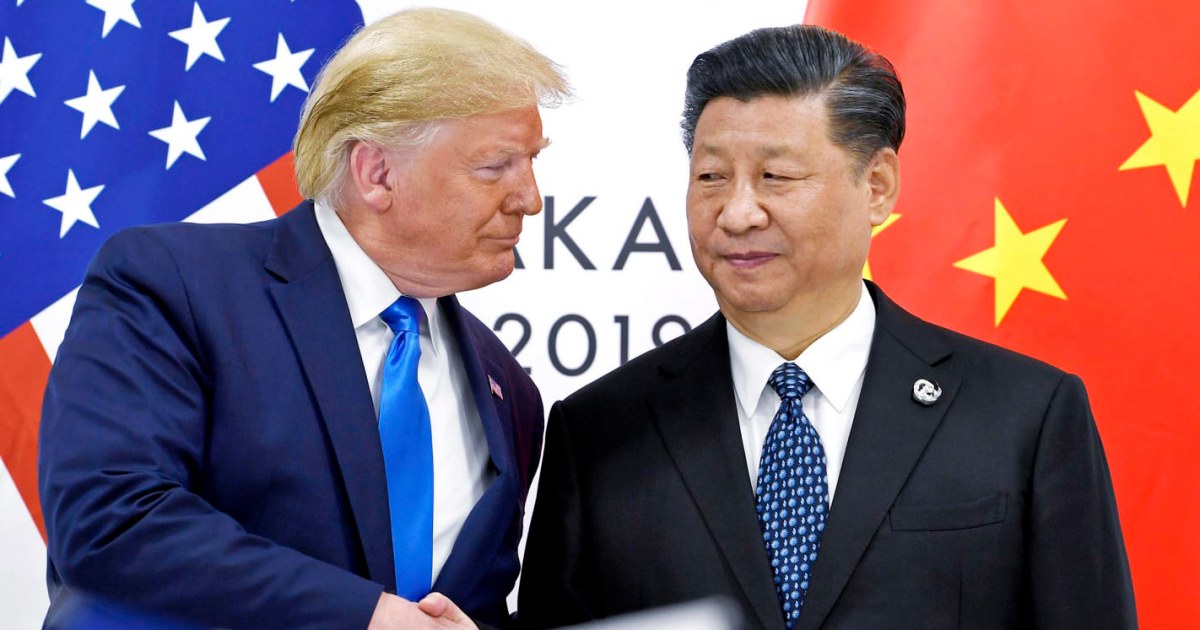
Oct. 29, 2025, 5:41 PM EDTBy Katherine DoyleGYEONGJU, South Korea — President Donald Trump and Chinese leader Xi Jinping will meet in Busan, South Korea, on Thursday morning, looking to cool an increasingly heated relationship.The two sides are expected to discuss moves on tariffs, combating fentanyl and access to rare-earth minerals, while leaving bigger targets for later. The meeting is set to begin at 11 a.m. local time (10 p.m. Wednesday ET).With a Nov. 10 deadline to reach a tariff deal approaching, what began as Trump’s crackdown on the flow of fentanyl into the U.S. has broadened into a longer list of trade and security issues.The working expectation is that Trump and Xi will agree on a pause in the fight rather than finalizing a sweeping deal, a person familiar with the meeting planning said. Beijing could ease export curbs on strategically crucial rare earths, Washington could hold off on broad tariff hikes, and both sides could reach for gestures, such as expanded purchases of U.S. farm goods by China.Xi is also weighing steps on fentanyl chemicals, likely focused on choking off money-laundering networks tied to gangs, this person said. A rollout of a larger agreement could be staged around Trump’s planned visit to China next year.Trump has sounded upbeat about the prospect of reaching agreements. “I think we’re going to do well with China,” he said this week. “We meet, as you know, in South Korea with President Xi … and they want to make a deal. We want to make a deal.”He added that he and Xi have agreed to meet again in China and in the United States, “in either Washington or at Mar-a-Lago.”Treasury Secretary Scott Bessent told NBC News this week that meeting is likely to come before Xi’s trip to the U.S. for the G20 at Trump’s Doral property in Florida next fall. Trump is likely to visit Xi in Beijing early next year, just ahead of the Lunar New Year, Bessent said.The president has said he expects to lower tariffs on China that he imposed over its role in the illicit international flow of fentanyl components. And he hopes to finalize a deal on TikTok that would allow the social media app to continue operating in the U.S. despite a law, passed before he took office, which had been poised to ban it.On Wednesday, Trump was overheard telling leaders at the Asia-Pacific Economic Cooperation forum that he expects the meeting with Xi to last three to four hours. Both Trump and his Chinese counterpart want the optics and tactical aspect of this meeting to go well, the person familiar with the meeting planning said.Dan Caldwell, a former senior adviser to U.S. Defense Secretary Pete Hegseth, said Trump deserves credit for pursuing a pragmatic China policy that maintains what he said was strategic ambiguity while taking steps to restore important military capabilities to deter Chinese aggression.“A lot of folks wanted to assume that he was going to be reflexively hawkish on China,” Caldwell said of Trump. “That hasn’t been the case.”But Caldwell cautioned against expecting a breakthrough in Busan. “I don’t think the overall push hinges on one meeting,” Caldwell said. “Ideally, these go well, but the whole thing does not hinge on just one set of talks.”In other words, the goal is to make enough progress to get to the next date between the leaders of the world’s two biggest economies.Miles Yu, a former State Department adviser on China, said the U.S. and Beijing are “sizing each other out” with trade now a key battleground issue. Washington is pushing for concrete steps on fentanyl, market access and more, he said, while China “stonewalls and foot-drags” and offers only broad “frameworks.”“This is the root cause of the five rounds of futile negotiations so far with China without a breakthrough,” Yu said, adding that the administration is trying to shift China’s approach by rallying its neighbors, a strategy that he said “may or may not work.”After talks with Chinese counterparts in Malaysia last weekend, Bessent said negotiators had shaped a framework for the two leaders to consider that spanned tariffs, trade, fentanyl, rare earths and “substantial” purchases of U.S. agricultural products such as soybeans. He credited Trump’s threat of an additional 100% tariff with creating leverage and said he believes that the framework would avoid that outcome and open space for tackling other issues.Trump’s meeting with Xi in Busan marks the end of a three-country Asia swing, during which he signed agreements with Malaysia, Cambodia, Thailand, Japan and South Korea; made new foreign investment announcements; and proclaimed that tariff leverage can drive warring parties to stand down. Reflecting on his approach, Trump said going against the grain can sometimes deliver results.“Oftentimes you’ll go the opposite way of almost everybody, and you’ll be the one that’s right, and the others will be the one that’s wrong,” he said, offering a peek into his thinking. “That’s where you have your greatest successes.”Still, Trump is continuing a long-standing practice of meeting with allies before Beijing, which former Assistant Secretary of State Dave Stilwell said indicates that the U.S. is not going to trade its alliance commitments for a deal with China.Some of the most sensitive terrain in the discussions involves critical minerals, said Stilwell, who also underscored the political guardrails around concerns for the Beijing-claimed island of Taiwan: “Acknowledge the words, but look at the actions,” he said, citing Secretary of State Marco Rubio’s recent comments that the U.S. isn’t trading away Taiwan’s sovereignty for better deal terms.Some of Trump’s aides are worried that the president could shift the U.S. position on independence for Taiwan, walking away from long-standing U.S. policy, and have advised him against it, NBC News reported this week.Trump seemed to downplay any discussions, saying, “I don’t know that we’ll even speak about Taiwan.” Xi “may want to ask about it,” Trump said. “There’s not that much to ask about. Taiwan is Taiwan.”Analysts in the region, too, see limited room for a sweeping agreement this week. It’s unlikely that Trump and Xi will reach a comprehensive deal that settles the long-term structural differences between the U.S. and China, said Zeng Jinghan, a professor of international relations at the City University of Hong Kong. “But some sort of consensus and agreements are very possible,” said Zeng, given that both sides want “a little bit of de-escalation.”The hope, Zeng added, is for “less aggressive” rhetoric, with both Beijing and Washington likely to come back and declare the meeting a success.After the meeting, Trump plans to board Air Force One and return to the U.S. He has appeared to relish the receptions from foreign leaders on this quick trip across Asia. In Tokyo, he stood alongside Japan’s new prime minister, Sanae Takaichi, accepting a gift of cherry blossom trees and a putter that belonged to his late friend and former Japanese leader Shinzo Abe, and in Seoul received from South Korean President Lee Jae Myung a large gold crown, a replica from the Silla period.In one snapshot, Trump and Lee were pictured in a gift shop at the Gyeongju National Museum, where items on display included a red “USA” hat, Trump-branded sneakers and a shirt bearing the president’s mugshot.Trump praised the welcome he received in “vibrant” Malaysia, where Prime Minister Anwar Ibrahim compared their experiences with their countries’ legal systems, saying, “I was in prison, but you almost got there.”Katherine DoyleKatherine Doyle is a White House reporter for NBC News. Carol E. Lee, Peter Guo and Peter Alexander contributed.
admin - Latest News - October 30, 2025
admin
15 views 12 secs 0 Comments


President Donald Trump and Chinese leader Xi Jinping will meet in Busan, South Korea, to discuss tariffs, fentanyl and rare-earth minerals.


Source link

TAGS:
PREVIOUS
Trump orders Pentagon to begin testing nuclear weapons 'immediately'
NEXT
Trump meets with Xi in South Korea
Related Post
November 10, 2025
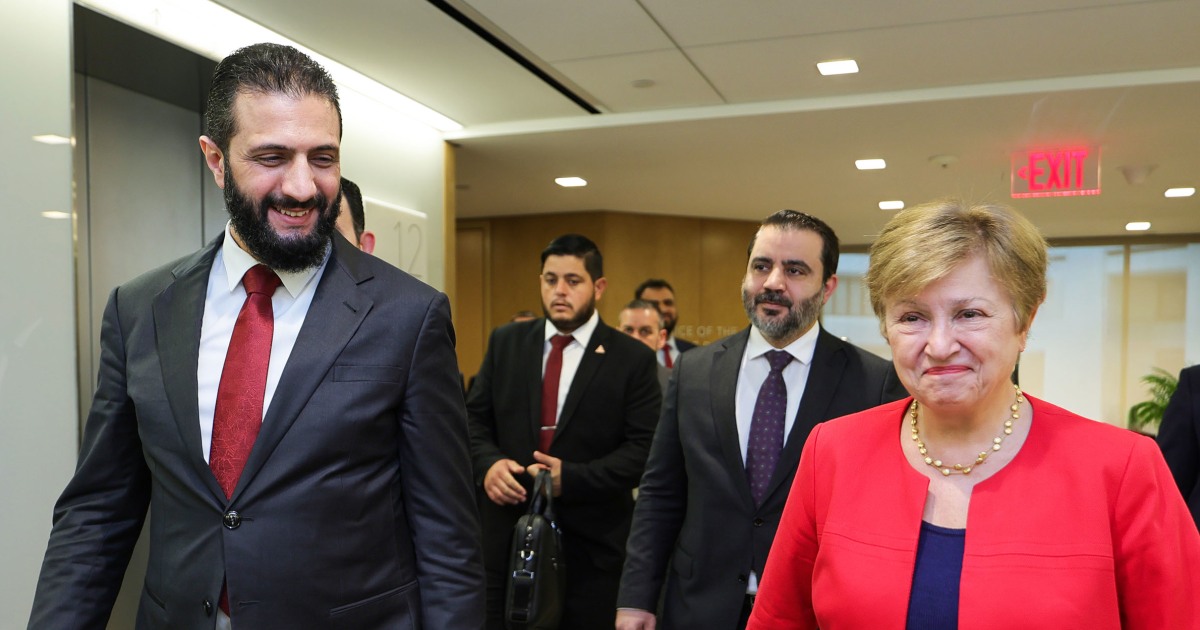
Savewith a NBCUniversal ProfileCreate your free profile or log in to save this articleNov. 10, 2025, 5:57 AM ESTBy Chantal Da Silva, Ammar Cheikh Omar, Abigail Williams and Monica AlbaThe Oval Office is a long way from Abu Ghraib.When he’s greeted by President Donald Trump on Monday, Ahmad al-Sharaa will have completed his journey from jihadist leader to head of state receiving a warm White House welcome.Since toppling the regime of President Bashar al-Assad, Syria‘s interim leader has spent the past year transforming his global image while tackling deep divisions at home.Now, al-Sharaa, who has thrown off his nom de guerre Abu Mohammad al-Jolani, will make history as the first Syrian president to visit the White House.“I think he’s doing a very good job,” Trump said last week, setting the tone for his landmark meeting with al-Sharaa, who would not have been able to set foot in the U.S. a year ago thanks to the $10 million bounty on his head. “It’s a tough neighborhood and he’s a tough guy, but I got along with him very well and a lot of progress has been made with Syria,” Trump said.During his Washington visit, Al-Sharaa is expected to commit to joining the U.S.-led coalition to defeat ISIS, two U.S. officials told NBC News. It would be a significant step in his country’s engagement with the West.The State Department removed al-Sharaa and his interior minister from the Specially Designated Global Terrorist list on Friday, while the U.K. and Europe removed sanctions on al-Sharaa after the United Nations Security Council voted in favor of a U.S.-drafted resolution to do so.The Washington trip is “a high-level sign of the trust that the American administration has placed in al-Sharaa — and the hope that he will succeed in holding Syria together during this incredibly complicated transition period,” said Burcu Ozcelik, a senior research fellow at the Royal United Services Institute, a London-based think tank.A ‘turning point’Al-Sharaa rose to power after leading Hayat Tahrir al-Sham, or HTS, in toppling Assad’s regime last December.Since then, he has sought to distance himself from his past as a jihadist who had been jailed by U.S. forces in Iraq, trading military fatigues for smart suits and vowing to rebuild Syria and unify its myriad religious and ethnic groups.Trump’s approach, a dramatic shift for the U.S., has underscored al-Sharaa’s success in breaking the country’s decadeslong global isolation.The U.S. removed its terrorist designation for HTS, along with the bounty on al-Sharaa himself, before lifting a string of sanctions following a May meeting between the Syrian leader and Trump in Saudi Arabia.President Donald Trump and Syrian President Ahmed al-Sharaa.@PressSec / via XAl-Sharaa was in New York in September to address the United Nations General Assembly, but Syria’s Ministry of Information said that being welcomed to the White House marked a “major turning point” for the country.At home, however, al-Sharaa has struggled to unify a deeply divided Syria while grappling with broader threats: a resurgent ISIS, fraught relations with increasingly assertive neighbor Israel, and Russia’s determination to maintain its strategic foothold in Syria while giving safe haven to Assad.Syria has experienced flashes of violence, including deadly attacks against minority groups allegedly carried out in part by government forces. Growing tensions with Kurdish authorities in northeast Syria have also erupted into violent clashes.“He’s certainly being (very) smart,” John Jenkins, a former British diplomat who has previously served as head of mission in Syria, said of al-Sharaa in emailed comments.“A trip to D.C. makes him look respectable,” said Jenkins, an associate fellow at Chatham House and a leader at Cambridge University’s Centre for Geopolitics. But, he added,”the key issues are domestic.”And within Syria, opinions have been deeply divided.“He does not represent the Syrian people,” said Sami Zain Al-Din, a 72-year-old political activist from Sweida, a southern city that was rocked by deadly clashes involving the Druze community, which has close ties to Israel.For doctor Jalnar Hamad, doubts over al-Sharaa were balanced against hopes that his meeting with Trump could open a “new chapter” that could see Sweida “benefit from development or reconstruction programs,” she said.Syria’s President Ahmed al-Sharaa with representatives of Syrian-American organizations in Washington D.C. on Sunday.AFP via Getty ImagesIlham Ahmed, co-chair of the Syrian Democratic Council, the political arm of the Kurdish-led and U.S.-backed Syrian Democratic Forces, said the Trump meeting was “an opportunity to redefine the position of the new Syrian state.” It’s also a chance for Trump to address “the rights of the Kurdish people and the coalition partners who fought terrorism on behalf of the world,” he said, referring to the SDF’s role against ISIS.Further sanctions lifted?Al-Sharaa will be hoping to emerge strengthened domestically, and key to that effort is his bid to remove remaining sanctions imposed on Syria during Assad’s rule.Already, “the pace with which sanctions have been eased on Syria since May has been absolutely spectacular,” Karam Shaar, a consultant on Syria and the research director at the Operations and Policy Center think tank in Turkey, said in a voice note.Shaar said he expected that two “main pieces of sanctions will have been either lifted or just about to be lifted” by the time al-Sharaa and Trump meet, including the removal of Syria from America’s list of “state sponsors of terrorism” and the repeal of sanctions under the Caesar Act, a 2019 law targeting the Assad regime.But sanctions will not be the only focus, with the effort to quell ISIS’ resurgence and relations with Israel also expected to play a central role.The U.S. ally has faced growing isolation on the global stage over its deadly assault in Gaza, but Trump has previously expressed hopes Syria would join other Arab nations in normalizing ties with Israel under the Abraham Accords, which were expanded again last week.It remains unclear whether Trump will push the matter during talks with al-Sharaa on Monday.Syria, historically a staunch ally of Iran, has never recognized Israel and has been locked in a state of conflict with the country since its establishment in 1948. Iranian proxy Hezbollah has also long been deeply embedded in Syria after joining the Assad regime’s military efforts.When Assad was in power, Israel routinely carried out airstrikes against what it said were Iranian-linked targets inside Syria, and since his ouster, it has deployed troops to a United Nations-patrolled buffer zone and has repeatedly launched airstrikes and incursions into Syria. Damascus has so far refused to retaliate, while both countries have kept the lines of communication open.Chantal Da SilvaChantal Da Silva reports on world news for NBC News Digital and is based in London.Ammar Cheikh OmarAmmar Cheikh Omar is a producer for NBC News.Abigail WilliamsAbigail Williams is a producer and reporter for NBC News covering the State Department.Monica AlbaMonica Alba is a White House correspondent for NBC News.
September 24, 2025
Sinkhole swallows vehicle and electrical poles
November 19, 2025
Australian prisoner sues for right to eat Vegemite
October 25, 2025
Many federal employees miss first full paycheck on Day 24 of shutdown
Comments are closed.
Scroll To Top
  • Home
  • Travel
  • Culture
  • Lifestyle
  • Sport
  • Contact Us
  • Politics
© Copyright 2025 - Be That ! . All Rights Reserved