• Police seek suspects in deadly birthday party shooting
  • Lawmakers launch inquires into U.S. boat strike
  • Nov. 29, 2025, 10:07 PM EST / Updated Nov. 30, 2025,…
  • Mark Kelly says troops ‘can tell’ what orders…

Be that!

contact@bethat.ne.com


Be That ! Menu   ≡ ╳
  • Home
  • Travel
  • Culture
  • Lifestyle
  • Sport
  • Contact Us
  • Politics Politics
☰

Be that!

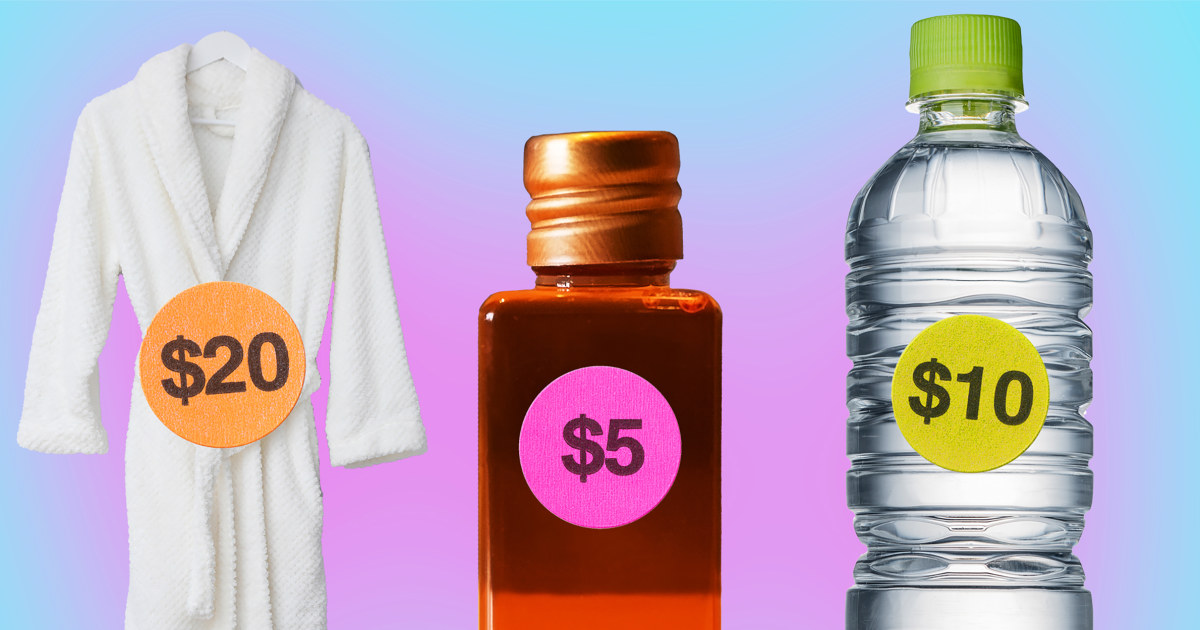
Nov. 2, 2025, 5:30 AM ESTBy Harriet BaskasTravelers booking hotel reservations online may soon notice that the process increasingly mirrors what it’s like to buy airline tickets.Want early check-in or late check-out? More space, a higher floor or a garden view? Pool access or a “hydration station” (aka bottled water) in your room?Check “yes” before you book and the cost will be added to your basic room rate.How about milk and cookies for the kids or a gourmet snack box for your dog? Those bonus amenities can be waiting for you in your room, for an added, prepaid fee.Artificial intelligence and other innovative technologies are turning hotel operators into travel retailers, selling much more than just rooms.Individual properties can now creatively unbundle and repackage their room inventories, allowing guests to personalize their stays and increasing revenue.But it can be tricky for a hotel to find the sweet spot between giving guests more control over the details of their stays and leaving them feeling like a hotel is charging for perks that guests expect for free.Boutique perksAt the 14-room Lakehouse Inn in Lee, Massachusetts, a new AI-powered booking platform helps match guests with specific rooms and maximizes returns on each booking.“Each of our rooms is unique, and previously guests could only book a room type, i.e., king or queen, and then call us if they wanted a specific room,” said co-owner Kurt Inderbitzin.The Lakehouse Inn’s new booking platform asks prospective guests their preferred room size, bedding, location and view. Then it provides detailed photos and descriptions of a few specific rooms that meet the requests.The question, then, becomes whether a guest is willing to pay more for a room that’s a little bit more to their liking.Only 14% of U.S. hotel guests were willing to pay a premium for a room with a better view, and only 11% for a room on a higher floor, according to surveys conducted earlier this year by Atmosphere Research Group, a travel industry market research firm.“I’m a budget traveler and never spend extra” on perks, said Debbie Twombly, 74, a substitute teacher in Astoria, Oregon.While some guests may feel nickel-and-dimed if they are asked to pony up for once-standard amenities like bottled water or pool access, others will pay for amenities they view as contributing to the enjoyment of their stay.Los Angeles-based leadership brand strategist Anne Taylor Hartzell, 50, is fine with paying extra for a better view. “I’ve also paid for a bottle of bubbles to be chilled and waiting in my room,” she said.At the 79-room Inn at the Market, a boutique hotel tucked in Seattle’s historic Pike Place Market, hotel guests can prepay to have a bouquet of market flowers or a box of fresh macaron cookies from a bakery around the corner waiting in their rooms.And even though only around 5%-10% of guests opt for one of these a la carte perks, the additional income is “a positive outcome” that helps the property stand out from the city’s other downtown properties, said Jay Baty, the inn’s marketing and sales director.Columbia Hospitality, which manages about 50 unique properties across the country, has also added optional upgrades into its booking path.Its 73-room Wren hotel in Missoula, Montana, offers flower bouquets and an in-room pour-over coffee station as pre-bookable perks.In Walla Walla, Washington, its hip, 80-room Finch offers a s’mores kit and half-pound boxes of chocolates.AI-powered amenitiesIt’s not just boutique inns that are taking advantage of new ways to create custom stays.In 2024, more than 5,000 Wyndham hotels adopted new technology that allows properties to text guests 24 hours before check-in with locally tuned add-on offers.These include early check-in at a Howard Johnson hotel near Disneyland, and a basket of sunscreen and beach toys at a Days Inn in Jekyll Island, Georgia.“The most successful hotels are those offering add-ons that truly enhance the experience at a price that makes sense for both sides,” said Scott Strickland, Wyndham’s chief commercial officer.Other large chains are also using new technology to expand optional attributes, amenities and add-on services offered during booking.Among them are IHG Hotels & Resorts, Marriott International and Hilton Hotels, according to a closely watched global business travel forecast for next year.A slippery slopeAt a time when U.S. hotels are facing big challenges from owner rentals like Airbnb and VRBO, it can be tempting for properties to lean on new technology to offer ever more add-ons.But this only works if hotels are prepared to deliver on all the products and experiences that technology permits them to offer to guests upfront.“Letting guests reserve a fruit and cheese plate or rose petals on the bed upon arrival is great,” said Henry Harteveldt, president of Atmosphere Research Group.“But it means a hotel has to make sure the cheese doesn’t look like it’s from the castaway bin at Safeway and that there are always fresh rose petals on hand and a staff member on duty who can artfully arrange them.”Harteveldt said this means hotel owners need to ask themselves a new question: “Just because we can do this, should we?”Harriet BaskasHarriet Baskas is an NBC News contributor who writes about travel and the arts.
admin - Latest News - November 2, 2025
admin
14 views 9 secs 0 Comments


Booking hotel reservations online increasingly mirrors what it’s like to buy airline tickets.


Source link

TAGS:
PREVIOUS
Trump wants new nuclear testing. What would that mean?
NEXT
Train collides with truck hauling cars in Texas
Related Post
October 23, 2025
Republicans need Democratic support to reopen government
September 25, 2025
ICE director says Dallas facility shooting was his 'worst nightmare'
October 1, 2025
Oct. 1, 2025, 6:00 AM EDTBy Denise ChowIf an asteroid is on a collision course with the moon, what should humanity do? Try to nudge the space rock out of the way before it strikes? Obliterate it with a nuclear explosion?Those are the questions explored in a recent paper from more than a dozen researchers, including several NASA scientists. And they’re not purely hypothetical: An asteroid known as 2024 YR4 is estimated to have a 4% chance of hitting the moon in 2032.Such a cosmic collision could produce debris “up to 1,000 times above background levels over just a few days, possibly threatening astronauts and spacecraft” in low-Earth orbit, the researchers wrote in the paper, which was uploaded to the preprint website arXiv on Sept. 15 but has yet to be peer-reviewed.To avoid creating that potentially dangerous debris field, one option is to nuke the asteroid, according to the paper — or trigger what the scientists call a “robust disruption” — before it reaches the moon. Cue the “Armageddon” movie references.But using a nuclear explosion to destroy an asteroid has never been tested, so the plan would come with a slew of major risks.Various key characteristics about asteroid 2024 YR4 aren’t known, including its mass, which would be critical in figuring out how to properly “disrupt” it without creating more problems.“If the explosion is not enough, you’re just going to create a debris field anyway,” said Julie Brisset, interim director of the Florida Space Institute, who wasn’t involved with the paper.Asteroid 2024 YR4 was first detected by the Asteroid Terrestrial-impact Last Alert System station in Chile in December. NASA estimates that it measures up to 220 feet across, large enough to be considered a “city killer” because it could be capable of causing severe damage to a city or region on Earth.Experts initially thought there was a small chance the asteroid could hit our planet, and the probability of such an impact was estimated to be as high as 3% earlier this year. But a collision with Earth was later ruled out.With Earth now thought to be in the clear, asteroid 2024 YR4 has an estimated 4.3% chance of smacking into the moon.The authors of the recent paper suggested launching a mission to conduct reconnaissance of the asteroid, including estimating its mass from up close. After that, they proposed, an explosive device could be built, then deployed to the space rock.Alternatively, if destroying the asteroid with a nuclear explosion is too extreme, the researchers detailed how it could be nudged out of the way.NASA has some experience with that: In a first-of-its-kind test in 2022, its DART probe intentionally crashed into a small space rock known as Dimorphos to alter its trajectory. The maneuver was carried out 6.8 million miles from Earth and changed Dimorphos’ path in space, shortening its orbit by 33 minutes, according to NASA.But a successful deflection would also require knowing the mass of asteroid 2024 YR4, Brisset said.In response to an NBC News inquiry to NASA about the recent paper, Kelly Fast, the agency’s acting planetary defense officer, said in a statement that there are no plans to deflect or otherwise interfere with the asteroid.However, she said there are plans to study it early next year using the James Webb Space Telescope. Any findings could provide better insight into its orbital path.“If observed, the additional data could improve our knowledge of where the asteroid will be in December 2032,” Fast said, “and could drop the impact probability to 0%.”Even if space missions like those described in the paper could be carried out, there would be political considerations to navigate.Although no astronauts or long-term habitats are on the moon, that might not always be the case. China, for instance, has said it aims to land its astronauts on the moon by 2030. Chinese officials have also said the country may build a nuclear plant on the lunar surface to power a moon base that it plans to jointly operate with Russia. The United States plans to launch regular missions to the lunar surface before NASA eventually ventures to Mars. But NASA’s future missions and priorities remain in flux amid significant personnel cuts and President Donald Trump’s budget blueprint for NASA, which proposes slashing more than $6 billion from its budget.Detonating a nuclear device in space could also add tension to the burgeoning space race among the United States, China and other spacefaring countries, with potential conflicts over which countries and space agencies would lead or participate in the project, Brisset said.“It would probably be countries that have the technical capability to do it,” she said, “which maybe narrows it down to three or four, but would they want to work together?”Denise ChowDenise Chow is a science and space reporter for NBC News.
October 28, 2025
U.S. tourist describes sheltering from Hurricane Melissa
Comments are closed.
Scroll To Top
  • Home
  • Travel
  • Culture
  • Lifestyle
  • Sport
  • Contact Us
  • Politics
© Copyright 2025 - Be That ! . All Rights Reserved