• Police seek suspects in deadly birthday party shooting
  • Lawmakers launch inquires into U.S. boat strike
  • Nov. 29, 2025, 10:07 PM EST / Updated Nov. 30, 2025,…
  • Mark Kelly says troops ‘can tell’ what orders…

Be that!

contact@bethat.ne.com


Be That ! Menu   ≡ ╳
  • Home
  • Travel
  • Culture
  • Lifestyle
  • Sport
  • Contact Us
  • Politics Politics
☰

Be that!

Nov. 6, 2025, 11:21 AM ESTBy Rob WileLike much else in the U.S. economy, the casual restaurant sector is increasingly bifurcating into a handful of winners and a growing group of laggards. At issue are two seemingly irreconcilable challenges: Operating costs that continue to surge, forcing companies to raise prices in order to maintain their profit margins — and a consumer base anchored by low and middle-income households that faces growing financial instability amid a weakening job market.It’s led to pain for much of the chain-restaurant sector — with some established but long-struggling brands announcing that they are exploring potential sales. But as consumers’ perception of value evolves, and their wallets tighten, some surprising stalwarts in the sit-down sector are making a comeback. “That perception of affordable fast-food has gone out the window,” said Alicia Kelso, executive editor of Nation’s Restaurant News, an industry publication. The winnersThe biggest beneficiary of the current environment has been the casual table-service dining sector, where Chili’s is leading the pack.Last week, Chili’s parent company reported that sales had increased a massive 21% in its most recent quarter, with foot traffic surging 13%. The chain has undertaken a series of operational improvements like more efficient ovens, sprucing up locations, and trimming its menu offerings. But what is changing faster than the restaurants themselves is that consumers are increasingly willing to spend a little more for table service and equivalent or even higher-quality food than they can get at traditional fast-food and fast-casual spots, Kelso said. The same effect is happening at chains like Applebees and Olive Garden, each of which also posted sales gains in their latest quarters. Texas Roadhouse is also expected to support steady sales growth Thursday. “As people have less money to spend at restaurants, they’re looking for more bang for their buck,” Kelso said. “These places have swooped in and said, ‘We are here for you.’”The losersThe current environment has changed the definition of value, she said. No longer does it simply mean the cheapest option. That’s led to struggles for several other fast-food players. On Wednesday, McDonald’s said traffic among lower-income diners fell by nearly 10% during the most recent quarter, even as it reported sales growth that topped Wall Street estimates. Other chains have also begun highlighting the concerns of less-well-off customers. Wingstop saw domestic sales decline 5.6% in its most recent quarter. Chipotle cut its sales outlook for the third-straight quarter last week. “We remain in a low-hire, low-fire labor market,” Andrew Charles, a research analyst and managing director at TD Securities financial group, said in a note published last week. “That translates into a consumer outlook that remains segmented, with middle to low income earners continuing to struggle as well as entry-level young workers who have seen demand for their labor decline.”The consumer struggles come alongside seemingly unending cost increases for chains. Alongside the price of beef, which has surged to record highs, restaurants also face rising costs for rent and electricity. In some markets, labor costs have also jumped since President Donald Trump ramped up deportations and federal immigration enforcement.Since April 2020, the cost of eating out has climbed approximately 33%, according to Bureau of Labor Statistics data. The outlookThe challenging environment for restaurants has resulted in a flurry of announcements indicating entire brands may be getting new ownership. On Tuesday, the parent company of Pizza Hut announced it was putting the stalwart restaurant chain up for sale after years of struggles. Denny’s announced a day earlier that it was being taken private in a $620 million deal that is slated to close early next year. And Apollo Global Management has withdrawn a $2.1 billion bid for Papa John’s pizza restaurants, amid ongoing fears about the trajectory of consumer spending. “It speaks to how intensely pressured the industry is right now,” Kelso said of the spate of sale statements. While some of these chains have faced ongoing issues, others are experiencing abrupt downturns after enjoying recent periods of strength — with no turnaround in sight. After more than half a decade of largely uninterrupted stock-price gains, Chipotle shares have declined by nearly 50% in 2025. Similar scenarios are playing out for the Mediterranean-focused chain Cava and the salad chain Sweetgreen, both of which reported weaker earnings in their most recent quarters after posting impressive gains in 2024. All three of these restaurants are part of what the industry refers to as the “fast casual” segment, a slightly more upscale version of old-school fast food that tends to cater to younger, working-professional diners.This segment is facing a particularly challenging outlook.“When you look at different age demographics of fast casual, the 25- to 34-year-old consumer seems to be impacted a bit more than others, and fast casual tends to have a higher concentration of those consumers within their guest portfolio,” Cava’s chief financial officer, Tricia Tolivar, said in a recent interview with CNBC.“It appears that the consumer is being more thoughtful around their dining occasions, and how frequently they are doing that,” she said.Rob WileRob Wile is a Pulitzer Prize-winning journalist covering breaking business stories for NBCNews.com.

admin - Latest News - November 6, 2025
admin
14 views 11 secs 0 Comments


The tough U.S. jobs market is creating new groups of casual and fast-food restaurant winners and losers.


Source link

TAGS:
PREVIOUS
Sudan paramilitary group agrees to U.S. ceasefire proposal
NEXT
Savewith a NBCUniversal ProfileCreate your free profile or log in to save this articleNov. 6, 2025, 9:58 AM ESTBy Steve KopackU.S.-based companies announced more than 153,000 job cuts in October, the research firm Challenger, Gray & Christmas reported Thursday.“This is the highest total for October in over 20 years, and the highest total for a single month in the fourth quarter since 2008,” the firm said in a news release. From January through the end of October, employers have announced the elimination of nearly 1.1 million jobs. It’s the most Challenger has recorded since 2020, when the Covid-19 pandemic shut down the global economy.“October’s pace of job cutting was much higher than average for the month,” Andy Challenger, the firm’s chief revenue officer, said in a statement. The last time there was a higher October monthly total was in 2003.“Some industries are correcting after the hiring boom of the pandemic, but this comes as AI adoption, softening consumer and corporate spending, and rising costs drive belt-tightening and hiring freezes,” he said.On Wednesday, the private payroll processor ADP released its own October jobs data, showing that employers added just 42,000 jobs in the month.The ADP report also flagged job losses in the leisure and hospitality sector as a potential sign of trouble ahead, given the industry’s acute sensitivity to consumer sentiment.ADP’s chief economist called the losses in hospitality and leisure a “concerning trend.” Both Challenger and ADP’s reports landed as major companies such as Amazon, IBM, UPS, Target, Microsoft, Paramount and General Motors announced plans to eliminate tens of thousands of jobs.Despite the wave of downbeat economic news, the Trump administration continues to deliver an upbeat take on the current environment.“Jobs are booming” and “inflation is falling,” Treasury Secretary Scott Bessent said Tuesday.However, the most recent available data paints a different picture.Inflation has also been on the rise. Prices as measured by the Consumer Price Index overall have risen every month since April.A spokesperson for the Treasury Department did not immediately reply to a request for comment on the Challenger report. Challenger’s report does not typically carry the same weight with economists and investors as federal jobs data, owing to its methodology. To arrive at its figures, the firm compiles the number of job cuts companies have publicly announced. But employers may not ultimately carry out all the cuts they roll out.Moreover, some of the job cuts that multinational companies announce could affect workers outside of the United States. Other headcount reductions could be achieved through attrition, rather than layoffs. The report also may not capture smaller layoffs over the long run.But in the midst of a federal data blackout caused by the government shutdown, Challenger’s latest report is being read more closely than usual.The federal government’s October jobs report that would traditionally be released Friday will not be published this week, due to the shutdown. Other key data about the U.S. economy like GDP and an inflation indicator called PCE, closely watched by the Federal Reserve, has also been delayed.Challenger equated the impact of AI on the current labor market to the rise of the internet in the early aughts. “Like in 2003, a disruptive technology is changing the landscape,” it said.”Technology continues to lead in private-sector job cuts as companies restructure amid AI integration, slower demand, and efficiency pressures,” Challenger said.But even firms that are not actively cutting jobs have warned that they do not plan to add to their headcount in the near term, with several pointing directly to AI’s impact on their personnel needs.On Wednesday night, JPMorgan Chase CEO Jamie Dimon told CNN that headcount at his company would likely remain steady as the nation’s largest bank rolls out AI internally. Goldman Sachs CEO David Solomon also recently told his employees that the firm would “constrain headcount growth through the end of the year,” as it takes advantage of AI efficiencies, Bloomberg reported. Steve KopackSteve Kopack is a senior reporter at NBC News covering business and the economy.
Related Post
November 13, 2025
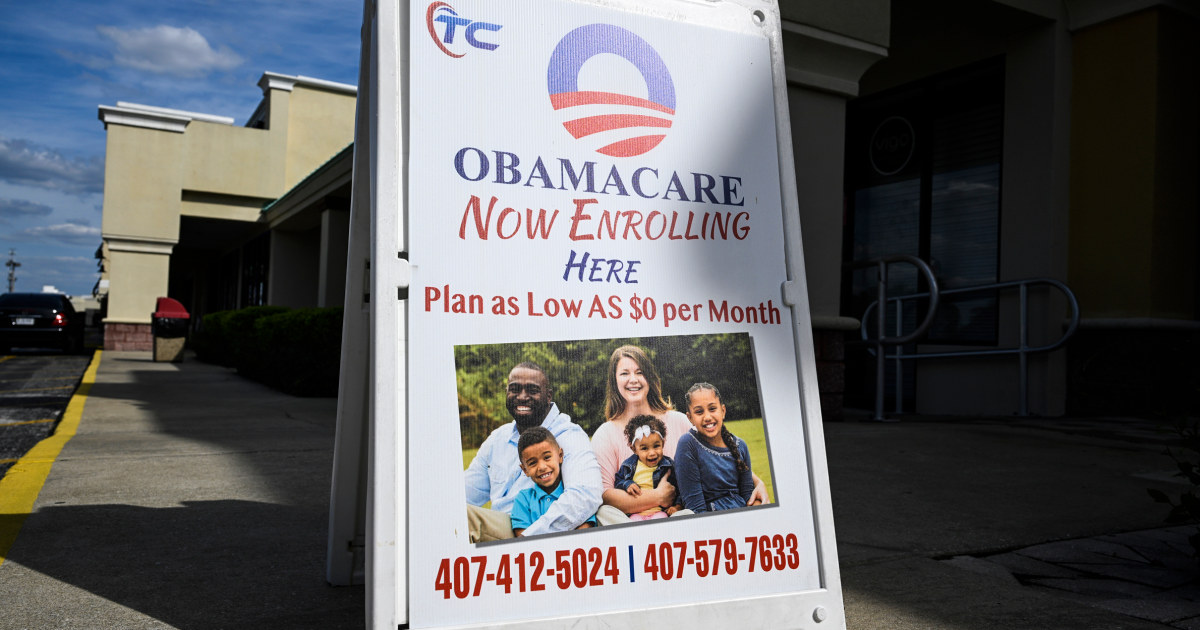
Nov. 13, 2025, 11:57 AM ESTBy Melanie Zanona, Julie Tsirkin and Sahil KapurWASHINGTON — House Speaker Mike Johnson says he still has “PTSD” from the GOP’s failed effort to repeal and replace the Affordable Care Act during President Donald Trump’s first term.Now, the party is about to plunge back into the tricky policy debate that once cost them seats in the House.This time around, though, Republicans are mostly stopping short of calling for a full-scale repeal of President Barack Obama’s signature health care law, even as they slam the policy as a failure. Instead, the mantra among Republicans is “fix Obamacare.”But the clock is ticking. Open enrollment for health insurance has already begun and enhanced Obamacare subsidies are set to expire at the end of the year, more than doubling insurance premiums for millions of Americans in red and blue states alike, with some seeing increases of thousands of dollars per month.Republicans, under pressure from Democrats after the government shutdown revived the health care clash, have not coalesced around legislation or even an abstract idea, and are only now starting serious discussions about putting proposals together.Trump calls for end of filibuster, takes aim at Affordable Care Act03:16As the party scrambles to craft an alternative, multiple Republicans are vying for Trump’s endorsement of ideas that could alleviate skyrocketing costs that are just around the corner. Two Republican senators have competing plans to create federally funded spending accounts that would help Obamacare enrollees directly, rather than subsidize insurers to keep costs down.Johnson, R-La., said House Republicans have also been brainstorming proposals behind the scenes and will “be rolling out some of those ideas,” but he declined to put a timeline on it.“I haven’t prejudged that or put any dates on it, but I mean, we worked on it today. We’ve been working on it every day. We got more members joining the discussion,” Johnson told NBC News on Wednesday evening. “This is how it works. It’s a deliberative process, where you build out the consensus, and we’ll be working on that in earnest in the days ahead.”Johnson also said he recently traded texts with House Minority Leader Hakeem Jeffries, D-N.Y., about the possibility of working on a bipartisan solution. But Jeffries is pushing for a three-year extension of the expiring ACA tax credits, which Johnson has said is a nonstarter.If Republicans aren’t able to agree on an alternative solution before the end of this year, they’ll have to decide whether to join with Democrats in extending the ACA tax credits, which risks drawing Trump’s ire, or letting them expire, which risks infuriating voters ahead of next year’s midterm elections.Republican Rep. Jeff Van Drew of New Jersey, who said he talked to Trump at length last week about the importance of health care, warned, “not only is it morally bankrupt, it’s political suicide” for Republicans to let the subsidies expire without an alternative in place.Sen. Rick Scott, R-Fla., told NBC News he pitched Trump on his plan, which would put federal money in health savings account-style accounts for individuals to “increase competition and drive down costs.”Scott hopes to release the text of the bill as soon as possible, citing a mid-December deadline set by Senate Majority Leader John Thune, R-S.D., to give Democrats a vote on the expiring ACA subsidies.Scott, who chairs the Senate Republicans’ policy committee, invited health care-focused guest speakers to weekly party lunches over the last six weeks to illustrate why members should oppose extending the ACA subsidies, as Democrats were demanding during the shutdown.“Obamacare has failed us. Cost has skyrocketed,” Scott told reporters in the Capitol on Monday. “The way to fix it is, any Obamacare subsidies go to the individual through an HSA and then allow people to buy whatever plan that fits their family.”It’s an idea that Trump — who stepped up his public attacks on Obamacare last week when Democrats were still digging in on their shutdown demands — seems open to.“We’re gonna pay a lot of money to the people. They’re gonna go out and buy their own health care, and we’re gonna forget this Obamacare madness,” Trump said during a bill signing to end the shutdown Wednesday evening.Earlier this week, Trump suggested naming the replacement plan “Trumpcare.”Despite the president repeatedly railing against Obamacare, a White House official told NBC News that Trump had not ruled out extending the ACA subsidies.“We need to do the right thing policy-wise but also the smart thing politically,” said the official, who spoke on the condition of anonymity to describe the president’s thinking.Another emerging idea is from Sen. Bill Cassidy, R-La., chairman of the Senate’s health committee, who advocated for flexible spending accounts that, like Scott’s proposal, would help Obamacare enrollees directly.Cassidy has pitched his idea to Republicans and the Trump administration, but also across the aisle as the only tangible solution to address rising health care costs with a chance of passing the House and being signed into law by Trump.“I don’t know if we can get something bipartisan, but you never can unless you at least give it a shot,” Cassidy said. “We actually want to get something that lowers health care costs for the American citizens implemented as quickly as possible. There’s some things we’re going to disagree on that might be really good policy, but if we’re going to get it done quickly, it has to be things that we do agree on.”The viability of those ideas remains to be seen.“While Republicans have talked for years about replacing the ACA, none of these current ideas are fully fleshed out yet. A tweet is not a health care plan,” said Larry Levitt, executive vice president for health policy at KFF, a nonpartisan research group. “So, it’s hard to tell exactly how these concepts of replacing ACA premium assistance with cash or health accounts would really work in practice.”“If people could use these Trump health care dollars to buy insurance not regulated by the ACA, it would likely cause the ACA to collapse and upend protections for pre-existing conditions,” Levitt continued.There is a third option. Republicans could try to overhaul Obamacare with only GOP votes by using the “budget reconciliation” process for a second time during Trump’s second term. The procedural tool allows Republicans to pass legislation with a simple majority, and Trump ally Sen. Lindsey Graham, R-S.C., has advocated doing so, pitching it as an alternative to Trump’s calls to get rid of the filibuster.Graham has even suggested crafting a Republican alternative to Obamacare and passing a package by Jan. 1 — no small feat — to avoid higher premiums from kicking in, according to two people familiar with his private comments. Graham’s suggestion is not being considered as a serious proposal because of the monumental lift required to put together such a plan, these people said. And, it’s an open question what would even be allowed under Senate rules, with multiple senators and aides telling NBC News they would need to run it by the Senate’s parliamentarian, who referees the reconciliation process, before hitting go.Republicans tried multiple times during Trump’s first term to repeal or undo Obamacare. “The definition of insanity is doing the same thing over and over again and expecting a different result, and that applies here,” Van Drew said. “I don’t want us to flounder around, say we’re working on something, go back and forth. And then Jan. 1 comes, and some people are not able to pay their bills because their health insurance costs so much, or other folks just give up their health insurance.”Van Drew said if they can’t pass an alternative before the end of the year, then they need to extend the subsidies for another year in order to buy themselves more time.And if Republicans don’t act, then Van Drew said he’d be open to signing a discharge petition to prevent ACA subsidies from lapsing — a tricky and rarely used procedural tool to go around leadership’s head that requires 218 signatures to succeed. Jeffries started a discharge petition Wednesday for a three-year extension of the ACA tax credits; if every Democrat signs on, they’ll need four Republicans to join them to force a House vote. That is unlikely to happen.“If we don’t do anything, we just flounder around, it’s certainly something I would consider,” said Van Drew, who participated in a bipartisan and bicameral health care meeting last week.Senate Minority Leader Chuck Schumer, D-N.Y., said Republicans now “own” the health care crisis, previewing the Democratic line of attack ahead of the midterms.In exchange for opening the government, Democrats got a promise for a floor vote in mid-December on an ACA bill of their choosing. But there’s no guarantee about the outcome. Democrats are exploring ways to win over Republicans, such as changing the eligibility requirement or income caps. But another wrinkle has emerged: a battle over GOP demands for stricter abortion guardrails around the ACA money, which Democrats say is a nonstarter.Meanwhile, Johnson has refused to commit to putting any Senate-passed ACA bill on the House floor. The speaker has insisted he needs to build consensus among his members first and has deputized House Majority Leader Steve Scalise, R-La., to work with the three chairmen of the committees with relevant jurisdiction over the issue, as well as the GOP doctors caucus, to put together some ideas. The working group will hold listening sessions with members next week.Rep. Ralph Norman, R-S.C., told NBC News the ACA money should “absolutely” expire, despite the wishes of some in the GOP to renew it.“There’s not gonna be any deal cut,” Norman said.Rep. Kevin Hern, R-Okla., the chair of the House Republican Policy Committee, said the GOP solution should not require federal money.“We should look at how we’re going to lower costs without having to inject more federal dollars into it,” he said. “The Democrat solution is to throw more federal dollars at it. We don’t have the access to that.”Rep. Marjorie Taylor Greene, R-Ga., has questioned how serious her colleagues are about a health care plan. Greene, the MAGA firebrand, who said her family’s health care costs have risen threefold since the ACA took effect, warned that her party will suffer politically in 2026 if they fail to improve the system.“Republicans must finally come up with a plan to address affordability,” she told NBC News. “Ignoring this crisis will not only leave the American people in a crisis but will likely lead to losses in the midterms. We have the majority; it’s time to solve this problem that the Democrats created.”Melanie ZanonaMelanie Zanona is a Capitol Hill correspondent for NBC News.Julie TsirkinJulie Tsirkin is a correspondent covering Capitol Hill.Sahil KapurSahil Kapur is a senior national political reporter for NBC News.Lillie Boudreaux and Gabe Gutierrez contributed.
October 24, 2025
An economic roller coaster sends Six Flags America off the tracks
November 30, 2025
Larry King in 1992 on why politicians are drawn to TV
October 7, 2025
Oct. 7, 2025, 11:21 AM EDT / Updated Oct. 7, 2025, 11:49 AM EDTBy Matt Lavietes and Corky SiemaszkoFlight delays were reported across the country for a second straight day Tuesday as the Federal Aviation Administration braced for more airport staffing shortages amid the government shutdown. Delays due to a shortage of air traffic controllers caused delays Tuesday at airports in Boston, Philadelphia, Nashville, Houston, Chicago and Las Vegas, the FAA reported.These delays came on the heels of slowdowns at airports in Denver, Phoenix, Burbank, California and Newark, New Jersey that the FAA reported during the first 24 hours that air traffic controllers began working without pay due to the shutdown. Meanwhile, the National Air Traffic Controllers Association reminded members it does not “endorse, support, or condone” federal employees participating in coordinated activities that could affect flight safety or cause delays.”Participating in a job action could result in removal from federal service,” the union posted on its website. “It is not only illegal, but it also undermines NATCA’s credibility and severely weakens our ability to effectively advocate for you and your families.”Despite the delays, the FAA had not issued a “staffing trigger” Tuesday that would reduce the number of flights in and out of airports that don’t have enough controllers to handle the traffic safely.But the number of domestic and international flight delays have been surging in recent days, with more than 6,000 reported Monday compared with roughly 3,000 delays Saturday, according to flight tracker website FlightAware. There were just over 1,000 delays within, into, or out of the U.S. as of Tuesday morning, according to the site.Transportation Secretary Sean Duffy said Monday at Newark International Airport that there had been a slight increase in sick calls since the government shutdown began Wednesday. “Our priorities are safety,” Duffy said. “And so, if we have additional sick calls, we will reduce the flow consistent with a rate that’s safe for the American people.”
Comments are closed.
Scroll To Top
  • Home
  • Travel
  • Culture
  • Lifestyle
  • Sport
  • Contact Us
  • Politics
© Copyright 2025 - Be That ! . All Rights Reserved