1 view

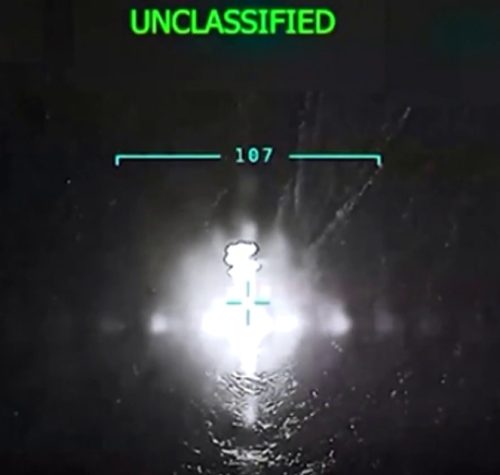
Nov. 29, 2025, 10:07 PM EST / Updated Nov. 30, 2025, 5:57 PM ESTBy Courtney Kube, Gordon Lubold and Raquel Coronell UribeBoth the House and the Senate have started inquiries into a reported second strike on an alleged drug boat in the Caribbean in September that killed the survivors of an initial strike.The Defense Department conducted a second strike on a boat the Trump administration says was carrying drugs from Venezuela after the first strike on the boat failed to kill all of its occupants, one U.S. official and a source familiar with the Pentagon’s actions that day told NBC News. The first of the two strikes conducted on Sept. 2 left at least two survivors, the officials said. The second strike killed the remaining survivors, according to the officials. ​The boat was carrying 11 people, the Pentagon said at the time. Both strikes that day were the first of several known U.S. strikes on vessels in the Caribbean Sea that the administration alleges carry drugs to the U.S. Since then, the Pentagon has conducted more than 20 strikes on vessels it says were transporting drugs from Venezuela, killing more than 80 people. The Washington Post was the first to report about the second strike in the Sept. 2 boat attack. The Post reported that the second strike was ordered by the Joint Special Operations commander overseeing the strike who was complying with a previous order from Defense Secretary Pete Hegseth to “kill everybody.”NBC News has not confirmed that detail. The second strike is significant as some legal experts say that if it was ordered to kill people who would be otherwise incapacitated, it amounts to a war crime. Sen. Mark Kelly, D-Ariz., said Sunday on CNN that if the reporting on the second strike is true, “it seems to” constitute a war crime. “If what has been reported is accurate, I’ve got serious concerns about anybody in that, you know, chain of command stepping over a line that they should never step over,” Kelly said. “We are not Russia. We’re not Iraq. We hold ourselves to a very high standard of professionalism.” Uproar after lawmakers urge troops to defy illegal orders04:23Speaking to reporters Sunday, President Donald Trump said he didn’t know anything about the reported second strike, adding that Hegseth “said he did not say that, and I believe him 100%.”Asked whether he thought it would be legal if a second strike had taken place to kill those wounded in the first, Trump said, “I don’t know that that happened. And Pete said he did not want that — he didn’t even know what people were talking about. “We’ll look into it. But no, I wouldn’t have wanted that. Not a second strike. The first strike was very lethal. It was fine, and if there were two people around, but Pete said that didn’t happen. I have great confidence,” he added.“Pete said he did not order the death of those two men,” Trump said.The top Republican and Democrat on the GOP-led Senate Armed Services Committee said in a statement Friday that the committee was aware of recent reports.“The Committee has directed inquiries to the [Department of Defense], and we will be conducting vigorous oversight to determine the facts related to these circumstances,” Sens. Roger Wicker, R-Miss., and Jack Reed, D-R.I., said in the statement.The Republican-led House Armed Services Committee followed suit Saturday, with Reps. Mike Rogers, R-Ala., and Adam Smith, D-Wash., saying in a joint statement that the House committee is “committed to providing rigorous oversight of the Department of Defense’s military operations in the Caribbean.”“We take seriously the reports of follow-on strikes on boats alleged to be ferrying narcotics in the SOUTHCOM region and are taking bipartisan action to gather a full accounting of the operation in question,” Rogers and Smith wrote.Chief Pentagon spokesperson Sean Parnell told the Post in a statement that “this entire narrative is completely false.” He told the newspaper that the “ongoing operations to dismantle narcoterrorism and to protect the Homeland from deadly drugs have been a resounding success.”Hegseth posted Friday evening on X that the strikes were intended to be “lethal, kinetic strikes.”“The declared intent is to stop lethal drugs, destroy narco-boats, and kill the narco-terrorists who are poisoning the American people. Every trafficker we kill is affiliated with a Designated Terrorist Organization,” he wrote.“Our current operations in the Caribbean are lawful under both U.S. and international law, with all actions in compliance with the law of armed conflict — and approved by the best military and civilian lawyers, up and down the chain of command,” he added.The Trump administration is ratcheting up pressure on Venezuela. Trump is weighing military action against the country following nearly two dozen known U.S. strikes on vessels in the region, which have killed at least 82 people. Trump said Saturday morning that Venezuela’s airspace should be considered “closed.”The strikes have raised concerns in Congress about a lack of information from administration officials. Trump last month indicated that his administration will not seek congressional approval for targeting drug traffickers, saying, “I think we’re just gonna kill people that are bringing drugs into our country.”“We’re going to kill them. They’re going to be, like, dead,” Trump added.Courtney KubeCourtney Kube is a correspondent covering national security and the military for the NBC News Investigative Unit.Gordon LuboldGordon Lubold is a national security reporter for NBC News.Raquel Coronell UribeRaquel Coronell Uribe is a breaking news reporter. Brennan Leach and Kyle Stewart contributed.

Both the House and the Senate have started inquiries into a reported second strike on an alleged drug boat in the Caribbean in September that killed the survivors of an.

TAGS:
2 views

Nov. 30, 2025, 10:04 AM ESTBy Jasmine Cui and Jared PerloSurveying the state of America’s artificial intelligence landscape earlier this year, Misha Laskin was concerned.Laskin, a theoretical physicist and machine learning engineer who helped create some of Google’s most powerful AI models, saw a growing embrace among American AI companies of free, customizable and increasingly powerful “open” AI models.But most of these models were being made in China, and these systems were quickly gaining ground on their U.S. competitors.“These models were not that far behind the frontier. In fact, they were surprisingly close to the frontier. The ones that are coming now,” Laskin said, pausing slightly, “well they’re palpably close to the frontier.”Laskin founded a startup called Reflection AI, recently valued at $8 billion, to provide an open-source American alternative to these increasingly capable Chinese models that have gained traction in Silicon Valley.“You’re starting to see glimpses of open-model companies actually driving the frontier of intelligence in China, and overall, the frontier of intelligence,” Laskin said.Over the past year, a growing share of America’s hottest AI startups have turned to open Chinese AI models that increasingly rival, and sometimes replace, expensive U.S. systems as the foundation for American AI products.NBC News spoke to over 15 AI startup founders, machine-learning engineers, industry experts and investors, who said that while models from American companies continue to set the pace of progress at the frontier of AI capabilities, many Chinese systems are cheaper to access, more customizable and have become sufficiently capable for many uses over the past year.The growing embrace could pose a problem for the U.S. AI industry. Investors have staked tens of billions on OpenAI and Anthropic, wagering that leading American artificial intelligence companies will dominate the world’s AI market. But the increasing use of free Chinese models by American companies raises questions about how exceptional those models actually are — and whether America’s pursuit of closed models might be misguided altogether.Michael Fine, head machine learning at Exa, an AI-focused search company valued at $700 million and supported by Silicon Valley mainstays like Lightspeed Venture Partners and Nvidia, said running Chinese models on Exa’s own hardware has proved to be significantly faster and less expensive than using bigger models, like OpenAI’s GPT-5 or Google’s Gemini, in many cases.“What often happens is we’ll get a feature working with a closed model and realize it’s too expensive or too slow, and we ask, ‘What levers do we have to make this faster and cheaper?’”“That usually means replacing the closed model with the equivalent open model and then running it on our own infrastructure,” Fine said.Chinese models, like DeepSeek’s R1 and Alibaba’s Qwen, are free to use and considered “open-source” or “open-weight” because anyone can download, copy, modify and operate them. They differ from leading American systems like Anthropic’s Claude or OpenAI’s most popular GPT models, which are “closed,” or proprietary, and accessed through data centers and pipelines controlled by the big tech giants. For years, American closed-source models from OpenAI and Anthropic vastly outperformed both American and Chinese open alternatives. Even well-resourced in-house efforts to use open-source models struggled: Bloomberg tried to create an internal tool, BloombergGPT, using open-source models trained on its expansive collection of financial news and documents, only to see it trail OpenAI’s closed models on financial knowledge.Yet in the past year, Chinese companies like DeepSeek and Alibaba have made huge technological advancements. Their open-source products now closely approach or even match the performance of leading closed American models in many domains, according to metrics tracked by Artificial Analysis, an independent AI benchmarking company.“The gap is really shrinking,” Lin Qiao, CEO of Fireworks AI and co-creator of PyTorch, the dominant framework for training AI models, said of the capability differences between American closed-source and Chinese open-source models.

Surveying the state of America’s artificial intelligence landscape earlier this year, Misha Laskin was concerned

Source link

TAGS: