14 views

Savewith a NBCUniversal ProfileCreate your free profile or log in to save this articleNov. 5, 2025, 4:14 PM ESTBy Camila Bernal and David DouglasMinutes before a 10-hour surgical procedure, 8-year-old Olivia Olson sat on a hospital bed grinning. With quiet confidence she explained why the operation was so important to her.“I think I look beautiful, and I don’t really care what other people think of me,” Olivia said. “I just want to get a big ear so people don’t bully me in the future.”Olivia was born with a rare congenital condition, microtia, that prevents the development of the outer ear. Fewer than 200,000 people in the U.S. have microtia, according to the National Institutes of Health. Olivia’s right ear developed normally, but her left was never fully formed. Her parents, Annie and Dave Olson, of Oro Valley, Arizona, knew from birth she would need surgery to reconstruct her ear. But up until the day of the operation last month, their insurance provider, Anthem Blue Cross and Blue Shield, had repeatedly refused to approve coverage for the procedure with the surgeon the Olsons wanted to use. Dr. Sheryl Lewin holds up the 3D-printed ear implant to Olivia’s right ear. The implant would become her left ear.Courtesy David OlsonOnly a handful of doctors in the U.S. regularly perform the operation Olivia needed. Most of them — including Dr. Sheryl Lewin, a pediatric craniofacial plastic surgeon in private practice based in Torrance, California — were out of network for the Olsons. “The anatomy of an ear, it’s very complex, lots of detail, shadows, highlights, etc., so just physically recreating something that complex is very difficult. It’s rare to have a surgeon that specializes in it,” Lewin said. “If you don’t have a lot of experience, you’re going to end up with a lot of problems with this complicated of a surgery.”The family chose Lewin after years of research. They believed her reconstruction method, which involved using a 3D-printed implant to rebuild the ear, was best for Olivia. (Another technique involves using the patient’s rib cartilage to reconstruct the ear.)“We got a denial letter, and it was literally like a stab in the heart,” said Annie Olson. “We’re like, what are we going to do now?”The family requested what’s known as a “gap exception,” which allows a patient to use in-network benefits for an out-of-network provider. The request was initially denied; instead, Anthem gave them a list of six in-network doctors, the Olsons said. NBC News reached out to all six. Not a single one said they performed the surgery.If you are dealing with bills that seem to be out of line or a denial of coverage, care or repairs, whether for health, home or auto, please email us at Costofdenial@nbcuni.com.“Very few programs really offer somebody enough surgical time experience to when they leave the program and go out in private practice, where they’ll feel comfortable enough to do this kind of surgery,” said Dr. Arturo Bonilla, a pediatric microtia reconstructive surgeon in San Antonio. “It’s very specialized.”Bonilla, who performs the rib-graft method for reconstructing ears, said he regularly requests gap exceptions for his patients — and while sometimes requests need to be appealed, they’re almost always approved by all insurers, including Anthem Blue Cross and Blue Shield. “Rarely will we get somebody that says, ‘No, we’re still not going to approve it,’” he said.The Olsons debated canceling the surgery but ultimately decided to keep the date and shield Olivia from the challenges they faced paying for it. Lewin prepares the 3D-printed ear in the operating room.NBC Nightly NewsAfter multiple appeals and denials, the Olsons fundraised, borrowed money from family members and turned to credit cards. But that was not enough. Eventually, Dave Olson pulled a huge portion of the surgery’s roughly $100,000 cost from his 401(k).He said he didn’t hesitate to take the money out of his retirement fund. “It is my responsibility as a parent to make sure that my kids have everything they need,” he said.“If we knew that this was going to be the outcome, we would have been responsible people and started saving since the day she was born, versus finding out last minute, and then also having to be penalized because of pulling out of your 401(k) early,” Annie Olson said.NBC News reached out to Anthem a couple days before Olivia’s surgery and was waiting for a complete response. On the day of the surgery, with Olivia on the operating table, the Olsons finally received word that Anthem would grant the gap exception — a change the Olsons attributed to NBC News’ involvement.“We went through literally what felt like a battle every day, day in and day out,” Dave Olson said. “Then at the 11th hour during the surgery, you say they’re gonna cover it. It’s like, what? Like, why? Why? Why now?”In a statement to NBC News nearly two weeks after Olivia’s surgery, Anthem Blue Cross and Blue Shield said: “We are happy that the member was able to receive the treatment she needed. Even though the member’s plan does not cover out-of-network providers when an in-network provider is available, we were able to make a unique one-time exception to ensure her care was not delayed.”Lewin shows Olivia her new ear for the first time.NBC Nightly NewsLewin, who performs about 120 microtia surgeries a year, said that in 2025, getting denials overturned and getting gap exceptions approved for microtia surgery has been a lot more challenging. She said in 2024, more than 90% of her Anthem patients’ gap exceptions were approved, or denied and overturned. In 2025, with the exception of Olivia, none of her Anthem patients have been approved.“It’s just become kind of a very slow trend that’s very much peaked in the last year,” Lewin said. “It’s been rough, and we’ve had to work much harder to get a negotiation agreed upon.”Anthem Blue Cross and Blue Shield didn’t respond to questions about Lewin’s claim that her patients have been denied gap exceptions this year. However, it said it is reaching out to Lewin to offer a potential in-network arrangement.The financial details for Olivia’s case are still being finalized, but she said she is already excited for the future.“When it’s fully recovered, I’m gonna be like, ‘OK, that was just a short little bump,’ and then I’ll just go on with the rest of my life,” she said.Camila Bernal David DouglasDavid Douglas is a supervising producer for NBC News based in Los Angeles.

Minutes before a 10-hour surgical procedure, 8-year-old Olivia Olson sat on a hospital bed grinning.

Source link

TAGS:
15 views

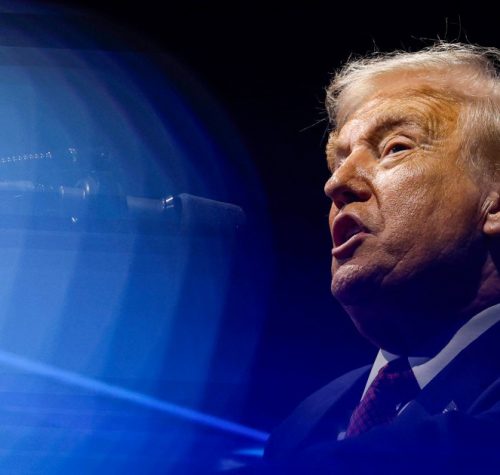
Savewith a NBCUniversal ProfileCreate your free profile or log in to save this articleNov. 5, 2025, 3:32 PM ESTBy Matt DixonPresident Donald Trump delivered a speech on the economy to business leaders in Miami on Wednesday, one day after Republicans suffered brutal election losses in states where exit polls showed voters deeply concerned about financial issues. While the president has started to acknowledge that economic anxiety — including over the government shutdown — is hurting Republicans politically, his address to the American Business Forum largely hyped his economic agenda.“This is the golden age of America,” Trump said opening his campaign-style remarks, which even featured the song “Y.M.C.A.” — a staple of his election rallies. Trump focused much of his time on what he views as three positive economic indicators: the stock market hitting record highs, wages ticking up and an easier environment for American-born workers to find jobs. “Almost 2 million American-born workers are employed today more than when I took office,” Trump said.Trump also said any economic slump is due to a “transition period” needed for his economic policies to really take hold, and — without evidence — boasted that there has been $18 trillion in investment made in the country since he returned to office, a number that has been debunked in the past.Trump’s speech, however, frequently weaved away from the economy.He returned to attacks against his political opponents, going after former President Joe Biden for using an autopen and the new presidential library of former President Barack Obama, and he tried out nicknames for Democratic California Gov. Gavin Newsom, saying he should be called “Slimy Newscum.”Trump’s upbeat remarks at the Miami event largely did not reflect the increasingly difficult economic and political environment for his party.On Tuesday night, Democrats swept almost every high-profile race across the country during off-year elections seen as a testing ground for the 2026 midterms, when Republicans will try to hold onto slim majorities in the House and Senate. Some voters say Ciattarelli’s links to Trump worked against him in the race for governor02:01Though Trump did not put much direct effort into any of the races, his shadow loomed large over polling places across the country. Exit polling data showed that in each of the four states with significant elections — Virginia, New York, California and New Jersey — at least 55% of voters said they “disapprove” of Trump’s performance during his first 100 days in office.It’s the latest in a flurry of data that show much of that disapproval is tied to the economy, which Trump has tried to rewire with his across-the-board tariffs and a more than $4-trillion tax cut package.An NBC News poll released on Sunday showed that just 34% of voters think he has “lived up” to expectations on the economy, while 52% blamed Trump and Republicans in Congress for the government shutdown, which has gone on for 36 days and is now the longest in the nation’s history.The legality of Trump’s unilaterally imposed tariff regime was also the subject of a much-awaited Supreme Court hearing Wednesday, where administration attorneys were greeted by justices who seemed skeptical of arguments that Trump had the legal authority to impose sweeping tariffs under a federal law designed for national emergencies.Chief Justice John Roberts said that the tariffs amount to a tax — an argument the administration has vocally rejected — and said the power of taxation is the responsibility of Congress.Ahead of Wednesday’s hearing, attorneys for the federal government argued that the Trump-imposed tariffs would “generate between $2.3 trillion and $3.3 trillion.” But when pressed during the hearing, Solicitor General D. John Sauer seemingly contradicted that argument, telling justices that they were not designed to raise revenue but rather “regulatory tariffs” designed to help Trump cut trade deals.If the court rules that Trump did not act lawfully when he unilaterally imposed the tariffs, it could spin off even further economic uncertainty.Trump does appear to finally be sensing some political trouble, showing a rare bit of reflection during a breakfast Wednesday morning with Republican senators.Trump acknowledged that the government shutdown is being blamed on Republicans more than Democrats, and said his party, which controls both the House and Senate, needs to reopen the government or face further political backlash. He also appeared to express some concern that “countless public servants are now not being paid, and the air traffic control system is under increasing strain” — a notable shift in rhetoric from his frequent criticisms and digs at federal workers, whom his administration targeted for layoffs and suggested might not be entitled to post-shutdown pay.Trump pushes GOP senators to eliminate filibuster as shutdown becomes longest in history01:31Trump has been pushing senators to pursue the “nuclear option” of scrapping the legislative filibuster, a rule that requires 60 votes to pass most legislation out of that chamber. Lawmakers have so far rejected that drastic measure.“If you read the pollsters, the shutdown was a big factor, negative for the Republicans,” Trump said Wednesday morning. “Last night, it was not expected to be a victory, it was a very Democrat areas. I don’t think it was good for Republicans. I don’t think it was good for anybody. We had an interesting evening and learned a lot.”“We have to get the country open,” he added.Vice President JD Vance wrote on social media Wednesday that it was “idiotic” to read too much into Tuesday’s election losses, since the contests took place in blue-leaning states. But even he admitted Republicans need to do more on the economy and said the outcome will be critical to the party’s future in the midterms. “The president has done a lot that has already paid off in lower interest rates and lower inflation, but we inherited a disaster from Joe Biden and Rome wasn’t built in a day,” he said. “We’re going to keep on working to make a decent life affordable in this country, and that’s the metric by which we’ll ultimately be judged in 2026 and beyond.”Matt DixonMatt Dixon is a senior national politics reporter for NBC News, based in Florida.

President Donald Trump delivered a speech on the economy to business leaders in Miami, one day after Republicans suffered brutal election losses.

Source link

TAGS: