17 views

Nov. 3, 2025, 10:41 PM ESTBy Gabe Gutierrez, Yamiche Alcindor, Gordon Lubold, Courtney Kube, Dan De Luce and Abigail WilliamsWASHINGTON — A Fox News report prompted President Donald Trump to call out Nigeria over the killing of Christians and then threaten military action, setting off a scramble in the White House over the weekend, according to multiple U.S. officials.It’s still unclear what — if anything — the administration will do to counter Islamic militants in Nigeria, but precision drone strikes are among the preliminary options being considered, two U.S. officials said.A White House spokesperson declined Monday to offer any details on the plans under consideration.“At President Trump’s direction, the administration is planning options for possible action to stop the killing of Christians in Nigeria,” the spokeswoman, Anna Kelly, said in a statement. “Any announcements will come from the President directly.”A vendor sells local newspapers with headlines referring to US President Donald Trump’s comments about Nigeria, on the street of Lagos, Nigeria on Sunday.Sunday Alamba / APTrump’s first social media post on Nigeria came Friday night after he watched a Fox News report on violence in the West African nation, two administration officials said. The president asked his staff for more information about the situation and, shortly after, declared in a Truth Social post that he was designating Nigeria a “country of particular concern” over its failure to, in his words, stop the “mass slaughter” of Christians.Trump then went further in a Saturday post, directing the Defense Department to prepare for possible military action.“If the Nigerian Government continues to allow the killing of Christians, the U.S.A. will immediately stop all aid and assistance to Nigeria, and may very well go into that now disgraced country, ‘guns-a-blazing,’ to completely wipe out the Islamic Terrorists who are committing these horrible atrocities,” Trump wrote. It’s not the first time the president’s rapid fire social media posts have moved faster than policy deliberations, with officials rushing to draft diplomatic and military options and allied governments taken by surprise. Experts and scholars who follow events in Nigeria say Trump’s portrayal of the security situation in the country as a “Christian genocide” is misleading and oversimplified, as Nigerians of all faiths have suffered at the hands of Islamist extremists and other groups.Trump’s posts even contradicted one of his own senior State Department advisors, Massad Boulous, who said last month that Muslims have died in larger numbers than Christians.“People of all religions and of all tribes are dying, and it is very unfortunate, and we even know that Boko Haram and ISIS are killing more Muslims than more Christians,” Boulos said while meeting with the Nigerian President Bola Ahmed Tinubu in Rome, according to state media outlet, Voice of Nigeria. “So people are suffering from all sorts of backgrounds. This is not specifically targeted at one group or the other.”People walk past torched houses following an attack by Boko Haram in Darul Jamal, Nigeria on Sept. 6, 2025.AP FileSpeaking to reporters on Monday, Trump hinted that he was open to sending troops on the ground in Nigeria, but that seemed like a far less likely option as he has generally been loath to deploy troops to conflicts overseas, according to the two U.S. officials.A senior Trump administration official said the White House is in regular contact with the Nigerian government. “We hope that the Nigerian government will be a partner in the process of addressing this issue, and work with the United States to take swift and immediate action to address the violence that is affecting Christians, as well as countless other innocent civilians across Nigeria,” the official said. Nigeria’s government was taken aback by Trump’s statements, but officials cited the two countries’ friendly relations and called for a cooperative approach between the two governments to tackle the threat posed by Islamist groups.Daniel Bwala, an advisor to Nigeria’s president, told the BBC that any military action against the Islamist groups should be carried out jointly. Nigeria would welcome U.S. help in tackling the militants but added that it was a “sovereign” country.Insurgent groups like Boko Haram and Islamic State’s branch in West Africa sometimes use anti-Christian language, but their attacks are indiscriminate, targeting civilians, officials, and local leaders regardless of religion, according to Miriam Adah, an analyst with the Armed Conflict Location and Event Data project (ACLED), a U.S.-based nonprofit that tracks conflicts and crises.“In Nigeria, the violence is widespread and complex. It involves insurgents, bandits, ethnic clashes, and land disputes — not a single campaign to eliminate Christians,” Adah said. “Both Christians and Muslims are victims.”The bipartisan U.S. Commission on International Religious Freedom has pointed to violence against both Christians and Muslims in Nigeria, saying there are systematic religious freedom violations in the country. “Violence affects large numbers of Christians and Muslims in several states across Nigeria,” the commission said in a report last year.It also described the Nigerian government response to attacks on Nigerian civilians by “nonstate actors” as slow or ineffective.Islamist groups like Boko Haram are not the only actors behind violence in Nigeria, experts say.Apart from Boko Haram and an Islamic State branch in northern Nigeria, there is a separatist movement in the southeast, ethnic militant groups in the oil-producing Niger Delta, kidnapping gangs in the northwest and clashes between Muslim herders and Christian farmers in the Middle Belt fueled by climate change.Trump’s comments may have had more to do with domestic American politics than addressing a security threat in Nigeria, experts said. Some Republican lawmakers, aligned with elements of Nigeria’s Christian diaspora population in the United States, have long focused on the plight of Christians in Nigeria. And Trump may have been trying to deliver a message to his Christian supporters in the United States, experts said. “Republicans on the Hill in particular, for years, have been trying to frame Nigeria as ‘a Christian genocide,’ and they have strong allies in the Nigerian diaspora in the United States,” said Darren Kerr, dean of the School of Peace Studies at the University of California at San Diego.Nigeria’s population of 230 million is split almost evenly between Muslims and Christians, and the sectarian divide has triggered political violence in the past. Trump’s comments threaten to potentially “light a match” in an already fragile landscape, Kerr said. “To bring the weight of the United States solely on the Christian side and to frame things in a Muslim-Christian dimension is probably extremely unhelpful to both Christians and Muslims in Nigeria,” Kerr said.The United States does, however, have grounds to question how the Nigerian government is using the weapons and other assistance that Washington has delivered over the years, Kerr said.“Had the President been more measured in his comments to say ‘Nigeria, we give it all this money, what’s happened? That, I think, is a legitimate criticism on the part of the United States to say to the government, ‘Look, what are you guys doing? Where’s the strategy? Where’s the success, where’s the progress that we’re expecting?’”Gabe GutierrezGabe Gutierrez is a senior White House correspondent for NBC News.Yamiche AlcindorYamiche Alcindor is a White House correspondent for NBC News.Gordon LuboldGordon Lubold is a national security reporter for NBC News.Courtney KubeCourtney Kube is a correspondent covering national security and the military for the NBC News Investigative Unit.Dan De LuceDan De Luce is a reporter for the NBC News Investigative Unit. Abigail WilliamsAbigail Williams is a producer and reporter for NBC News covering the State Department.

A Fox News report prompted President Trump to call out Nigeria over the killing of Christians and then threaten military action, multiple U.S. officials said.

Source link

TAGS:
17 views

Nov. 3, 2025, 5:36 PM ESTBy Ben KamisarA super PAC supporting former New York Gov. Andrew Cuomo in the New York mayoral election is running a late ad that depicts Democratic nominee Zohran Mamdani in front of video of the Twin Towers crashing down on 9/11. The ad quotes liberal streamer Hasan Piker, with whom Mamdani appeared earlier this year, saying “America deserved 9/11” during a 2019 livestream. Alongside Piker’s stream, the ad includes video of one of the World Trade Center towers bursting into flames during the 2001 terror attack, with Mamdani superimposed on top of the video for a moment. “That’s Zohran’s buddy, Hasan Piker, saying we deserve 9/11. It’s a disgrace to every life lost,” the narrator says in the ad.”Zohran went on Piker’s show, and now Piker was just spotted at Zohran’s event. Mamdani is wrong for New York.” Mamdani’s opponents have repeatedly criticized the Democrat for appearing with Piker in early April, during the Democratic mayoral primary. Cuomo has repeatedly invoked the appearance to argue, among other things, that Mamdani wouldn’t be the right mayor for the city’s Jewish population, including making that case on the debate stage last month. After months of criticism, Mamdani addressed Piker’s comments about 9/11 during the NBC 4/Telemundo 47/Politico New York debate, calling them “objectionable and reprehensible.””I also think that part of the reason why Democrats are in the situation that we are in, of being a permanent minority in this country, is we are looking only to speak to journalists and streamers and Americans with whom we agree [on] every single thing that they say,” he added. For Our City, the super PAC behind the ad, is one of the outside groups boosting Cuomo’s campaign. Former Mayor Michael Bloomberg is one of the largest funders of the group and gave $3.5 million on Oct. 29, campaign finance records show. The ad comes two weeks after Cuomo briefly laughed during a radio interview when the host said Mamdani would be “cheering” if “another 9/11” happened on his watch, after which Cuomo added: “That’s another problem. But can you imagine that? If Mamdani was in the seat on 9/11, what would have happened in this city?” Cuomo had been talking about executive experience before that exchange. Piker was not named during that portion of the interview, but a Cuomo spokesman, Rich Azzopardi, later told NBC News that Cuomo was referring to Piker in his response and that he did not agree with the interviewer’s comments. The next day, Mamdani delivered an emotional speech outside a mosque in the Bronx, where he blasted the “racist, baseless” attacks he’s faced as a candidate, lamenting that “Islamophobia is not seen as inexcusable” and pledging to no longer brush the attacks aside and stay silent. “While my opponents in this race have brought hatred to the forefront, this is just a glimpse of what so many have to endure every day across the city,” Mamdani said, later adding: “The question lies before each of us: Will we continue to accept a narrow definition of what it means to be a New Yorker?””I will not change who I am, how I eat or the faith that I am proud to call my own. but there is one thing that I will change: I will no longer look for myself in the shadows. I will find myself in the light,” Mamdani said. Ben KamisarBen Kamisar is a national political reporter for NBC News

A super PAC supporting former New York Gov.

Source link

TAGS:
17 views

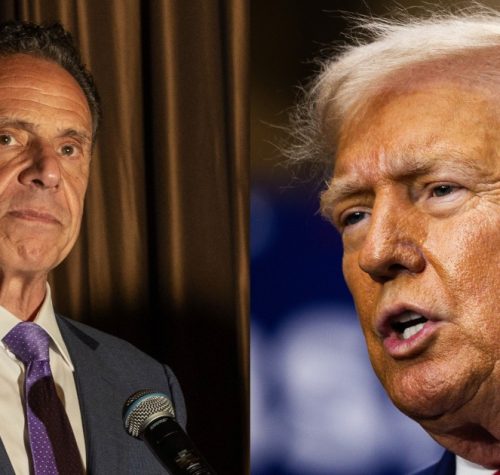
Nov. 3, 2025, 6:30 PM EST / Updated Nov. 3, 2025, 9:51 PM ESTBy Raquel Coronell UribePresident Donald Trump on Monday endorsed former New York Gov. Andrew Cuomo, a lifelong Democrat running as an independent, in New York City’s mayoral election.The president urged voters not to cast a ballot Tuesday for Republican nominee Curtis Sliwa, saying it would be “a vote for [Zohran] Mamdani.”“Whether you personally like Andrew Cuomo or not, you really have no choice,” Trump wrote on Truth Social.A recent poll from Suffolk University showed Mamdani leading the race with 44% support, with Cuomo trailing behind him by 10 percentage points. Sliwa, meanwhile, sat at 11%.Trump’s endorsement came shortly after his interview with CBS News’ “60 Minutes,” where he reiterated his threat to withhold federal funds from the city if Mamdani is elected.During the interview, Trump also indicated his preference for Cuomo over Mamdani, whom he’s called a “communist” through much of the mayoral race.Mamdani on Sunday used Trump’s remarks as ammunition, mocking Cuomo on social media by congratulating him and saying, “I know how hard you worked for this.”Cuomo has rebuffed the prospect of Trump’s endorsement in recent weeks. In an interview with NBC News’ “Meet the Press” last month, Cuomo said he would reject an endorsement from Trump, saying his tent was not big enough to include the president in his coalition of supporters.“I have not had a conversation nor would I accept an endorsement from President Trump,” Cuomo said.Neither Cuomo’s campaign nor Sliwa’s immediately responded to requests for comment on Trump’s endorsement.While governor of New York, Cuomo was an outspoken critic of Trump during the president’s first term. The Democratic governor frequently slammed Trump over his response to Covid. During a mayoral debate last month, Cuomo described their clashes as “bloody battles.”Cuomo resigned as governor in 2021 after multiple women accused him of sexual harassment. He has repeatedly denied those allegations. In an interview with “Meet the Press” last month, Cuomo said he has no regrets about his behavior “vis-à-vis those allegations,” but added that he has “learned to be more careful.”Trump boosted several other candidates Monday ahead of Election Day. The president held tele-rallies for candidates in Virginia and New Jersey, talking up New Jersey GOP gubernatorial nominee Jack Ciattarelli and Republican candidates in Virginia, but without mentioning the name of Virginia’s GOP nominee for governor, Winsome Earle-Sears.Trump has endorsed Ciattarelli but hasn’t done the same for Earle-Sears.Raquel Coronell UribeRaquel Coronell Uribe is a breaking news reporter. 

The president endorsed Cuomo, who is running as an independent against Democratic nominee Zohran Mamdani, instead of Republican candidate Curtis Sliwa.

Source link

TAGS:
19 views

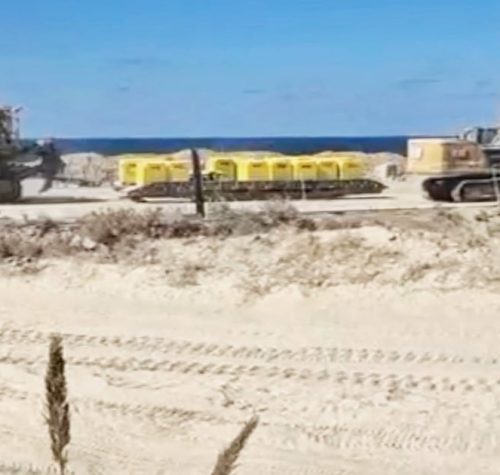
Savewith a NBCUniversal ProfileCreate your free profile or log in to save this articleNov. 3, 2025, 12:00 PM ESTBy Chantal Da SilvaThe blocks are concrete — but little else about Israel’s “yellow line” appears to be. Israeli troops have laid yellow blocks down on the ground in Gaza, marking the parts of the Palestinian enclave — just more than half of the territory — still under their control as part of the ceasefire with Hamas.Envisioned as a temporary boundary under the first phase of the agreement, which was brokered in part by President Donald Trump, the line has instead become a flashpoint. Israel carried out days of strikes on Gaza last week despite the truce, killing more than 100 people, including dozens of children, according to the Palestinian Health Ministry in Gaza, Israel said it was responding to what it said was a Hamas attack that killed one of its soldiers operating within the “yellow line.” Hamas denied involvement. Israeli forces had earlier separately opened fire on Palestinians in incidents in which it said people neared or crossed the boundary line prior to physical barriers being put in place.The next stages of Trump’s plan that would see Israel withdraw further are still to be negotiated. Israeli Prime Minister Benjamin Netanyahu’s office said Monday that he met with senior White House officials to discuss efforts to further implement Trump’s 20-point plan. Analysts warned that with the future of the truce appearing to be on “shaky” ground, it could be some time before there is clarity.NBC News spoke to some Palestinians whose homes, or what’s left of them, lie just beyond the barrier. For them, the line has become a physical manifestation of their fears that they may never be able to return to their land.’I can’t even look at it’The Israel Defense Forces began laying the yellow markers last month in what the military said was an effort to clearly delineate the areas it had agreed to withdraw to under the ceasefire deal with Hamas, which came into effect Oct. 10. It came after repeated incidents of Israeli forces firing upon Palestinians who they said had approached or crossed the withdrawal boundary, dubbed the “yellow line.” In one case last month, the Gaza Civil Defense agency said Israeli forces had killed nine people in a bus. The Israeli military said troops initially fired warning shots at the vehicle, which it said had crossed the boundary, and then “opened fire to remove the threat” when the vehicle didn’t stop.

The blocks are concrete — but little else about Israel’s “yellow line” appears to be.

Source link

TAGS: