
29 views

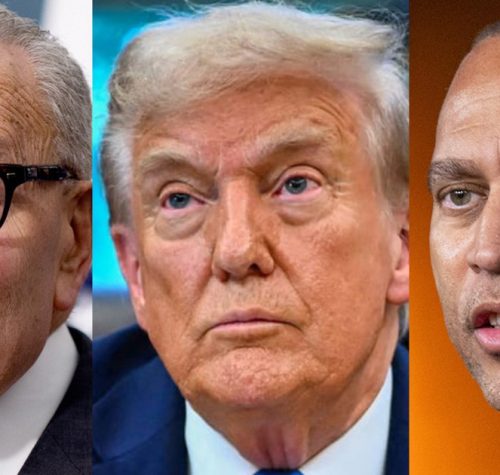
Sept. 22, 2025, 6:14 PM EDTBy Melanie Zanona, Julie Tsirkin and Dareh GregorianWASHINGTON — President Donald Trump is expected to meet with House Minority Leader Hakeem Jeffries and Senate Minority Leader Chuck Schumer this week to discuss funding the government as the specter of a shutdown looms, two sources familiar with the matter told NBC News.A time and a date have not yet been set. The meeting is expected to take place in Washington.Jeffries and Schumer, both of New York, had requested that the meeting take place ahead of the Sept. 30 funding deadline.Trump said over the weekend, “I’d love to meet with them, but I don’t think it’s going to have any impact.”The Senate voted last week to block dueling Republican and Democratic proposals to keep the government funded past Sept. 30 on a short-term basis.A deal to avert a shutdown and give lawmakers more time to work out a longer-term deal has to be bipartisan to clear the 60-vote threshold in the Senate, where Republicans hold 53 seats.The Democrats’ funding bill would extend Obamacare subsidies set to expire at the end of the year.The Republican bill would fund the government at current spending levels through Nov. 21 but preserve cuts to previously appropriated spending that have incensed Democrats.The GOP bill fell 16 votes short of the 60 needed, while the Democratic bill fell 13 votes short.The House and the Senate are on recess this week, and Republican leaders have decided not to bring the House back until after the funding deadline.Senate Majority Leader John Thune, R-S.D., last week said the bill Democrats “put on the floor makes it very clear they are very unserious.”Schumer and other Democrats have noted that Trump has publicly called on Thune and House Speaker Mike Johnson, R-La., not to negotiate with Democrats over a funding bill.If there is a shutdown, mandatory services such as the Border Patrol, the Postal Service and Social Security will continue, but many federal workers will go unpaid.Melanie Zanona and Julie Tsirkin reported from Washington and Dareh Gregorian from New York.Melanie ZanonaMelanie Zanona is a Capitol Hill correspondent for NBC News.Julie TsirkinJulie Tsirkin is a correspondent covering Capitol Hill.Dareh GregorianDareh Gregorian is a politics reporter for NBC News.

The president is expected to meet this week with Senate Minority Leader Chuck Schumer and House Minority Leader Hakeem Jeffries.

Source link

TAGS:
31 views

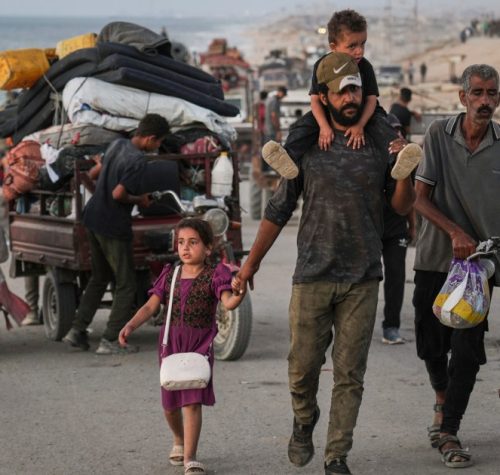
Sept. 22, 2025, 7:46 PM EDTBy Matt BradleyAs Palestinians and much of the Arab and Muslim worlds praised the decision by several European countries to recognize Palestinian statehood, Israeli politicians across the political spectrum reacted with anger and spoke of retaliation.“You are giving a huge prize to terrorism,” Israeli Prime Minister Benjamin Netanyahu said in a recorded address released Sunday night, as countries including the United Kingdom, Canada and Australia began to express their commitments to Palestinian statehood. “It will not happen. There will be no Palestinian state west of the Jordan River.”France formally recognized Palestinian statehood at a United Nations meeting on Monday. The statehood acknowledgements were “a diplomatic disaster,” Israeli opposition leader Yair Lapid, a long-standing opponent of Netanyahu, posted on X on Sunday. He added that it was “a harmful step” and a “reward for terror.”Though the fast-moving diplomatic events are mostly symbolic, the resentment across Israel’s political class shows just how isolated the Jewish state has become two years into its war with Hamas that has upended much of the Middle East.The Trump administration has also warned of possible repercussions for countries taking measures against Israel, including France. But European leaders defended their decisions, calling them a strike against Hamas rather than a pledge of support for what Israeli leaders called a potential “terrorist state.”“Recognizing Palestine is a categorical disavowal of Hamas, and it permanently isolates it,” French Foreign Minister Jean-Noel Barrot said on French channel TF1. “It vindicates those among the Palestinians who have chosen to renounce violence and terrorism.”Netanyahu said that his government’s response would not come until next week after he returns from the United States. His trip will include an address to the United Nations General Assembly in New York on Friday and a meeting with President Donald Trump on Monday.Netanyahu’s choices, reported by Israeli local media, range from a face-saving climbdown to more drastic moves that could threaten Israel’s hard-won partnerships with its Arab and Muslim neighbors.The prime minister faces substantial pressure from his right-wing ideological flank, particularly hard-line ministers in his government, to retaliate by annexing the whole of the occupied West Bank.But the United Arab Emirates, one of a handful of Arab nations that maintain diplomatic relations with Israel, already warned Israel earlier this month that annexation would be a “red line.”The UAE did not specify what action it might take, but officials told Reuters they were considering downgrading the UAE’s diplomatic ties with Israel, potentially damaging the U.S.-brokered Abraham Accords, one of Israel’s most important diplomatic victories in recent memory.British Foreign Secretary Yvette Cooper told the BBC that she had warned the Israelis against annexing all or part of the West Bank.Short of taking over the West Bank in full, senior Israeli officials also discussed the possibility of bringing more West Bank territory now governed by the Palestinians under full Israeli control, according to media reports in the country.Israel may also decide to shutter France’s consulate in Jerusalem, which tends to deal with issues related to the Palestinians, the reports said. Israeli leaders are focusing their outrage on France because it was the first in a series of Western countries to announce that it would recognize a Palestinian state last summer.For Palestinians in the Gaza Strip, the decisions were met with cheer and relief — a sign that the West is finally ready to treat Palestinians as equal.“This is a beginning, or a glimmer of hope for the Palestinian people,” said Fawzi Nour Al-Deen, a displaced person from the north of Gaza. “We are a people who deserve to have a state.”But for others, the lofty, abstract diplomacy unfolding in New York felt a world away from the suffering in the famine-stricken enclave where more than 65,000 people have died in almost two years of war with Israel, which began with the Hamas-led terrorist attacks on Oct. 7, 2023, in which 1,200 people were killed and about 250 taken hostage.“Where is the state? In the street? Or in the tents? What state is this that [they] recognize?” said Mohammed al-Yazigi, a displaced person in central Gaza. “Are we able to find something to eat or a place to stay? Leave it to God.”Matt BradleyMatt Bradley is an international correspondent for NBC News based in Israel.

As Palestinians and much of the Arab and Muslim worlds praised the decision by several European countries to recognize Palestinian statehood, Israeli politicians across the political spectrum reacted with anger.

TAGS:
35 views

Sept. 23, 2025, 5:00 AM EDTBy Katherine DoylePresident Donald Trump will address the United Nations General Assembly on Tuesday at a moment of heightened strain with U.S. allies over Palestinian statehood, trade and other flash points as his administration retreats from the global body.White House press secretary Karoline Leavitt previewed Trump’s remarks, saying he will highlight “the renewal of American strength around the world” and what the White House sees as key accomplishments since he returned to office, including winding down conflicts abroad. Leavitt said Trump would also deliver a “straightforward and constructive” vision of global leadership.After his speech, Trump is scheduled to meet with U.N. Secretary-General António Guterres, as well as leaders from Ukraine, Argentina and the European Union. He will also take part in a multilateral meeting with Qatar, Saudi Arabia, Indonesia, Turkey, Pakistan, Egypt, the United Arab Emirates and Jordan, Leavitt said.Trump’s speech is expected to recall a U.N. appearance during his first term, when he promised to “reject the ideology of globalism” and urged other countries to join him in a patriotic national embrace. Those remarks drew derisive snickers from the world leaders and dignitaries in the audience.While his relationships with many foreign leaders have improved this time around, Trump has not shied from envisioning an expansionary image of American strength while imposing punishing tariffs on friends and foes alike.At the same time, the administration has accelerated its pullback from the U.N., slashing its contributions to the organization and, until last week, leaving its ambassadorship vacant. On Friday, a State Department spokesperson called for the U.N. to “get back to basics, reorienting the organization to its origins as an effective tool for advancing peace, sovereignty, and liberty.”The retreat was on display Sunday and Monday, after France, the U.K., Canada and Australia formally recognized a Palestinian state — with more countries likely to follow this week — breaking with leadership in Washington. Trump “has been very clear he disagrees with this decision,” Leavitt told reporters Monday in a preview of his address.“Frankly, he believes it’s a reward to Hamas,” she said, adding that Trump sees the action as “just more talk and not enough action” from his Western counterparts. Trump has urged European leaders to impose huge tariffs on India and China over their oil purchases to pressure Russian President Vladimir Putin to end the war in Ukraine, and separately, the United States has imposed its own punishing trade tariffs on India and a new $100,000 fee on new H-1 B visas. Other leaders have been locked in negotiations with the administration over the tariff regime.Trump is also grappling with unresolved wars in Gaza and Ukraine, which he has pledged to end, a task that remains vexingly out of reach. Acknowledging his frustrations, he said recently that Putin “really let me down” about a month after they met in Alaska for talks aimed at progress.Michael Waltz, in his first remarks as the U.S. ambassador to the U.N., warned Monday that Washington expects Russia to “seek ways to de-escalate” following airspace violations into Estonia and Poland — both NATO members. The Senate confirmed Waltz, Trump’s former national security adviser, on Friday.Trump is also weighing an offer from Putin for a one-year extension to the nuclear weapons treaty with the United States before it expires early next year, Leavitt told reporters.Katherine DoyleKatherine Doyle is a White House reporter for NBC News.

President Donald Trump will address the United Nations General Assembly on Tuesday at a moment of heightened strain with U.S. allies over Palestinian statehood, trade and other flash points as.

TAGS:
30 views

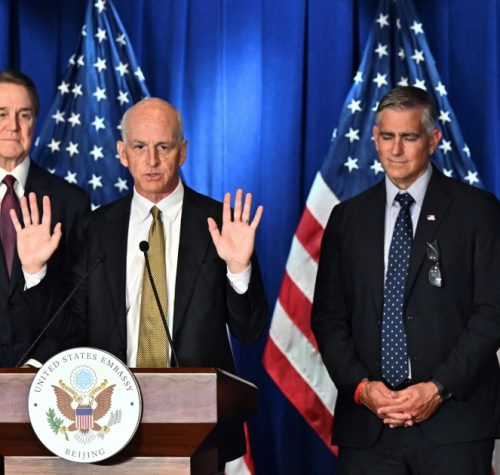
Sept. 23, 2025, 1:03 AM EDTBy Janis Mackey Frayer and Jennifer JettBEIJING — Washington and Beijing will have to communicate better if they are to resolve their various disagreements — and if they don’t talk, it could be “dangerous,” a U.S. lawmaker said Tuesday during a rare congressional visit to China.This is the first delegation of House lawmakers to visit China since 2019; a group of U.S. senators visited Beijing in 2023. Their trip comes amid tensions between the United States and China over trade, technology and wars in the Middle East and Ukraine.Rep. Adam Smith, D-Wash., the leader of the bipartisan delegation, said that they held “robust and very helpful” meetings with Chinese officials and that the objective of the trip was to reopen lines of communication between “the two most powerful countries in the world.”“Our relationship is going to be the most consequential relationship in terms of what the world is going to be like for decades to come,” Smith told reporters at the U.S. Embassy in Beijing. “It is really important that we work to strengthen that relationship and better understand each other.”The military relationship between the United States and China is of particular concern, he said. The congressional delegation arrived weeks after Beijing showed off its military might and advanced weaponry in a highly choreographed parade.“China is the most rapidly growing military and the most rapidly growing nuclear power in the world. The U.S. has the biggest military in the world and the biggest nuclear arsenal,” Smith said. “It is dangerous for us not to be having regular communications about our capabilities and intentions.”President Donald Trump and Chinese leader Xi Jinping spoke Friday in their first phone call since June. Trump said that they agreed during the call to meet on the sidelines of the Oct. 31-Nov. 1 APEC Summit in South Korea and that he would visit China early next year. David Perdue, the new U.S. ambassador to China, said the two leaders had a “great call” and were “looking forward to getting together.” “I would say that the relationship between President Xi and President Trump is actually very good and very encouraging right now,” he said.The other members of the delegation are Reps. Michael Baumgartner, R-Wash.; Ro Khanna, D-Calif.; and Chrissy Houlahan, D-Pa. They are in China until Thursday.Trump discusses TikTok deal in call with China’s Xi02:47After they arrived Sunday, the lawmakers met with Premier Li Qiang, China’s No. 2 official. On Monday, they met with Vice Premier He Lifeng, who has been leading the Chinese side in trade negotiations with the United States, and Defense Minister Dong Jun.In their meeting with He, the delegation discussed the talks with China, which accounts for the largest U.S. trade deficit, and urged Beijing “to help stem the flow of fentanyl to the U.S. and reduce non-tariff barriers to U.S. companies seeking to do business in China,” according to a congressional readout.The delegation also discussed the future of the video app TikTok, which faces a ban in the United States unless its Chinese parent company sells its U.S. assets to U.S. owners, as well as the issue of critical minerals and the export controls Beijing has sought to impose on them as it leverages its near-monopoly in the industry. In their meeting with Dong, the lawmakers stressed the importance of greater communication between the U.S. and Chinese militaries to avoid miscalculation and conflict. Communications between the militaries were suspended starting in August 2022 after Rep. Nancy Pelosi, D-Calif., the House speaker at the time, angered Beijing by visiting Taiwan, a self-governing island democracy that China claims as its territory. They were restored in November 2023 after a meeting in the United States between Xi and President Joe Biden. The lawmakers visiting China said that the U.S. military presence in the Asia-Pacific “should not be construed as a threat to China,” that they sought a peaceful resolution to the issue of Taiwan and that conflict between the United States and China “should not be inevitable.”Speaking before their meeting, Dong said the visit “shows a good phase in strengthening China-U.S. communications, and I believe it is the right thing to do.”Janis Mackey Frayer reported from Beijing and Jennifer Jett from Hong Kong.Janis Mackey FrayerJanis Mackey Frayer is a Beijing-based correspondent for NBC News.Jennifer JettJennifer Jett is the Asia Digital Editor for NBC News, based in Hong Kong.

BEIJING — Washington and Beijing will have to communicate better if they are to resolve their various disagreements — and if they don’t talk, it could be “dangerous,” a U.S..

TAGS: