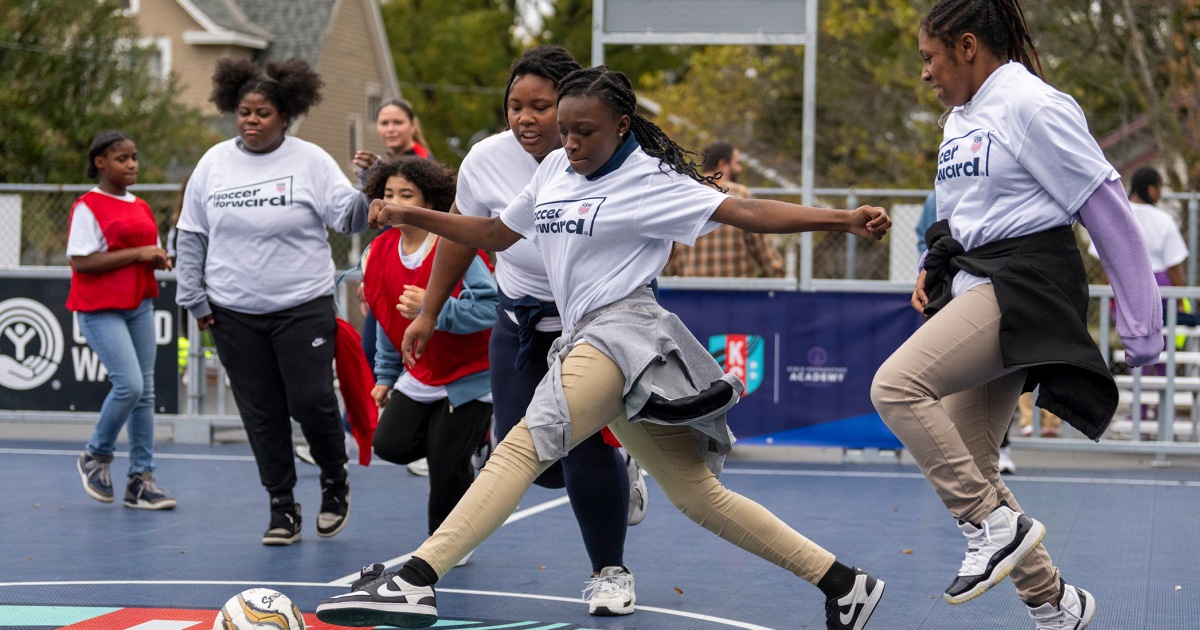
U.S. soccer last week announced the launch of the Kang Institute, a platform focused on addressing disparities that “has left generations of female soccer players training under models built for male physiology.”
Source link
Dec. 13, 2025, 6:54 AM ESTBy Doha MadaniWith women’s soccer on track to become one of the world’s top five sports, U.S. Soccer is committing a $30 million donation from billionaire Michele Kang to researching some of the major issues facing female athletes. The national federation announced earlier this month the launch of the Kang Institute, a platform focused on addressing disparities that “has left generations of female soccer players training under models built for male physiology.” It’s an underfunded area of research that leaves women in sport more susceptible to different injuries as well as keeping young girls from pursuing the sport, Georgie Brunvels, female health and research innovation lead with U.S. Soccer, told NBC News. “Football is a global game,” Brunvels said. “By people seeing what is happening in football —or soccer — I think it will trickle on a global level to making people stand up and pay attention and listen.” Kang’s donation will advance work that was already taking place at the Soccer Forward Foundation, which focused on community-level work aimed on inclusion and expanding access to the sport. It will take on three forms: dedicated research, a creation of best practices based on that research, and education from the youth level all the way to the national team. And that may not just be in the United States. There are already discussions on initiatives to make it more accessible globally before the 2027 FIFA Women’s World Cup in Brazil and when the U.S. hosts the tournament in 2031. “The [Women’s National Team] is an absolute icon and pioneer and leader in the space of soccer,” Soccer Forward Foundation Executive Director Lex Chalat said. “And we want to support other countries in developing their best practices and developing and understanding how to raise the bar in their country as well.” The institute’s first study will focus on the needs of players by targeting research around injury prevention, mental health, workload management, menstrual health, and the transition from youth to elite competition. Kang Institute aiming to lower injury rate for female athletesInjury prevention and recovery is an area that’s been a hot topic in women’s soccer, as research shows female players are two to eight times more likely to tear their ACLs than men. These are devastating injuries that can require surgery and nearly a year of recovery time. USWNT defender Tierna Davidson tore her ACL in March during a National Women’s Soccer League game and missed the rest of the season. It was her second ACL tear in three years. A number of factors have been correlated to the issue including the difference in women having looser knee ligament, their menstrual cycle, and wearing cleats designed around men’s physiology. “We don’t have access to big data pools to really understand more,” Brunvels said. “Someone tears their ACL and the moment that happens, someone will say, ‘Were you on your period?’ It’s like the no-brainer question, but no one’s pulling that data together.” But while these knee injuries often get the most coverage, and now investment, they are just one of the many injuries female athletes suffer at a higher rate than men, according to Brunvels. Concussions and ankle injuries are prevalent, too, she said.Brunvels also cited pregnancy, another physical condition that poses challenges for women, as an underfunded area of research. USWNT stars Sophia Wilson and Mallory Swanson, two thirds of the “Triple Espresso” goal-scoring sensation during the gold-medal winning run at the Olympics, both gave birth this year. “We’ve got seven players within our Women’s National Team ecosystem who are either pregnant or returning to play postpartum,” Brunvels said. “That’s an injury. It’s a planned injury we don’t talk about that doesn’t get enough air time.” More from SportsThe medical professionals guiding your fantasy football teamsNASCAR settles federal antitrust case filed by 2 of its teams, one owned by NBA great Michael JordanNotre Dame calls relationship with ACC ‘strained’ after College Football Playoff snubMental health a major concern in women’s sportsMental health is another area being targeted by the Kang Institute in its first study. Chalat says it’s an “absolute priority” for the federation, especially when it comes to the next generation of female athletes.“There are two kinds of major research projects … (the first is a) foundational research piece connecting health and performance,” Chalat said. “The other project is really focusing on girls soccer dropout rates, particularly at that middle school age.” Girls from City of Los Angeles Department of Recreation and Parks, and Football for Her attend the U.S. Soccer / Soccer Forward Community Spotlight on April 03, in Wilmington, Calif.Joe Scarnici / Getty Images for USSFAccording to a study by the Aspen Institute, one in three girls participates in a sport from age 6-12, but nearly one in two quit during puberty. Chalat says the Soccer Forward Foundation’s work has shown that girls drop out because they feel like they don’t belong or have negative experiences with their coaches. “We know that a lot of young people’s first point of contact around sharing that they feel that they might have a mental health issue and not even know it is their coach,” Chalat said. “And as a result, we’re working across the board on a variety of issues that focuses on mental health — one of them being really focused on coaching, education and coaching in communities.” Research has suggested that 60% of female athletes have experienced some form of body shaming and are two times more likely to experience depressive symptoms and eating disorders when compared to their male counterparts.Angel City FC forward Sydney Leroux, who has had more than 70 appearances with the national team, posted on Instagram last month that she’d been diagnosed with anorexia. The revelation came more than eight months after she announced she was taking a break from her NWSL team to focus on her mental health. Leroux said it’s not a coping skill but an important issue that she wanted to open a discussion on. “I have been living with that for as long as I could remember,” Leroux told followers. “I didn’t think it was a problem. I just thought that that was the way my body reacted to the pressure I put on it, or being anxious or not being able to do it all.” For Brunvels, allowing girls and women to understand their bodies better creates empowerment through the arc of their lives both on and off the pitch. But they have to be “supported and trained as females, not as small males.” “They can understand more about their bodies, what they can do to help themselves,” Brunvels said. “And as a part of that, we want to keep girls in sport for longer. We want to keep girls in soccer.” Doha MadaniDoha Madani is a senior breaking news reporter for NBC News. Pronouns: she/her.