• Police seek suspects in deadly birthday party shooting
  • Lawmakers launch inquires into U.S. boat strike
  • Nov. 29, 2025, 10:07 PM EST / Updated Nov. 30, 2025,…
  • Mark Kelly says troops ‘can tell’ what orders…

Be that!

contact@bethat.ne.com


Be That ! Menu   ≡ ╳
  • Home
  • Travel
  • Culture
  • Lifestyle
  • Sport
  • Contact Us
  • Politics Politics
☰

Be that!

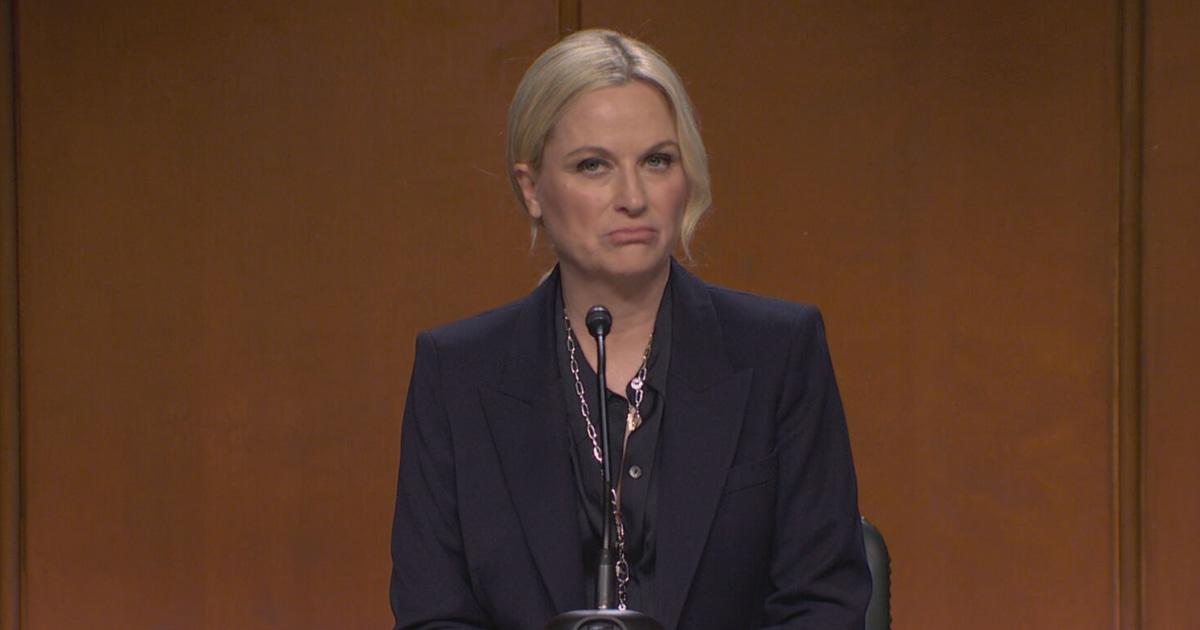
Oct. 12, 2025, 1:54 AM EDTBy Phil HelselPam Bondi vs. the Senate: Round Two. That was the scenario envisaged by “Saturday Night Live” on Saturday, with alum Amy Poehler portraying the attorney general in a follow-up to her combative hearing with Democrats this week.Asked how President Donald Trump could justify deploying National Guard troops against Americans, Poehler’s Bondi was confrontational.”Before I don’t answer, I’d like to insult you personally,” Poehler’s Bondi responded.Fellow former cast member Tina Fey made a surprise appearance as Homeland Security Secretary Kristi Noem, toting an assault-style rifle and making a pitch for applicants to become Immigration and Customs Enforcement officers that included questions like, “Do you need a job now?” and “Do you take supplements that you bought at a gas station?””Then buckle up and slap on some Oakleys, big boy: Welcome to ICE,” Fey’s Noem said.Poehler, a seven-year “SNL” cast member who left in 2008 to go on to “Parks and Recreation” fame, hosted for the third time Saturday.Her appearance came on the 50th anniversary of “Saturday Night Live,” which premiered Oct. 11, 1975.”It’s always a dream come true to be here. I remember watching the show in the ’70s, sitting in my house in Burlington, Massachusetts, thinking: ‘I want to be an actress someday — at least until they invent an AI actress who’s funnier and willing to do full-frontal,'” Poehler said in her monologue.She also had a message of hope for those who may feel overwhelmed. “If there’s a place that feels like home, that you can go back to and laugh with your friends, consider yourself lucky — and I do,” she said.And she had the last laugh against her imagined AI doppelgänger. “And to that little AI robot watching TV right now who wants to be on this stage someday, I say to you: Beep, boop, beep, boop beep beep,” Poehler said. “Which translates to: You’ll never be able to write a joke, you stupid robot! And I am willing to do full-frontal, but nobody’s asked me, OK?”Another skit had a cameo by Aubrey Plaza, a former intern and guest host on “SNL” who also starred on “Parks and Recreation.”In a parody of Netflix’s “The Hunting Wives” — introduced as “the straight but lesbian horny Republican murder drama” — Plaza played “a new new girl” who joined the group. After a sexually charged lesson in how to make a mimosa, Plaza revealed she had a girlfriend, prompting the other women to shout, “lesbian!” and immediately pull their guns on her.The reunion did not end there. A “Weekend Update” anchor trio of Seth Meyers, Fey and Poehler, who have all been behind the desk, joined current hosts Colin Jost and Michael Che for a quiz show-style battle.Role Model was Saturday’s musical guest. His performance of “Sally, When The Wine Runs Out” featured an appearance by Charli XCX. At the end of the episode, “SNL” paid tribute to Oscar-winning actor Diane Keaton, showing a portrait. Keaton died at the age of 79, her daughter said earlier Saturday.Sabrina Carpenter, who recently released the album “Man’s Best Friend,” is the host and musical guest of next week’s episode. “SNL” airs on NBC, a division of NBCUniversal, which is also the parent company of NBC News.Phil HelselPhil Helsel is a reporter for NBC News.

admin - Latest News - October 12, 2025
admin
24 views 5 secs 0 Comments


Pam Bondi vs. the Senate: Round Two.


Source link

TAGS:
PREVIOUS
Oct. 11, 2025, 7:00 AM EDTBy Aria BendixIt started with an unsubstantiated warning that taking Tylenol during pregnancy could raise a child’s risk of autism. But the message from President Donald Trump and Health Secretary Robert F. Kennedy Jr. seems to have quickly expanded to suggest that babies and young children should avoid the common painkiller.“Don’t give it to the baby when the baby’s born,” Trump said of Tylenol at a Cabinet meeting on Thursday.Kennedy jumped in to suggest that children who are circumcised have higher autism rates, “likely because they’re given Tylenol.”As the administration’s stance on the medication has broadened over the last few weeks, researchers say the notion that young children may develop autism as a result of taking Tylenol is particularly far-fetched.“There’s even less evidence that there’s a link between Tylenol in early childhood and autism than there is that Tylenol taken during pregnancy causes autism,” said David Mandell, a psychiatry professor at the University of Pennsylvania.The bulk of scientific evidence suggests moderate Tylenol use is safe in pregnancy, and many autism researchers say data does not support a causal link to autism. When it comes to young children, the American Academy of Pediatrics says Tylenol is safe when taken correctly under the guidance of a pediatrician. The medication shouldn’t be given to children younger than 12 weeks, the group says, unless a doctor recommends it, since Tylenol can mask fevers or early signs of sepsis, which require immediate medical attention.Packages of Tylenol and generic pain and fever relief medicine for sale on a shelf in a pharmacy in Houston on Sept. 23.Ronaldo Schemidt / AFP – Getty Images fileTrump and Kennedy’s first announcement about Tylenol and autism came on Sept. 22, when they unveiled regulatory actions to limit the medication’s use in pregnancy. Though Trump warned pregnant women to “fight like hell not to take it,” the actual policy changes were more subdued. The Food and Drug Administration issued a letter asking physicians to “consider minimizing the use of acetaminophen during pregnancy for routine low-grade fevers.” (Acetaminophen is the active ingredient in Tylenol.)The FDA acknowledged, however, that Tylenol is the safest over-the-counter pain reliever in pregnancy and that “a causal relationship has not been established” with autism.The agency made no mention of risks to children. Nevertheless, both Kennedy and Trump have repeated such warnings on several occasions — a significant leap from the FDA messaging.In a post on Truth Social two weeks ago, Trump wrote that young children should not take Tylenol “for virtually any reason.”Kennedy, meanwhile, doubled down on his statement about circumcision in a post on X on Friday, saying that “the observed autism correlation in circumcised boys is best explained by acetaminophen exposure.”Dr. Joshua Gordon, chair of the psychiatry department at Columbia University, said the snowballing warnings about Tylenol represent a common tactic among those looking to attribute autism to vaccines or medications.“Robert F. Kennedy and his colleagues will start with asking one question, and when the scientific community answers that question, they’ll tweak the question slightly to prolong, if you will, the debate on the topic,” Gordon said.He pointed to the way the anti-vaccine community first raised concerns about the measles, mumps and rubella vaccine in connection to autism, then pivoted to focus on a mercury-based preservative in vaccines and on the cumulative amount of vaccines administered in childhood. (Each of these concerns has been debunked.)“No amount of scientific evidence can ever be conclusive for this community,” Gordon said. “The debate is like a hydra. You cut off one head and they’re just going to try to emerge with another.”The Department of Health and Human Services did not respond to a request for comment.White House spokesperson Kush Desai said that “the President is right to express his commonsense opinion that Americans should use caution with all medications and adhere to FDA guidance, including the longstanding guidance regarding appropriate use and dosage of acetaminophen in young children.”A spokesperson for Kenvue, the maker of Tylenol, said the medication is “one of the most widely studied pain relievers and fever reducers in infants and children, and numerous randomized, controlled clinical trials support the safety of acetaminophen in infants and children when used as directed.”The spokesperson added that “independent, sound science clearly shows that taking acetaminophen does not cause autism.”Mandell said claims that Tylenol increases autism rates in babies and toddlers are based on low-quality studies that don’t prove causation.He pointed to a small study that found younger children with autism were significantly more likely to take acetaminophen for a fever compared to children without the disorder. Mandell said the study had limitations: Parents had to recall how often they gave their children acetaminophen, and children with autism are more prone to discomfort, which may lead their parents to give acetaminophen more frequently.One scientist in particular, immunologist William Parker, has fueled the theory that autism can be attributed to acetaminophen use in babies and young children. In his post on X, Kennedy cited a paper by Parker that says there is “overwhelming evidence” that acetaminophen triggers autism. But the paper hasn’t been peer-reviewed or published in a scientific journal.Kennedy also mentioned a Danish study from 2015 that concluded that boys who are circumcised may have a greater risk of developing autism. But the study authors said they couldn’t attribute the purported effect to Tylenol.Dr. Sian Jones-Jobst, a pediatrician and the president of Complete Children’s Health, a pediatric network in Lincoln, Nebraska, said very few pediatricians administer Tylenol for circumcisions; instead, the common practice is injecting a numbing medication.She added that in other situations, Tylenol is a useful tool to reduce fever or pain.“You shouldn’t let your child suffer if they’re obviously uncomfortable,” Jones-Jobst said.Aria BendixAria Bendix is the breaking health reporter for NBC News Digital.
NEXT
Oct. 12, 2025, 6:30 AM EDTBy Jared PerloOpenAI’s new text-to-video app, Sora, was supposed to be a social AI playground, allowing users to create imaginative AI videos of themselves, friends and celebrities while building off of others’ ideas.The social structure of the app, which allows users to adjust the availability of their likeness in others’ videos, seemed to address the most pressing questions of consent around AI-generated video when it was launched last week. But as Sora sits atop the iOS App Store with over 1 million downloads, experts worry about its potential to deluge the internet with historical misinformation and deepfakes of deceased historical figures who cannot consent to or opt out of Sora’s AI models.In less than a minute, the app can generate short videos of deceased celebrities in situations they were never in: Aretha Franklin making soy candles, Carrie Fisher trying to balance on a slackline, Nat King Cole ice skating in Havana and Marilyn Monroe teaching Vietnamese to schoolchildren, for instance.That’s a nightmare for people like Adam Streisand, an attorney who has represented several celebrity estates, including Monroe’s at one point.“The challenge with AI is not the law,” Streisand said in an email, pointing out that California’s courts have long protected celebrities “from AI-like reproductions of their images or voices.”“The question is whether a non-AI judicial process that depends on human beings will ever be able to play an almost 5th dimensional game of whack-a-mole.”Videos on Sora range from the absurd to the delightful to the confusing. Aside from celebrities, many videos on Sora show convincing deepfakes of manipulated historical moments. For example, NBC News was able to generate realistic videos of President Dwight Eisenhower confessing to accepting millions of dollars in bribes, U.K. Prime Minister Margaret Thatcher arguing that the “so-called D-Day landings” were overblown, and President John F. Kennedy announcing that the moon landing was “not a triumph of science but a fabrication.”The ability to generate such deepfakes of nonconsenting deceased individuals has already caused complaints from family members.In an Instagram story posted Monday about Sora videos featuring Robin Williams, who died in 2014, Williams’ daughter Zelda wrote: “If you’ve got any decency, just stop doing this to him and to me, to everyone even, full stop. It’s dumb, it’s a waste of time and energy, and believe me, it’s NOT what he’d want.”Bernice King, Martin Luther King Jr.’s daughter, wrote on X: “I concur concerning my father. Please stop.” King’s famous “I have a dream” speech has been continuously manipulated and remixed on the app. George Carlin’s daughter said in a BlueSky post that his family was “doing our best to combat” deepfakes of the late comedian.Sora-generated videos depicting “horrific violence” involving renowned physicist Stephen Hawking have also surged in popularity this week, with many examples circulating on X.A spokesperson for OpenAI told NBC News: “While there are strong free speech interests in depicting historical figures, we believe that public figures and their families should ultimately have control over how their likeness is used. For public figures who are recently deceased, authorized representatives or owners of their estate can request that their likeness not be used in Sora cameos.”In a blog post from last Friday, OpenAI CEO Sam Altman wrote that the company would soon “give rightsholders more granular control over generation of characters,” referring to wider types of content. “We are hearing from a lot of rightsholders who are very excited for this new kind of ‘interactive fan fiction’ and think this new kind of engagement will accrue a lot of value to them, but want the ability to specify how their characters can be used (including not at all).”OpenAI’s quickly evolving policies for Sora have led some commentators to argue the company’s move fast and break things approach was purposeful, showing users and intellectual-property holders the app’s power and reach.Liam Mayes, a lecturer at Rice University’s program in media studies, thinks increasingly realistic deepfakes could have two key societal effects. First, he said, “we’ll find trusting people falling victim to all kinds of scams, big, powerful companies exerting coercive pressures and nefarious actors undermining democratic processes,” Mayes said.At the same time, being unable to discern deepfakes from real video might reduce trust in genuine media. “We might see trust in all sorts of media establishments and institutions erode,” Mayes said.As founder and chairman of CMG Worldwide, Mark Roesler has managed the intellectual property and licensing rights for over 3,000 deceased entertainment, sports, historical and music personalities like James Dean, Neil Armstrong and Albert Einstein. Roesler said that Sora is just the latest technology to raise concerns about protecting figures’ legacies.“There is and will be abuse as there has always been with celebrities and their valuable intellectual property,” he wrote in an email. “When we began representing deceased personalities in 1981, the internet was not even in existence.”“New technology and innovation help keep the legacies of many historical, iconic personalities alive, who shaped and influenced our history,” Roesler added, saying that CMG will continue to represent its clients’ interests within AI applications like Sora.To differentiate between a real and Sora-generated video, OpenAI implemented several tools to help users and digital platforms identify Sora-created content.Each video includes invisible signals, a visible watermark and metadata — behind-the-scenes technical information that describes the content as AI-generated.Yet several of these layers are easily removable, said Sid Srinivasan, a computer scientist at Harvard University. “Visible watermarks and metadata will deter casual misuse through some friction, but they are easy enough to remove and won’t stop more determined actors.”Srinivasan said an invisible watermark and an associated detection tool would likely be the most reliable approach. “Ultimately, video-hosting platforms will likely need access to detection tools like this, and there’s no clear timeline for wider access to such internal tools.”Wenting Zheng, an assistant professor of computer science at Carnegie Mellon University, echoed that view, saying: “To automatically detect AI-generated materials on social media posts, it would be beneficial for OpenAI to share their tool for tracing images, audio and videos with the platforms to assist people in identifying AI-generated content.”When asked for specifics about whether OpenAI had shared these detection tools with other platforms like Meta or X, a spokesperson from OpenAI referred NBC News to a general technical report. The report does not provide such detailed information.To better identify genuine footage, some companies are resorting to AI to detect AI outputs, according to Ben Colman, CEO and co-founder of Reality Defender, a deepfake-detecting startup.“Human beings — even those trained on the problem, as some of our competitors are — are faulty and wrong, missing the unseeable or unhearable,” Colman said.At Reality Defender, “AI is used to detect AI,” Colman told NBC News. AI-generated “videos may get more realistic to you and I, but AI can see and hear things that we cannot.”Similarly, McAfee’s Scam Detector software “listens to a video’s audio for AI fingerprints and analyzes it to determine whether the content is authentic or AI-generated,” according to Steve Grobman, chief technology officer at McAfee.However, Grobman added, “new tools are making fake video and audio look more real all the time, and 1 in 5 people told us they or someone they know has already fallen victim to a deepfake scam.”The quality of deepfakes also differs among languages, as current AI tools in commonly used languages like English, Spanish or Mandarin are vastly more capable than tools in less commonly used languages.“We are regularly evolving the technology as new AI tools come out, and expanding beyond English so more languages and contexts are covered,” Grobman said.Concerns about deepfakes have made headlines before. Less than a year ago, many observers predicted that the 2024 elections would be overrun with deepfakes. This largely turned out not to be true.Until this year, however, AI-generated media, like images, audio and video, has largely been distinguishable from real content. Many commentators have found models released in 2025 to be particularly lifelike, threatening the public’s ability to discern real, human-created information from AI-generated content.Google’s Veo 3 video-generation model, released in May, was called “terrifyingly accurate” and “dangerously lifelike” at the time, inspiring one reviewer to ask, “Are we doomed?”Jared PerloJared Perlo is a writer and reporter at NBC News covering AI. He is currently supported by the Tarbell Center for AI Journalism.
Related Post
November 8, 2025
Savewith a NBCUniversal ProfileCreate your free profile or log in to save this articleBy Tom Costello and Phil HelselUPS has grounded its fleet of McDonnell Douglas MD-11’s, the type of plane involved in Tuesday’s deadly crash in Louisville, Kentucky, two sources familiar with the situation told NBC News Friday.UPS did not immediately respond to a request for comment. A photo seen by NBC news showed a screen in a plane that directed pilots to return and which read: “Per UPS MD11 are not to depart effective immediately.” At least 14 people have died in the crash, officials said. The UPS flight, headed from Louisville to Honolulu, crashed around 5:15 p.m. as it was taking off and struck an industrial area near the airport, causing a huge fire and killing the three crew in the plane and others on the ground.A UPS MD-11 cargo plane sits idle on the tarmac on Wednesday at Muhammad Ali International Airport in Louisville, Ky.Michael Swensen / Getty ImagesVideo shows that the left engine of the plane caught fire during takeoff and immediately detached, National Transportation Safety Board member Todd Inman said Wednesday.The NTSB is the lead agency in the investigation.On Friday night, Mayor Craig Greenberg said that the remains of a 14th victim had been found at the crash site.”We pray for each of the victims’ families, and pray that no additional victims were lost as our first responders continue to search and seek answers,” Greenberg said in a video.UPS is the largest employer in the Louisville metro area, with around 25,000 workers. The airport where the disaster happened, Louisville Muhammad Ali International Airport, is a main hub for the company’s global air network.Tom CostelloTom Costello is an NBC News correspondent based in Washington, D.C.  Phil HelselPhil Helsel is a reporter for NBC News.
September 25, 2025
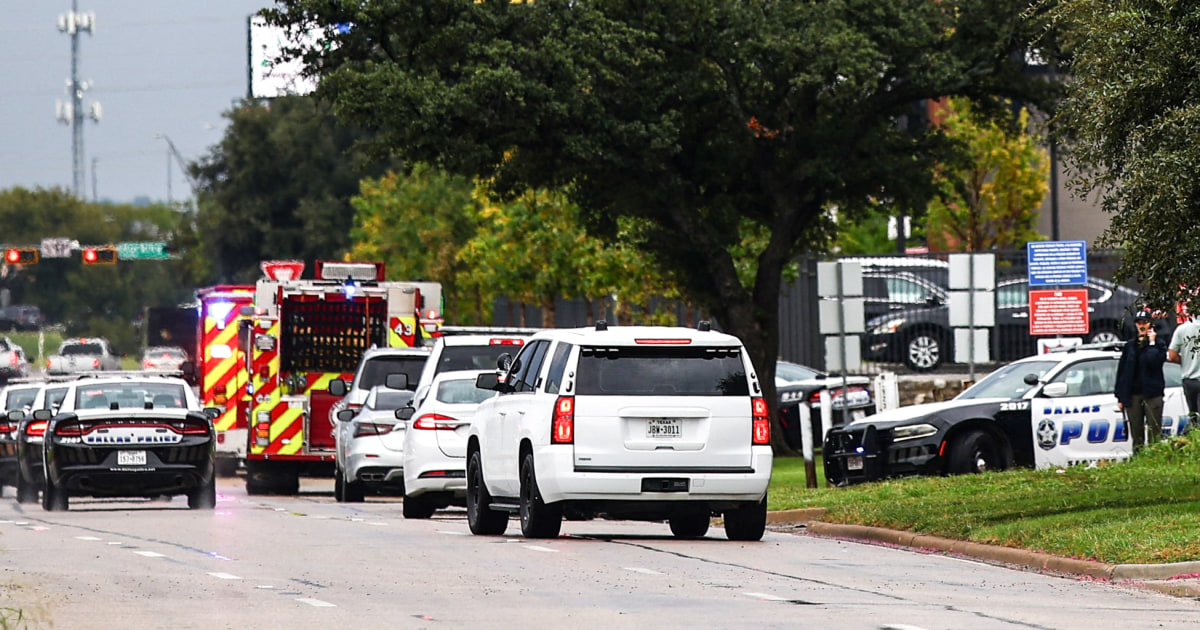
Sept. 24, 2025, 7:57 PM EDTBy Rich Schapiro, Chloe Atkins and Erik OrtizA 29-year-old Texas man opened fire on an Immigration and Customs Enforcement facility in Dallas on Wednesday, the second instance in two weeks of a gunman setting up with a rifle on a rooftop, opening fire and communicating a message through writing on bullets.Authorities identified the shooter as Joshua Jahn. He was found dead with a self-inflicted gunshot wound. Vice President JD Vance said evidence that is “not yet public” indicates the shooter was “politically motivated” to go after law enforcement and people enforcing the border.Vance called Jahn “a violent left-wing extremist.” Authorities have yet to release an official motive. The FBI special agent in charge in Dallas, Joe Rothrock, said the attack was “targeted violence.”Three detainees in a van in the facility’s sally port were shot. No ICE officers were hurt in the shooting, Dallas police said at a news conference.A bullet found near the shooter had the words “anti-ICE” written on it, according to the FBI. Other recent shooters, including those who assassinated Charlie Kirk and killed UnitedHealthcare CEO Brian Thompson, have also engraved messages on bullets.The anti-ICE messaging surprised Joshua Jahn’s brother, Noah Jahn.“He didn’t have strong feelings about ICE as far as I knew,” Noah Jahn said of his brother, who DHS officials said fired at the ICE building “indiscriminately.”Public records show that Joshua Jahn registered as an independent in Oklahoma and last voted in November.In 2016, he was charged in Texas with delivering marijuana in an amount greater than ¼-ounce but less than 5 pounds. He pleaded guilty to the felony charge, records show.Noah Jahn described his brother as “unique” but said he was not one he ever would have thought would be involved in a politically motivated shooting.“I didn’t think he was politically interested,” he said. “He wasn’t interested in politics on either side as far as I knew.”He said they grew up about 30 miles away in Allen, Texas. He said that they were Boy Scouts and that his brother took an interest in coding but was unemployed. Joshua Jahn had been planning to move onto their parents’ property in Oklahoma, his brother said.Noah Jahn said that the last time he saw his brother was two weeks ago at their parents’ house and that nothing seemed out of the ordinary.A man who said he had known Joshua Jahn since his early teens as a member of the same Boy Scout troop in Texas said Jahn did voice his opinions about politics, and he recalled a conversation several years ago about migrant caravans entering the United States.“He was just upset about how people were not understanding people’s desperation to get out of bad situations and how immigration was being handled as a whole,” the troop member said.The troop member, who asked not to be named for fear of harassment, said that the shooter was “passionate” about his stance on issues but that he did not know him to be “the action type of person.” The troop member was surprised that Jahn had been identified as the shooter.“He was pretty against it,” the fellow troop member said of the notion of gun violence, “so that’s why this is making it even more surprising. He was not somebody that would condone those kind of actions.”The troop member said he remained friends with him as an adult but lost touch about five years ago when Jahn said he was planning to move to Oklahoma. He said the shooter’s father was an active troop leader. He said Jahn had helped him move a couple of times.“He was one of those people that I would call for help, just in different situations, whether it be emotional support or physical support,” the troop member said.According to Noah Jahn, his brother was “not a marksman” but knew how to use their parents’ rifle. Noah said he did not think his brother would have been able to fire accurately from a nearby roof.Rich Schapiro Rich Schapiro is a reporter with the NBC News national security unit.Chloe AtkinsChloe Atkins reports for the NBC News National Security and Law Unit, based in New York.Erik OrtizErik Ortiz is a senior reporter for NBC News Digital focusing on racial injustice and social inequality.Minyvonne Burke contributed.
October 15, 2025
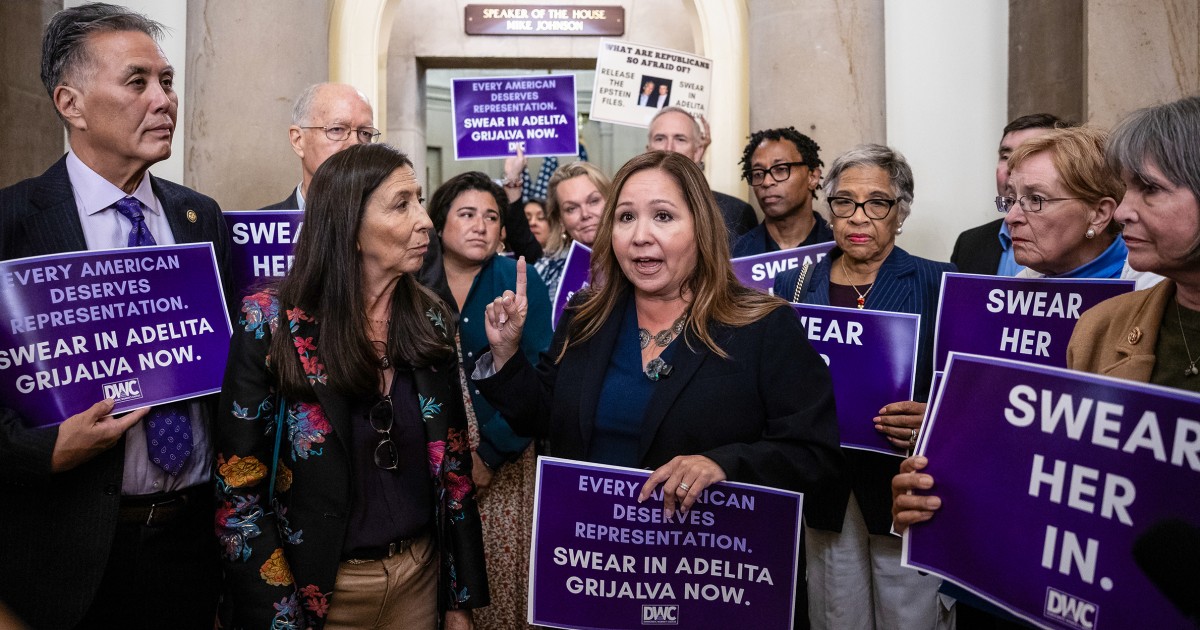
Savewith a NBCUniversal ProfileCreate your free profile or log in to save this articleOct. 15, 2025, 2:11 PM EDTBy Scott Wong, Gabrielle Khoriaty and Kyle StewartWASHINGTON — Democrats are ramping up pressure on House Speaker Mike Johnson to seat Rep.-elect Adelita Grijalva, staging a protest at his office, holding news conferences and threatening a lawsuit to try to get him to swear in the newest Democratic member of Congress.Grijalva won the Arizona House seat of her father, the late progressive leader Rep. Raul Grijalva, in a Sept. 23 special election. But the House has not been in session since her election as part of the stalemate over the government shutdown.While Grijalva has been in and around the Capitol complex waiting to take the oath, Johnson, R-La., has said for the past two weeks he won’t swear her in until the government reopens.House Dems march to demand Johnson swear in Grijalva00:56Once she is seated, Grijalva would bring the House to 219 Republicans and 214 Democrats. She is also expected to be the final signature needed to force a House vote to release the Justice Department’s Jeffrey Epstein files.Now, Democrats are trying new, more aggressive tactics to force Johnson to reverse course.On Tuesday night, Grijalva and members of the Democratic Women’s Caucus marched to Johnson’s office, chanting “Swear her in!” A U.S. Capitol Police officer briefly tried to stop lawmakers and could be seen on video getting into a short verbal altercation with Rep. Nanette Barragán, D-Calif. She claimed that the officer grabbed her, but a video only shows her pushing past an officer into the speaker’s foyer. Capitol Police did not immediately respond to a request for comment.In remarks outside Johnson’s office, Grijalva said she has heard “not one word” from the speaker.“I am a woman of color from Arizona, and 700,000 people deserve to have their voice heard, …” Grijlava said. “Let’s just be really clear, if I were a Republican, I would have already been sworn, and that is not acceptable. They’re afraid of me signing and being the 218th signer to the Epstein petition.”Johnson was not in the Capitol during the protest. But Arizona’s two Democratic senators — Ruben Gallego and Mark Kelly — verbally sparred with Johnson in the same spot just last week over his refusal to immediately seat Grijalva.Tuesday night’s protest came on the same day that top Arizona state officials certified the results of Grijalva’s election victory. And on Tuesday, Arizona Attorney General Kris Mayes, a Democrat, sent a letter to Johnson threatening to sue if he did not seat Grijalva or set a date to do so.“Failing to seat Ms. Grijalva immediately or to otherwise provide a reasonable explanation as to when she will be seated will prompt legal action,” Mayes wrote.She added: “You and your staff have provided ever-shifting, unsatisfactory, and sometimes absurd stories as to why Ms. Grijalva has not been sworn in. In a particularly worrisome comment, an aide connected the swearing-in and admission to the ongoing budget fight, suggesting that the House is trying to use Arizona’s constitutional right to representation in the House as a bargaining chip.”When asked about Mayes’ letter, Johnson said in a short statement, “The House will follow customary practice by swearing in Rep-elect Grijalva when the House is in legislative session.”Speaking to reporters Wednesday, Johnson accused Democrats of “playing political games” and disrespecting police by protesting at his office. “They stormed my office. Maybe you saw some of the video online that they themselves shared. … They berated a Capitol Police officer, screamed at him. He was just merely standing his post. It shows, again, their disdain for law enforcement, as we see all around the country … and it shows their desperation.”House Minority Leader Hakeem Jeffries, D-N.Y., Grijalva and other Democrats have pointed out that Johnson, in April, swore in two Florida Republicans — Rep. Jimmy Patronis and Randy Fine — shortly after their special elections, while the House was out of town.Johnson has argued it was because the pair of Floridians had family in Washington at the time, so he did it as a courtesy to accommodate visiting family members. He also told reporters Tuesday he wants to ensure Grijalva has “all the pomp and circumstance” of having a full chamber in session to witness her being sworn in.And the speaker has repeatedly said the delay has nothing to do with the effort to force a vote on the Epstein files.Following the Tuesday protest, Democrats in both the Arizona delegation and the Congressional Hispanic Caucus on Wednesday stood in front of the Capitol and again demanded he administer the oath of office.“I don’t need bells and whistles,” Grijalva said, rejecting the speaker’s explanation. “I don’t need pomp and circumstance. I just need to get to work for southern Arizona.”Kelly, the Arizona senator, noted he and his family live in Grijalva’s district, which extends along the southern border from Yuma to Tucson.“We currently do not have representation in the U.S. House of Representatives,” Kelly said, “and that is wrong.”Scott WongScott Wong is a senior congressional reporter for NBC News. Gabrielle KhoriatyGabrielle Khoriaty is a desk assistant in the NBC News Washington bureau.Kyle StewartKyle Stewart is a producer and off-air reporter covering Congress for NBC News, managing coverage of the House.Frank Thorp V contributed.
November 9, 2025
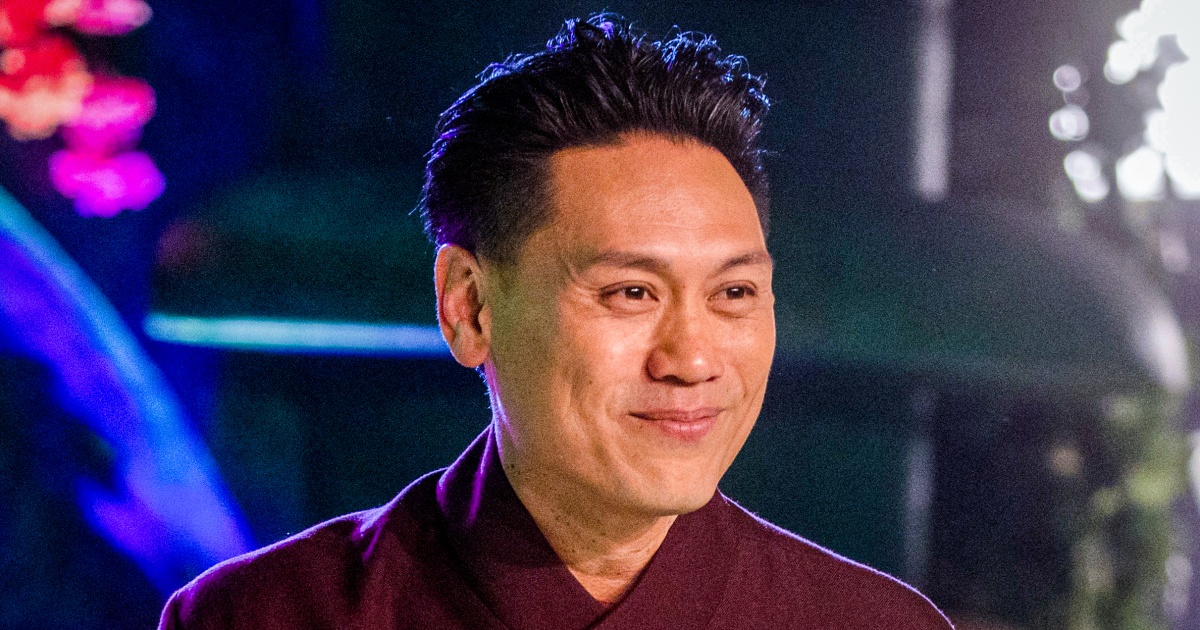
Nov. 9, 2025, 9:00 AM ESTBy Juhi Doshi“Wicked: For Good” director Jon M. Chu has built his career on turning stories about outsiders into celebrations of belonging. But in an interview with “Meet the Press” that aired Sunday, the filmmaker opened up about following his own yellow brick road: one marked by rejection and resilience.“My whole life, I’ve been trying to prove myself, that I can be here, that I can be in this business,” Chu told “Meet the Press” moderator Kristen Welker. “And I think I was always searching for that kind of validation. But through the process of making movies and doing it over — and I had a whole long career before ever doing ‘Wicked’ — I think I got killed many times.”“Wicked: For Good,” the second chapter in his adaptation of the hit Broadway musical, will hit theaters on Nov. 21. It is loosely based on Gregory Maguire’s 1995 novel — a creative reimagining of “The Wizard of Oz.” The new film is produced by Universal Pictures, part of NBCUniversal.“Wicked,” which Chu also directed, is the most profitable Broadway film adaptation of all time and was nominated for 10 Oscars, of which it won two.Chu says he found that lesson of authenticity reflected in his film’s two main characters — Elphaba and Glinda — and in the actors who played them, Cynthia Erivo and Ariana Grande.Glinda, played by Grande, and Elphaba, played by Erivo, form an unlikely friendship, each challenging the other to view life from a new perspective and defy the expectations their world pins onto them.“I learned so much from Elphaba and Glinda and from Cynthia and Ariana,” he said. “I think I’ve gotten to let go of that idea of proving yourself.”When Chu was just 23, fresh out of the University of Southern California’s film school, he landed two movie deals. Both collapsed before production began.“There were days where I was like, ‘Am I a fool?’ … I would go into USC — they asked me to speak at USC, because this is the guy that just came out of college and got his deal … and I sit in the loading dock, and I’m watching all these kids excited about making a movie. And I feel like nothing. I feel like — and I just started to weep. It was probably the first time I cried in 20 years or something at that point. I was like, ‘These people think I’m a complete fake.’”Years later, after gaining experience and completing a variety of film projects such as “Step Up 2” and “Now You See Me 2,” Chu found a story that changed the trajectory of his career and became a watershed moment for Asian American representation on screen: “Crazy Rich Asians.”“‘Crazy Rich Asians’ was great, because it cracked the door open or showed a path for the other people who needed to invest money in this. I’m not sure if it was for us,” he said. “I think it was for everyone else to say, ‘Oh, these actors have value.’”“Crazy Rich Asians” was the first major Hollywood studio film to feature a majority-Asian cast in 25 years and was the highest-grossing romantic comedy of the decade. Chu says he sees his film as an “avenue” for other Asian American filmmakers to share aspects of their own experience: “Let’s own our stories and tell every version of our story we could.”However, Chu said that more representation “takes time.”“I think we have to be careful to expect too big of a change too quickly,” he said. “Of course we want that, but to change culture, it takes time. You cannot force people to do that.”Chu also says he remains deeply committed to the movie theater experience, despite the growth of streaming.“I think movies are one of our last analog spaces. It’s a space that we have to protect,” Chu said. “You have to make a choice to go in. You have to leave your phone … and then you have to just sit back in the dark and watch something for two hours through someone else’s perspective. That is maybe one of the last spaces we have to do that. It is a part of our culture.”And that, he says, is what “Wicked” is all about.“Even though it’s a fantasy, even though it’s a fairy tale, it’s our access into a human experience. What does it feel like when you believe so deeply, when you love so deeply, when you sacrifice everything? That we still have the capacity to do that,” Chu said. “It’s what my parents taught me. It’s what America has taught me.”Juhi DoshiJuhi Doshi is an associate producer with NBC News’ “Meet the Press.”
Comments are closed.
Scroll To Top
  • Home
  • Travel
  • Culture
  • Lifestyle
  • Sport
  • Contact Us
  • Politics
© Copyright 2025 - Be That ! . All Rights Reserved