• Police seek suspects in deadly birthday party shooting
  • Lawmakers launch inquires into U.S. boat strike
  • Nov. 29, 2025, 10:07 PM EST / Updated Nov. 30, 2025,…
  • Mark Kelly says troops ‘can tell’ what orders…

Be that!

contact@bethat.ne.com


Be That ! Menu   ≡ ╳
  • Home
  • Travel
  • Culture
  • Lifestyle
  • Sport
  • Contact Us
  • Politics Politics
☰

Be that!

Oct. 18, 2025, 7:00 AM EDTBy Carlo AngererRIGA, Latvia — They’re dotted on dozens of buildings across the Latvian capital: signal green signs with white stick figures of a family and the word “patvertne,” which means shelter.Installed everywhere from art deco buildings to wooden gates, the signs alert people to places to hide in the event of an attack — and have become one of many symbols of war preparedness in this charming city, which is crisscrossed with canals and looks nervously east at its Russian neighbor.After a string of recent aircraft incursions along NATO’s eastern flank and suspicious drones shutting down airports in several European countries including Germany, Denmark and Norway, fears about Russian aggression are growing in Latvia and its fellow Baltic nations, Estonia and Lithuania, already spooked by Moscow’s war in Ukraine.“We are on the front line. We are the eastern flank countries. We are neighboring Russia, an aggressive country,” Andris Sprūds, Latvia’s defense minister, told NBC News earlier this month at the Riga Conference, a meeting of international political and military leaders.A building marked “patvertne,” the Latvian word for “shelter,” in the capital, Riga.Carlo Angerer / NBC NewsHe added that Latvia, which launched a drone initiative earlier this year, had to some extent “already developed some resilience” in the face of any Kremlin aggression.Other attendees openly talked about a direct conflict between NATO and Russia. In an onstage discussion at the conference, Matthew Whitaker, the U.S. ambassador to the organization, publicly theorized with his fellow panelists about weapons systems, including long-range missiles and strategic bombers, that could be used against the Kremlin’s forces.But he also emphasized that modern warfare begins before troops and military hardware are deployed.“The first shot of the next war is not going to be tanks through the Suwalki Gap,” he said in a separate interview with NBC News, referring to the narrow land bridge between Poland and the Baltic states, seen as a potential attack point in a Russian invasion. “It’s going to be a cyberattack. It’s going to be knocking out airports or critical infrastructure.”Latvia and other Baltic countries have been very receptive to recent NATO initiatives and are on track to reach defense spending targets soon, he said, adding that they were “investing in things that are going to field more capabilities for our defense and deterrence.”Emergency services have identified hundreds of existing shelters in Riga and authorities are planning to build new ones.Carlo Angerer / NBC News“The investments that make each individual ally stronger and therefore the collective alliance stronger are the important investments, and a country like Latvia is certainly doing it best in class right now,” he added.Adm. Rob Bauer, who chaired NATO’s military committee from June 2021 until January, also suggested that a new conflict with Russia would be fought “in a different way.”Ukraine, he said, lacked air power and strong naval assets, adding that NATO fighter jets had been carrying out missions over the Baltics from the USS Gerald Ford after it was deployed to the North Sea earlier this year.Others, like Roberta Metsola, the president of the European Parliament, openly acknowledged that it took “way too long” for other nations to listen to Latvia, Estonia and Lithuania, which were occupied by the Soviet Union for decades and more recently have been at the forefront of pushing NATO allies to take the Russian threat seriously.Airis Rikveilis, the national security adviser to Latvia’s Prime Minister Evika Silina, said his country was not only focusing on increasing military capabilities, but also on preparing civil society for conflict.“This is not going to be 1940,” he said, referring to the first Soviet occupation, when the Red Army was able to take over within weeks. “Should that battle start tomorrow, we’ll be ready to fight tomorrow with what we have,” he added.After Russian President Vladimir Putin launched his invasion of Ukraine in February 2022, there have been visible changes across Latvia, which has installed a fence along its 176-mile border with Russia. It has also cut itself off from the shared power grid with Russia and Kremlin ally Belarus, which sits to Latvia’s south, and is now relying on energy from its other neighbors.Ukrainian flags fly outside the Russian Embassy in Riga, Latvia.Carlo Angerer / NBC NewsIn Riga, officials have demolished the 260-foot victory memorial dedicated to the Soviet army and renamed the road where the Russian Embassy is located to Ukrainian Independence Street.The blue street sign sits at the corner building next to the embassy’s CCTV cameras and under its large flag. Dozens of Ukrainian flags fly in the square just across the road.Linda Ozola, who served as Riga’s deputy mayor for five years until this summer, oversaw the rebuilding of the shelter network, among other civil protection measures. She said her staff had to scout museums and archives for old documents, as well as reinspect old shelter spaces, some of which had fallen into disrepair.Emergency services have identified hundreds of existing shelters, and updated legislation has cleared the way to build new ones. Their locations are available on a website and cellphone app.Some of them will likely be funded by an 85 million euro ($99.4 million) deal signed on the sidelines of the Riga Conference by Arvils Ašeradens, Latvia’s finance minister, and European allies. The majority of that funding will be used to enhance the civil protection infrastructure, and some will also be used to install generators at health care facilities.Ozola said the city has also started to build up a stock of emergency supplies including canned food and sleeping cots. Riga has been an example for the other regions of Latvia and could also be one for cities across Europe, she said.“The truth is not good because we have a crazy neighbor who wants to destroy our country. And the neighbor is not hiding that, really,” she said. “They haven’t physically crossed the border, but they have crossed the airspace and they have cut our critical infrastructure in the Baltic Sea.”Carlo AngererCarlo Angerer is a multimedia producer and reporter based in Mainz, Germany. 

admin - Latest News - October 18, 2025
admin
21 views 17 secs 0 Comments


RIGA, Latvia — They’re dotted on dozens of buildings across the Latvian capital: signal green signs with white stick figures of a family and the word “patvertne,” which means shelter


Source link

TAGS:
PREVIOUS
Oct. 18, 2025, 7:00 AM EDTBy Mustafa FattahAfter a rough, record-setting flu season, doctors and health officials are bracing for another wave of fever, misery and respiratory distress. In the U.K., health officials are warning about an early rise in flu levels among children and young adults. In Japan, health officials recently declared a flu epidemic and closed schools after experiencing an unusually high number of flu cases early in the season. What does that mean for the U.S.? Typically, flu cases start to rise in November, along with RSV (respiratory syncytial virus) and enteroviruses, and peak in February. But job-cut chaos at the Centers for Disease Control and Prevention and the government shutdown could make it hard to know how the virus is playing out this fall, experts worry. The CDC’s last influenza report for the U.S. was for the week ending Sept. 20, when there was minimal activity. Angela Rasmussen, a virologist at the University of Saskatchewan, is concerned about the possibility of limited flu surveillance by the CDC, leaving the U.S. blind to the scale and scope of flu outbreaks.“Everything from outreach campaigns to more logistical efforts to actually get vaccines out” could be affected, Rasmussen said. “That information just may not be available, so it will be very difficult to coordinate a national response,” she said.Last year’s flu was harsh. There were about 1.1 million hospitalizations associated with the flu, the highest rate in 14 years, according to the CDC. And there were the highest number of doctor visits for flu-like illnesses in more than a decade. An estimated 38,000 to 99,000 deaths were associated with the 2024-2025 flu season, according to a preliminary assessment by the CDC. For kids, it was one of the deadliest years on record: 280 children died from flu. At least three of those children died this June and July, far outside of the typical flu season.How bad will the flu be? Flu is notoriously hard to predict, and this year, things are already looking a little different. The CDC predicted at the end of August that this flu season will be more moderate than last year’s. However, there’s the possibility that some age groups could be hit hard, especially if people don’t get their flu shots. The main strains of flu currently circulating are similar to those that caused the severe outbreaks last season: H1N1 and H3N2 for flu A, as well as flu B. “It’s a little early to know which strains will predominate this year for flu season, but certainly there is risk that similar very virulent strains could circulate again this year,” said Dr. George Diaz, a fellow of the Infectious Diseases Society of America, and chief of medicine at Providence Regional Medical Center in Everett, Washington. “This prediction for a moderate season could be off, and it could be another severe flu season,” he said.“We’re still very early in the flu season in North America, and it’s a little hard to know with certainty,” he added. Even if someone got the flu last year, they’ll still be vulnerable to the new version because immunity wanes over time, especially in older people and the immunocompromised, experts say. When is the best time to get the flu shot? The strain is only one factor in how bad it could be this year. Vaccine hesitancy and a weakened public health infrastructure in the U.S. could contribute to flu spread. “It’s going to be largely driven more by social and policy changes than it is going to be driven by virologically related ones,” Rasmussen said.Last flu season, less than half of kids were vaccinated against the flu, a decline of over 20 percentage points from the 2019-2020 season. This year, that trend is expected to continue, said Rasmussen.Dr. William Schaffner, a professor of infectious diseases at Vanderbilt University Medical Center, said that it’s difficult to know how severe it will be this year in the U.S, but that it’s very unusual to have “two ultra-severe seasons back to back.” So, even though the virus hasn’t changed much, getting vaccinated is the best way to protect against the worst of the season.“October is the ideal time to get vaccinated,” he said. “That ought to provide quite reasonable protection throughout what we consider the influenza season, through February and into March.”Mustafa FattahMustafa Fattah is a medical fellow with the NBC News Health and Medical Unit. 
NEXT
Officer pulls woman from a burning car in Texas
Related Post
October 13, 2025
Nor’easter slams East Coast bringing dangerous flooding
October 20, 2025
Trump warns Hamas against violating ceasefire
November 4, 2025
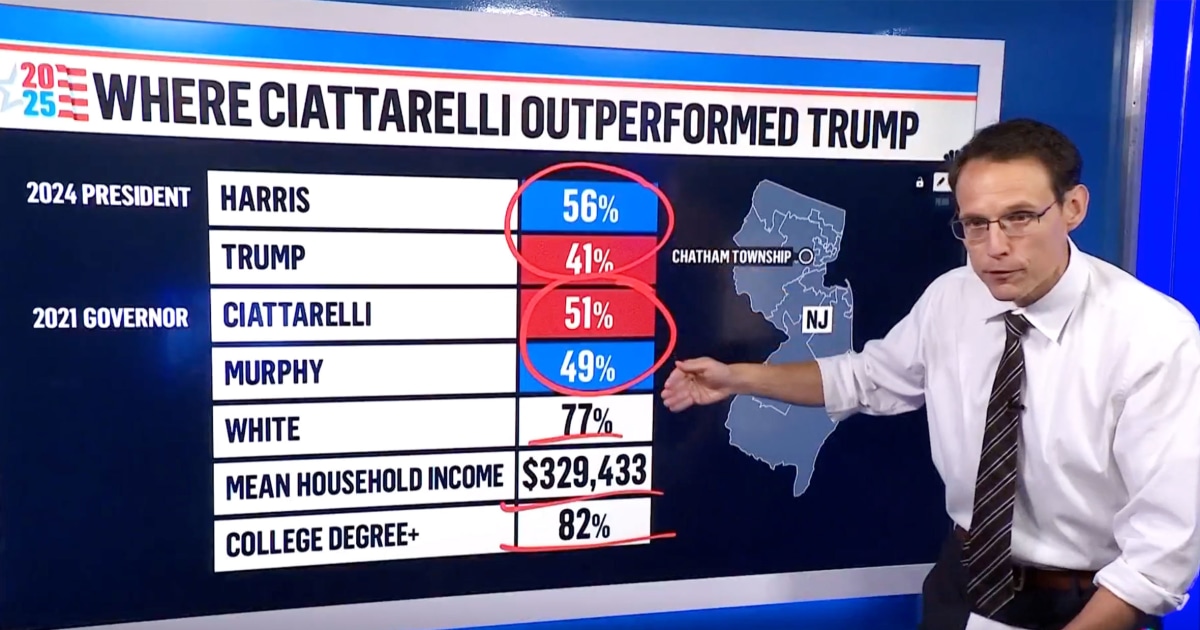
Savewith a NBCUniversal ProfileCreate your free profile or log in to save this articleNov. 4, 2025, 5:00 AM EST / Updated Nov. 4, 2025, 10:33 AM ESTBy Steve KornackiThe Donald Trump era has changed American politics for a decade. On Tuesday night, two contentious races for governor will define what the next steps for Republicans and Democrats might look like — not only who will lead Virginia and New Jersey for four years, but how the two parties are appealing to different types of voters and building coalitions for future elections.Republicans have gained ground in those two blue-leaning states since Trump’s heavy losses there in 2020. Tuesday’s elections will show just how durable those advances were, hinging in part on the progress the Republican Party under Trump made with groups that once voted more strongly against the GOP. That especially includes Latino voters, who banked heavily toward Trump in 2024. But Democrats have spent the last year focused on how to reverse those trends, nominating candidates without baggage from the party’s 2024 election loss. And, of course, Trump is now in the White House, which led to voter backlash against him as the incumbent during his first term.Follow live updates on the 2025 electionTune in to live NBC News election night coverage:NBC News NOW, our free streaming service, will be airing an election special beginning at 7 p.m. ET.NBCNews.com and the NBC News app will feature real-time results of all the major races as well as all the latest reporting.NBC News’ podcast, “Here’s the Scoop,” will be livestreaming on YouTube and NBCNews.com beginning around 11 p.m. ET.NBC News’ Chief Data Analyst Steve Kornacki will be at the big board all night, analyzing results and providing minute-by-minute updates exclusively on the NBC News NOW special and the “Here’s the Scoop” livestream.The two states saw similar results in the last presidential election, but the races have gone differently this year. In Virginia, Democrat Abigail Spanberger enters Election Day with a clear polling lead over Republican Lt. Gov. Winsome Earle-Sears. And in New Jersey, Democrat Mikie Sherrill holds a smaller advantage in most surveys over Republican Jack Ciattarelli. Here are the places and the trends to watch when the votes get tallied Tuesday night.NEW JERSEYBack in 2020, Joe Biden trounced Trump by 17 points in New Jersey. But Republicans have been seeing steady gains since then.In 2021, Ciattarelli came within just three points of unseating Democratic Gov. Phil Murphy. And last year, Trump lost by less than 6 points, the second-largest improvement he posted anywhere in the country. Both results were better performances — in all of the state’s 21 counties — than Trump in 2020. Crucially, the areas where Trump and Ciattarelli made their biggest strides don’t necessarily overlap. They each tapped into different voters in different places. Ciattarelli made some of his biggest gains in suburban areas with above-average median incomes and higher concentrations of college degrees. Meanwhile, Trump’s largest improvements largely came in areas with heavier Hispanic populations.Where Ciattarelli outperformed TrumpSomerset County is an affluent and historically Republican county filled with New York City bedroom communities. But like many suburban areas around the country, its population has diversified — from 75% white at the turn of the century to barely 50% in the most recent census — and its highly educated voters have reacted with hostility to the Trump-led GOP. George W. Bush carried Somerset in 2004, but Democrats have won it in every presidential election since, with Biden’s 21-point romp in 2020 as their high water mark.In 2021, Ciattarelli came within four points of Murphy — a 17-point improvement over that Trump 2020 performance. Trump didn’t give back all of those gains in 2024, but he did lose significant ground from Ciattarelli’s showing, finishing 14 points behind Kamala Harris. (It helped that Ciattarelli once represented parts of Somerset in the state Legislature.)A key question is whether Ciattarelli can at least replicate that 2021 showing. Four years ago, he benefited from the fact that Biden was in the White House. Many anti-Trump voters were willing to put aside their concerns with the national Republican Party. It turned out they had concerns with the Democrats who were running New Jersey, too, and deemed Ciattarelli an acceptable alternative. But with Trump back in power, will it be different?Within Somerset, Bernards Township (population 27,000) is a great example of these dynamics. It has a median household income that’s nearly twice the statewide average. Two-thirds of its population is white, and more than two-thirds of its white adult population have college degrees, far above the statewide level. As recently as 2012, it was still voting Republican at the presidential level, but Trump’s emergence changed that. He lost it by 14 points in 2020 and only improved a smidge in 2024, when Harris bested him by 11. Ciattarelli, on the other hand, won it by 5. Bernards Township is chock full of exactly the kind of voter Ciattarelli needs to hang on to: the avowedly anti-Trump, affluent suburbanite.Where Trump outperformed CiattarelliPassaic County in North Jersey includes the state’s third-largest city, Paterson, along with a number of densely populated middle-class suburbs and a stretch of rural land and wilderness. It is racially and ethnically diverse: a population that’s about 40% Hispanic and white, just under 10% Black and Asian, and notable Orthodox and Arab American pockets. Bill Clinton broke a string of Republican successes in Passaic when he carried it in his 1996 re-election bid and his party then posted double-digit wins until last year, when Trump flipped it. While Ciattarelli also made sizable strides in 2021, he didn’t make the kinds of inroads Trump did in the county’s largest and least white municipalities: Paterson and Passaic city. In Paterson, which is two-thirds Hispanic and less than 10% white, Ciattarelli lost by 71 points in his 2021 campaign, around what the typical margin of defeat for a Republican in the city had long been. But Trump finished only 28 points behind Harris last year. He did this by demonstrating significant new appeal in heavily Hispanic areas and by posting improvements in heavily Arab American South Paterson, where voters seemed to cast protest votes either for Trump or Green Party candidate Jill Stein. With 70,000 residents, Passaic city is about half the size of Paterson, but it’s also overwhelmingly (75%) Hispanic. In 2024, Trump carried the city by 6 points after Ciattarelli lost it by 40 in 2021.This was a trend seen across the state. Trump’s biggest gains from 2020 — and his biggest overperformances relative to Ciattarelli — tended to come from areas with sizable Hispanic populations. Ciattarelli’s inability to make even remotely similar inroads four years ago casts doubt on whether he can add these voters to his coalition this year. Certainly, his campaign hopes that Trump will serve as a gateway to the broader Republican Party for them. But it also appears that many were first-time voters or voters who don’t normally participate in non-presidential elections. If Ciattarelli can fold in some of these new Trump voters, he’ll be taking a major step toward victory. Short of winning over new votes in Paterson and Passaic city, Ciattarelli will have to hope that turnout is low. This was the case in 2021, when turnout plummeted in many heavily Democratic urban areas around the state. Take Paterson, where turnout in 2021 was just 35% of the level it had been in the 2020 presidential race — compared to the statewide average of 57%. Reasserting their dominance in cities like Paterson while also beefing up turnout is a major priority for Sherrill this year.VIRGINIAIn 2024, Trump lost Virginia by just under 6 points, an improvement from his 10-point defeat in four years earlier. In a way, the result amounted to a tale of two different elections in the same state.In the Washington, D.C., suburbs and exurbs of Northern Virginia, Trump made big strides, particularly in areas with significant Hispanic and Asian American populations. Had these gains extended across the state, he might have actually put Virginia in play, but outside of northern Virginia his progress was spotty at best, and he even backtracked in some areas.The counties and cities that comprise Northern Virginia account for about one-third of all votes statewide. The growing and diversifying populations here are the primary source of Virginia’s evolution into a blue state — but those same places also drove Trump’s Northern Virginia improvement in 2024.Building on 2021 gainsIn reducing his deficit, Trump locked in many — but not all — of the gains that Republican Gov. Glenn Youngkin made in these same places in his victorious 2021 gubernatorial campaign. For example, in sprawling Loudoun County, which accounts for 5% of all votes cast statewide, Youngkin lost by 11 points in 2021, and Trump lost by 16 points last year. Both represent big jumps from Trump’s 25-point loss in 2020.Trump did this in part by building support with Latino voters, as he did nationally. Case in point: Sterling has the highest concentration of Latino residents (50%) of any census-designated place in Loudoun County. Trump lost Sterling by 19 points to Harris after getting crushed by 44 against Biden in 2020.Notably, this is one place where Trump outperformed Youngkin, who lost it by 24 in his own campaign. For Earle-Sears, building on this momentum is essential.GOP improvements in Loudoun are also rooted in local politics, especially contentious disputes over education standards and school policies over the last half-decade. In particular, gains by both Youngkin and Trump with Asian American voters seem tied to these battles.Earle-Sears is seeking to capitalize the same way. This makes majority-Asian Loudoun Valley Estates worth watching closely. A development community of about 10,000, its median income and college attainment rate are both far above the state average. In 2020, Loudoun Valley Estates sided with Biden by 43 points. Youngkin cut that to a 28-point Democratic margin a year later, and Trump brought it down five points further last year.It will be a solid barometer of whether Earle-Sears has tapped into the same currents that boosted Youngkin and Trump in Loudoun and across northern Virginia. There are similar dynamics in suburban Prince William County, another population juggernaut that accounts for 5% of all votes statewide. With a white population of around 40%, Prince William is more diverse and slightly more Democratic than Loudoun. Trump lost by 27 points there in 2020, a margin that both he and Youngkin reduced by about 10 points in 2021 and 2024.Then there’s the geographically compact city of Manassas Park, which has just over 16,000 residents, almost half of whom are Hispanic — the highest concentration of any county or independent city in Virginia. Trump cut his deficit there from 33 points in 2020 to 20 points last year.Where to watch beyond Northern VirginiaMoving away from Northern Virginia, two major population centers stand out for their willingness to embrace Youngkin — and their refusal to do the same for Trump last year.One is Chesterfield County, which takes in the suburbs to the south of Richmond. With 365,000 residents, it’s the fourth-largest county in the state, and the biggest outside of Northern Virginia.These were staunchly Republican suburbs from the end of World War II on, but a gradual shift away from the GOP exploded with the emergence of Trump. In 2016, he carried Chesterfield by 2 points, the worst showing for a Republican since Thomas Dewey in 1948. By 2020, it had flipped completely and Trump lost it by 7 points. And last year, it was the rare county in America that actually got bluer, with Harris pushing the margin to 9 points.Chesterfield is racially diverse and has one of the largest Black populations in the state. Notably, though, a precinct-level analysis finds that Trump actually improved his performance in predominantly Black parts of the county; it was in largely white and high-educated precincts that he continued to lose ground:A major reason why Youngkin is governor today is that he managed to roll back these Trump-era Democratic inroads, beating Democrat Terry McAuliffe by 5 points in Chesterfield. His campaign kept Trump at arm’s length and was no doubt helped by the fact that Trump was a former president in 2021, with the White House then occupied instead by an unpopular Democrat in Biden. Now, with polls indicating there’s been no growth in Trump’s popularity over the last year, it figures to be tougher for Earle-Sears to connect with these voters. Democrats are banking on a backlash against Trump, and Chesterfield looms as a test of whether they are right to.The biggest bellwether in the state may be the independent city of Virginia Beach, which has about 460,000 residents. For years, a large Navy presence helped make Virginia Beach one of the most Republican-friendly big cities in the country, but as it has continued to grow and diversify, it has tipped into the Democratic column. In 2020, Biden became the first Democrat since Lyndon B. Johnson to carry Virginia Beach, taking it by 5 points. Flipping it back was a priority for Republicans as they sought to make Virginia a battleground state last year, but Harris managed to hang on to it by 3 points.The story was different in the last governor’s race, though, with Youngkin winning Virginia Beach by 8 points. As with Chesterfield, the question is whether Trump’s return to the White House will make it all but impossible for the GOP to replicate that 2021 roadmap this year.Steve KornackiSteve Kornacki is the chief data analyst for NBC News.
October 25, 2025
Oct. 25, 2025, 9:19 AM EDTBy Katherine DoyleKUALA LUMPUR— President Donald Trump arrives in Malaysia on Sunday for his first visit to Asia since returning to office, a three-nation tour through Malaysia, Japan and South Korea that is expected to culminate in a meeting with Chinese President Xi Jinping, as tensions between the world’s two biggest economies tick higher.“The first message is Trump the peacemaker. The second is Trump the moneymaker,” said Victor Cha of the Center for Strategic and International Studies. “And then, of course, with the meeting with China, I think what everybody’s expecting is that there’s probably not going to be a big trade deal, but there will be an effort to de-escalate or put a pause on the situation.”Trade is expected to dominate the week. Aboard Air Force One on Friday, Trump said he would subsidize U.S. farmers if he did not reach a deal with China, and that he planned to discuss the ongoing Russia-Ukraine war with Xi, saying he’d like to see China “help us out.”The president also suggested he was angling for a meeting with North Korean Leader Kim Jong Un, even as the White House has said that no meeting is planned. “You know, they don’t have a lot of telephone service,” Trump said, before urging reporters to “put out the word.” In Kuala Lumpur, Trump is scheduled to meet with Malaysian Prime Minister Anwar Ibrahim before attending a working dinner of the Association of Southeast Asian Nations leaders. Malaysia, this year’s ASEAN chair, has set “Inclusivity and Sustainability” as the summit theme. The White House said Trump will also join a signing ceremony for a peace agreement between Cambodia and Thailand, whose deadly border conflict he has claimed credit for helping to resolve. During his first term, Trump attended the annual ASEAN summit only once.Sandwiched between the summit in Kuala Lumpur and South Korea’s Asia-Pacific Economic Cooperation conference, Trump will pay an official visit to Japan, his fourth, for talks with the new Prime Minister Sanae Takaichi and an audience with Japanese Emperor Naruhito.Takaichi, a conservative protege of the late Shinzo Abe, has pledged to raise defense spending to 2% of GDP by March, two years ahead of schedule, a target likely to draw praise from Trump, who has pressed for allies to spend more. She has also raised the idea of revisiting the U.S.-Japan trade deal announced in July. Trump and Abe forged a close personal relationship during his first term, before Abe’s assassination in 2022. Trump will also meet with business executives and visit American troops while in Japan, a country that hosts more U.S. service members than any other in the world.In South Korea on Wednesday, Trump is slated to address business leaders at APEC, hold a bilateral meeting with the president, and attend a leaders’ dinner that evening.Topping the agenda at every stop is trade, with negotiators still ironing out the details of pacts with South Korea and Japan and taking steps towards agreements with China and Malaysia. U.S. and Chinese delegations are meeting in Malaysia over the weekend ahead of Trump’s arrival in Kuala Lumpur.“It’s not the U.S. president coming to Asia to meet the multilateral schedule; it’s the U.S. president coming to Asia and then bending the multilateral schedule around his schedule,” said Cha, noting Trump is skipping the U.S.–ASEAN leaders meeting, the East Asia Summit, and formal APEC sessions. Even so, Cha said regional leaders are eager to engage.“Everybody still wants to cut a deal with the U.S. president,” he said. “They all want tariff relief, and they will try to make a deal to achieve that.”Central to the trip is Trump’s anticipated meeting with Xi in South Korea on Thursday, though Beijing has not yet confirmed the session. Top officials from the U.S. and China are sitting down in Malaysia on Saturday to find a way forward after Trump threatened new tariffs of 100% on Chinese goods and other trade limits starting on November 1 in response to China’s expanded export controls on rare earth minerals and related technologies. Trump has said he plans to raise fentanyl, accusing China of failing to curb the flow of precursor chemicals, and a senior administration official said China’s purchases of Russian oil will also be on the table. Trump said he also expects to discuss Taiwan. “We have a lot to talk about with President Xi, and he has a lot to talk about with us,” Trump said Friday, adding he expects “a good meeting” even as he has intermittently threatened to call it off over trade frictions, including soybean purchases.Both leaders want the optics and tactical aspect of this meeting to go well, a person familiar with the meeting planning said. Analysts urged caution about what a leader-level encounter can deliver. “During Trump’s first term, high-level exchanges with China did not prevent him from later taking a harder line,” said Sun Chenghao, a fellow at Tsinghua University’s Center for International Security and Strategy. “So the symbolic value of summit diplomacy should not be overstated.”Earlier this week, a senior administration official pushed back on speculation that Trump could reprise his 2019 encounter with North Korean leader Kim Jong Un, when he made a surprise visit to the demilitarized zone that separates the two Koreas in an effort to revive nuclear talks that had collapsed. Trump said before leaving Washington on Friday that he “would like” to meet with Kim, but was unsure whether it would happen on this trip. Kim says he will negotiate only if the U.S. recognizes North Korea as a nuclear power, and has only further strengthened his weapons programs since Trump’s first term. “I think they are sort of a nuclear power,” Trump seemed to acknowledge as he began his journey to Asia on Friday, perhaps paving the way for a possible meeting. “They’ve got a lot of nuclear weapons. I’ll say that.”Katherine DoyleKatherine Doyle is a White House reporter for NBC News. Carol E. Lee, Jennifer Jett, Peter Guo, Arata Yamamoto and Stella Kim contributed.
Comments are closed.
Scroll To Top
  • Home
  • Travel
  • Culture
  • Lifestyle
  • Sport
  • Contact Us
  • Politics
© Copyright 2025 - Be That ! . All Rights Reserved