• Police seek suspects in deadly birthday party shooting
  • Lawmakers launch inquires into U.S. boat strike
  • Nov. 29, 2025, 10:07 PM EST / Updated Nov. 30, 2025,…
  • Mark Kelly says troops ‘can tell’ what orders…

Be that!

contact@bethat.ne.com


Be That ! Menu   ≡ ╳
  • Home
  • Travel
  • Culture
  • Lifestyle
  • Sport
  • Contact Us
  • Politics Politics
☰

Be that!

Oct. 18, 2025, 7:00 AM EDTBy Mustafa FattahAfter a rough, record-setting flu season, doctors and health officials are bracing for another wave of fever, misery and respiratory distress. In the U.K., health officials are warning about an early rise in flu levels among children and young adults. In Japan, health officials recently declared a flu epidemic and closed schools after experiencing an unusually high number of flu cases early in the season. What does that mean for the U.S.? Typically, flu cases start to rise in November, along with RSV (respiratory syncytial virus) and enteroviruses, and peak in February. But job-cut chaos at the Centers for Disease Control and Prevention and the government shutdown could make it hard to know how the virus is playing out this fall, experts worry. The CDC’s last influenza report for the U.S. was for the week ending Sept. 20, when there was minimal activity. Angela Rasmussen, a virologist at the University of Saskatchewan, is concerned about the possibility of limited flu surveillance by the CDC, leaving the U.S. blind to the scale and scope of flu outbreaks.“Everything from outreach campaigns to more logistical efforts to actually get vaccines out” could be affected, Rasmussen said. “That information just may not be available, so it will be very difficult to coordinate a national response,” she said.Last year’s flu was harsh. There were about 1.1 million hospitalizations associated with the flu, the highest rate in 14 years, according to the CDC. And there were the highest number of doctor visits for flu-like illnesses in more than a decade. An estimated 38,000 to 99,000 deaths were associated with the 2024-2025 flu season, according to a preliminary assessment by the CDC. For kids, it was one of the deadliest years on record: 280 children died from flu. At least three of those children died this June and July, far outside of the typical flu season.How bad will the flu be? Flu is notoriously hard to predict, and this year, things are already looking a little different. The CDC predicted at the end of August that this flu season will be more moderate than last year’s. However, there’s the possibility that some age groups could be hit hard, especially if people don’t get their flu shots. The main strains of flu currently circulating are similar to those that caused the severe outbreaks last season: H1N1 and H3N2 for flu A, as well as flu B. “It’s a little early to know which strains will predominate this year for flu season, but certainly there is risk that similar very virulent strains could circulate again this year,” said Dr. George Diaz, a fellow of the Infectious Diseases Society of America, and chief of medicine at Providence Regional Medical Center in Everett, Washington. “This prediction for a moderate season could be off, and it could be another severe flu season,” he said.“We’re still very early in the flu season in North America, and it’s a little hard to know with certainty,” he added. Even if someone got the flu last year, they’ll still be vulnerable to the new version because immunity wanes over time, especially in older people and the immunocompromised, experts say. When is the best time to get the flu shot? The strain is only one factor in how bad it could be this year. Vaccine hesitancy and a weakened public health infrastructure in the U.S. could contribute to flu spread. “It’s going to be largely driven more by social and policy changes than it is going to be driven by virologically related ones,” Rasmussen said.Last flu season, less than half of kids were vaccinated against the flu, a decline of over 20 percentage points from the 2019-2020 season. This year, that trend is expected to continue, said Rasmussen.Dr. William Schaffner, a professor of infectious diseases at Vanderbilt University Medical Center, said that it’s difficult to know how severe it will be this year in the U.S, but that it’s very unusual to have “two ultra-severe seasons back to back.” So, even though the virus hasn’t changed much, getting vaccinated is the best way to protect against the worst of the season.“October is the ideal time to get vaccinated,” he said. “That ought to provide quite reasonable protection throughout what we consider the influenza season, through February and into March.”Mustafa FattahMustafa Fattah is a medical fellow with the NBC News Health and Medical Unit. 

admin - Latest News - October 18, 2025
admin
21 views 12 secs 0 Comments


After a rough, record-setting flu season, doctors and health officials are bracing for another wave of fever, misery and respiratory distress.


Source link

TAGS:
PREVIOUS
Savewith a NBCUniversal ProfileCreate your free profile or log in to save this articleOct. 18, 2025, 7:35 AM EDTBy Sara Monetta and Daniele HamamdjianPalestinian detainees have spoken of their shock at returning to a Gaza unrecognizable from the one from which they were taken, as some are freed from Israeli detention with stories of brutal treatment.Gaza is now gone, Shadi Abu Sido, 35, shouted to the cameras as he emerged from a bus in the southern city of Khan Younis on Monday. “It’s like a scene from ‘Judgment Day,’” he said of the destruction.Later, he was reunited with his wife and children, who he said his captors had falsely told him had died.Shadi Abu Sido, 35, and his children.Abu Sido is among 1,718 Palestinian detainees released in exchange for Israeli hostages, in addition to 250 security prisoners convicted of serious crimes including murder. The detainees, taken captive since the Hamas terror attacks on Israel on Oct. 7, 2023, had faced no charges. All 20 surviving Israeli hostages held in Gaza were released under the exchange.Abu Sido, a cameraman for a Lebanon-based TV station who was arrested in March 2024 while filming at Al-Shifa Hospital in northern Gaza, told NBC News over the phone that he was stripped naked, handcuffed and had his rib broken when he was first arrested 19 months ago. In prison, he says he was left handcuffed and blindfolded for weeks.Israeli soldiers stand by a truck packed with bound and blindfolded Palestinian detainees in Gaza in December 2023.Moti Milrod / AP file”No food, no bathroom, no talking, no lifting your head,” he said. Those who disobeyed were ” hung on the wall and beaten,” he added.Abu Sido said soldiers picked on him because of his job, with one interrogator hitting him repeatedly in his eye so that he would lose his ability to operate a camera. He said he now needs specialist treatment that he worries won’t be available in Gaza.Moureen Kaki, a Palestinian American aid worker from the medical nongovernmental organization Glia, was at Nasser Hospital on Monday as the released detainees arrived for health checks, most appearing gaunt, limping and shrunken.“Everybody was affected by scabies,” she said in a video call on Tuesday evening. “It wasn’t just one person that shared the same story of torture, of being withheld food, of being forced to drink toilet water since the announcement of the ceasefire. It was every single person that we talked to that had the same stories. It was truly horrifying.”She said that three people who had been imprisoned for months arrived at the hospital with fresh gunshot wounds that appeared to have “happened within the span of the last three weeks.”Palestinian inmates after being released from the Ofer military prison near Ramallah in the occupied West Bank on Monday.Hazem Bader / AFP – Getty ImagesIsrael also returned the bodies of 120 detainees. On Thursday, the Ministry of Health in Gaza posted photos of what it said were bodies returned showing signs of torture and with various toes and fingers missing.The Israel Defense Forces did not respond to NBC News’ request for comment over the allegations of torture and abuse. In a separate case in February, five Israeli reservists were charged over the beating and stabbing of a detainee, accused in an indictment of breaking the man’s ribs, puncturing his lung and tearing his rectum.Dozens of detainees released on Monday were health care workers. Among them was Dr. Ahmed Muhanna, the director of Al-Awda Hospital, detained during a December 2023 raid when he ignored IDF warnings to leave, choosing instead to stay with his patients.Dr. Ahmed Muhanna, director of Al-Awda Hospital, was welcomed by his colleagues and medical staff after being released as part of a prisoner-hostage exchange in Gaza City on Monday.Hassan Jedi / Anadolu via Getty ImagesMuhanna, after nearly two years in detention, addressed a crowd that gathered to welcome him back to the hospital.“They directly targeted medical staff,” he said. “But we will never leave our hospitals.”The Israeli military has previously defended strikes at hospitals, repeatedly saying medical facilities in Gaza were being used as operating bases for Hamas.According to the monitoring group Healthcare Workers Watch, there are at least 115 health care workers from Gaza among the thousands of Palestinians still in Israeli detention.Hussam Abu Safiya, center, treating a patient who was injured in an Israeli strike on Beit Lahia on Nov. 21.AFP via Getty Images fileThey include a prominent pediatrician and director of Kamal Adwan Hospital, Dr. Hussam Abu Safiya, who, according to his family, had been approved for release. On Thursday, an Israeli court extended Abu Safiya’s detention by another six months.Sara MonettaSara Monetta is a multimedia producer based in London.Daniele HamamdjianDaniele Hamamdjian is an NBC foreign correspondent based in London.
NEXT
Oct. 18, 2025, 7:00 AM EDTBy Carlo AngererRIGA, Latvia — They’re dotted on dozens of buildings across the Latvian capital: signal green signs with white stick figures of a family and the word “patvertne,” which means shelter.Installed everywhere from art deco buildings to wooden gates, the signs alert people to places to hide in the event of an attack — and have become one of many symbols of war preparedness in this charming city, which is crisscrossed with canals and looks nervously east at its Russian neighbor.After a string of recent aircraft incursions along NATO’s eastern flank and suspicious drones shutting down airports in several European countries including Germany, Denmark and Norway, fears about Russian aggression are growing in Latvia and its fellow Baltic nations, Estonia and Lithuania, already spooked by Moscow’s war in Ukraine.“We are on the front line. We are the eastern flank countries. We are neighboring Russia, an aggressive country,” Andris Sprūds, Latvia’s defense minister, told NBC News earlier this month at the Riga Conference, a meeting of international political and military leaders.A building marked “patvertne,” the Latvian word for “shelter,” in the capital, Riga.Carlo Angerer / NBC NewsHe added that Latvia, which launched a drone initiative earlier this year, had to some extent “already developed some resilience” in the face of any Kremlin aggression.Other attendees openly talked about a direct conflict between NATO and Russia. In an onstage discussion at the conference, Matthew Whitaker, the U.S. ambassador to the organization, publicly theorized with his fellow panelists about weapons systems, including long-range missiles and strategic bombers, that could be used against the Kremlin’s forces.But he also emphasized that modern warfare begins before troops and military hardware are deployed.“The first shot of the next war is not going to be tanks through the Suwalki Gap,” he said in a separate interview with NBC News, referring to the narrow land bridge between Poland and the Baltic states, seen as a potential attack point in a Russian invasion. “It’s going to be a cyberattack. It’s going to be knocking out airports or critical infrastructure.”Latvia and other Baltic countries have been very receptive to recent NATO initiatives and are on track to reach defense spending targets soon, he said, adding that they were “investing in things that are going to field more capabilities for our defense and deterrence.”Emergency services have identified hundreds of existing shelters in Riga and authorities are planning to build new ones.Carlo Angerer / NBC News“The investments that make each individual ally stronger and therefore the collective alliance stronger are the important investments, and a country like Latvia is certainly doing it best in class right now,” he added.Adm. Rob Bauer, who chaired NATO’s military committee from June 2021 until January, also suggested that a new conflict with Russia would be fought “in a different way.”Ukraine, he said, lacked air power and strong naval assets, adding that NATO fighter jets had been carrying out missions over the Baltics from the USS Gerald Ford after it was deployed to the North Sea earlier this year.Others, like Roberta Metsola, the president of the European Parliament, openly acknowledged that it took “way too long” for other nations to listen to Latvia, Estonia and Lithuania, which were occupied by the Soviet Union for decades and more recently have been at the forefront of pushing NATO allies to take the Russian threat seriously.Airis Rikveilis, the national security adviser to Latvia’s Prime Minister Evika Silina, said his country was not only focusing on increasing military capabilities, but also on preparing civil society for conflict.“This is not going to be 1940,” he said, referring to the first Soviet occupation, when the Red Army was able to take over within weeks. “Should that battle start tomorrow, we’ll be ready to fight tomorrow with what we have,” he added.After Russian President Vladimir Putin launched his invasion of Ukraine in February 2022, there have been visible changes across Latvia, which has installed a fence along its 176-mile border with Russia. It has also cut itself off from the shared power grid with Russia and Kremlin ally Belarus, which sits to Latvia’s south, and is now relying on energy from its other neighbors.Ukrainian flags fly outside the Russian Embassy in Riga, Latvia.Carlo Angerer / NBC NewsIn Riga, officials have demolished the 260-foot victory memorial dedicated to the Soviet army and renamed the road where the Russian Embassy is located to Ukrainian Independence Street.The blue street sign sits at the corner building next to the embassy’s CCTV cameras and under its large flag. Dozens of Ukrainian flags fly in the square just across the road.Linda Ozola, who served as Riga’s deputy mayor for five years until this summer, oversaw the rebuilding of the shelter network, among other civil protection measures. She said her staff had to scout museums and archives for old documents, as well as reinspect old shelter spaces, some of which had fallen into disrepair.Emergency services have identified hundreds of existing shelters, and updated legislation has cleared the way to build new ones. Their locations are available on a website and cellphone app.Some of them will likely be funded by an 85 million euro ($99.4 million) deal signed on the sidelines of the Riga Conference by Arvils Ašeradens, Latvia’s finance minister, and European allies. The majority of that funding will be used to enhance the civil protection infrastructure, and some will also be used to install generators at health care facilities.Ozola said the city has also started to build up a stock of emergency supplies including canned food and sleeping cots. Riga has been an example for the other regions of Latvia and could also be one for cities across Europe, she said.“The truth is not good because we have a crazy neighbor who wants to destroy our country. And the neighbor is not hiding that, really,” she said. “They haven’t physically crossed the border, but they have crossed the airspace and they have cut our critical infrastructure in the Baltic Sea.”Carlo AngererCarlo Angerer is a multimedia producer and reporter based in Mainz, Germany. 
Related Post
November 5, 2025
Here’s the Scoop hosts break down the big winners of Election Night 2025
November 6, 2025
Sudan paramilitary group agrees to U.S. ceasefire proposal
October 29, 2025
As Trump watches, Georgia Republicans brace for a bruising Senate primary
October 22, 2025
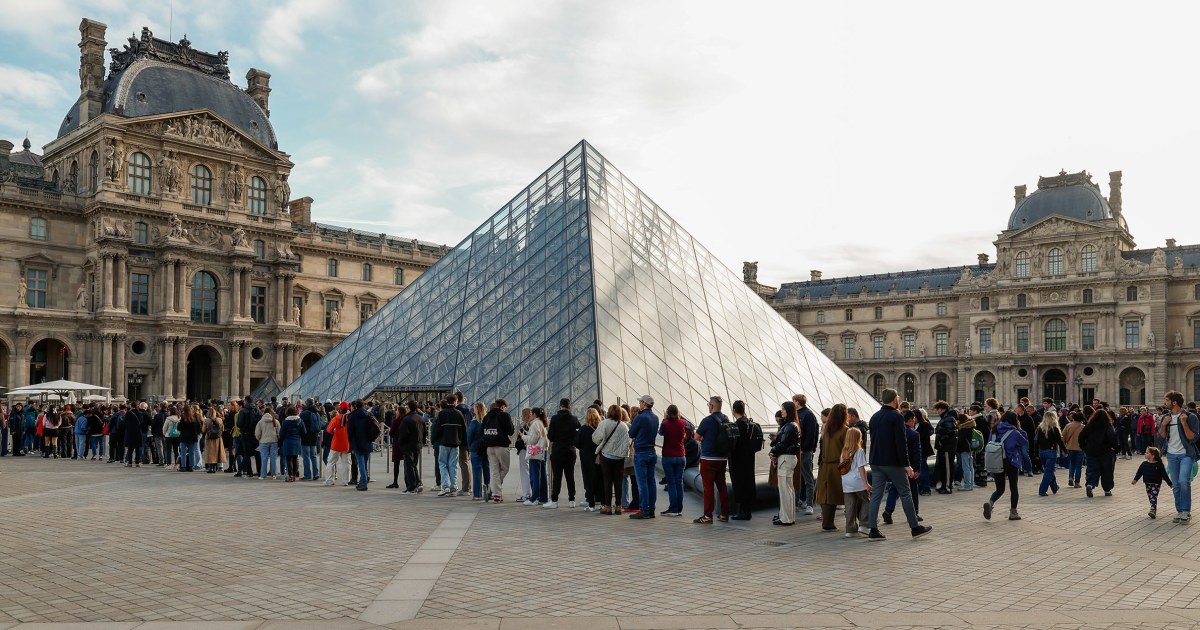
Oct. 22, 2025, 3:57 AM EDT / Updated Oct. 22, 2025, 6:29 AM EDTBy Jamie GrayThe Louvre reopened Wednesday morning for the first time since the brazen heist of France’s crown jewels.Police are still hunting the four thieves who made off with eight priceless pieces from the museum’s Apollo Room in a daylight robbery that took just four minutes. Paris prosecutor Laure Beccuau revealed in a television interview Tuesday that the stolen jewels have an estimated value of €88 million ($102 million). Beccuau, whose office is leading the probe, said there were now around 100 investigators involved in the race to retrieve the jewels before the thieves melt them down to sell. She said doing so would mean failing to realize anything near their value, but art crime experts fear that’s exactly what the thieves may have planned.“The wrongdoers who took these gems won’t earn 88 million euros if they had the very bad idea of disassembling these jewels,” Beccuau said in an interview with broadcaster RTL. “We can perhaps hope that they’ll think about this and won’t destroy these jewels without rhyme or reason.”Tourists queue to enter the Louvre on Wednesday.Pierre Suu / Getty ImagesThe museum’s director, Laurence des Cars, will face a grilling from the French senate’s culture committee later Wednesday as the incident fuels national outcry over security at key cultural sites.The theft has struck a heavy blow to French pride, already tested by political turmoil and social unrest. Officials have faced pressure to explain how such a theft could happen.French Culture Minister Rachida Dati told lawmakers Tuesday that the incident was “a wound for all of us.” “The Louvre Museum is much more than the largest museum in the world. It is the showcase of French culture and our shared heritage,” Dati told France’s National Assembly. Dati also insisted that security at the museum was not faulty.“Did the Louvre Museum’s security measures fail? No, they didn’t. It’s a fact. The Louvre Museum’s security measures worked,” Dati said. Interior Minister Laurent Nuñez acknowledged that the heist constituted a failure, but also said that the museum’s alarms functioned as they should have. “There was a burglary at the Louvre, some of the most precious jewels in France were stolen. So obviously it’s a failure, there is nothing else I can say,” Nunez told Europe 1 radio.”The alarm system worked perfectly, as soon as the window was attacked, it was activated. Police were notified, and within three minutes they were on the scene. The whole system worked, it didn’t fail, but what happened has happened.”Jamie GrayJamie Gray is a senior desk editor for NBC News based in London. Reuters and Zacharie Petit contributed.
Comments are closed.
Scroll To Top
  • Home
  • Travel
  • Culture
  • Lifestyle
  • Sport
  • Contact Us
  • Politics
© Copyright 2025 - Be That ! . All Rights Reserved