Japan has been feeling the sting of China’s economic retaliation as their diplomatic spat over Taiwan worsens, with travel agencies canceling group tours and fears mounting over an outright ban on Japanese seafood and movies.
Source link
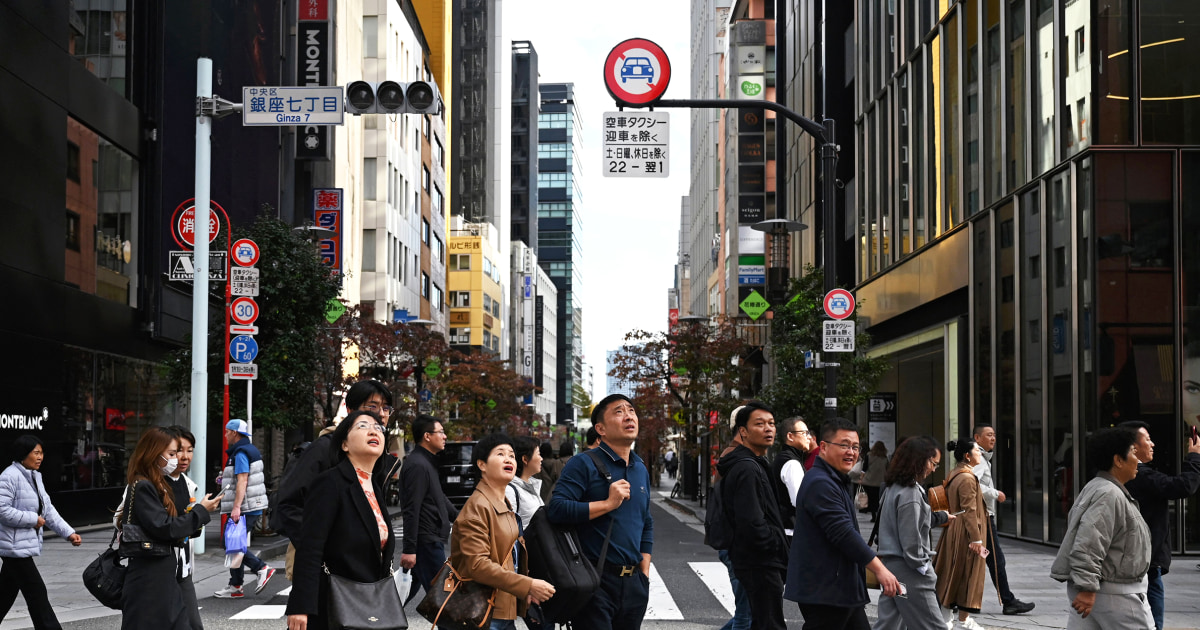
Savewith a NBCUniversal ProfileCreate your free profile or log in to save this articleNov. 19, 2025, 6:00 AM ESTBy Peter Guo and Jay GanglaniHONG KONG — Japan has been feeling the sting of China’s economic retaliation as their diplomatic spat over Taiwan worsens, with travel agencies canceling group tours and fears mounting over an outright ban on Japanese seafood and movies.China hinted that it might halt seafood imports from Japan on Wednesday after warning its citizens to avoid traveling there and postponing the release in China of at least two Japanese movies.The two largest economies in Asia have been locked in a war of words that began when Japanese Prime Minister Sanae Takaichi told lawmakers on Nov. 7 that a Chinese attack on Taiwan could force a military response from Tokyo. It was the first time such a comment had been made by a sitting prime minister of Japan, a U.S. ally that has a mutual defense pact with Washington.The first day of the auction at the Hamasaka fishing port in Toyooka, Japan, on Nov. 6.Buddhika Weerasinghe / Getty ImagesChina, which claims self-ruling Taiwan as a breakaway province to be seized by force if necessary, has repeatedly demanded that Takaichi retract her “egregious” remarks, saying it will take “severe” countermeasures if she refuses.Though unspecified, Beijing’s threats have fueled concerns for Japan’s already fragile economy that is heavily dependent on China, especially as Tokyo grapples with the effects of U.S. tariffs.On Wednesday, the Chinese Ministry of Foreign Affairs suggested that China might reimpose its ban on imports of Japanese seafood because Japan has “so far failed” to provide documents proving the quality and safety of its aquatic products.China resumed importing seafood from all but 10 Japanese prefectures earlier this month after suspending imports two years ago over the release of treated radioactive wastewater from Japan’s wrecked Fukushima Daiichi nuclear power plant.Takaichi’s comments on Taiwan have triggered “strong public outrage in China,” ministry spokesperson Mao Ning said. “Under the current circumstances, even if Japanese aquatic products were exported to China, they would have no market.”China’s newest sign of economic retaliation came days after authorities advised Chinese citizens not to travel to Japan, saying Takaichi’s “blatantly provocative” Taiwan remarks posed a “significant risk” to the safety of Chinese people in the country.Japan, which says it continues to prefer a peaceful solution to the Taiwan issue, has also advised its citizens to take extra safety precautions while in China. “The government will continue to closely monitor the situation, including the impact of the series of measures by China, and take appropriate action,” Minoru Kihara, the Japanese government’s top spokesperson, told reporters Tuesday.Following the government’s instructions, several major Chinese airlines have started offering free refunds or itinerary changes for eligible flight tickets to and from Japan.While the number of canceled flights was not immediately clear, some travel businesses have reported disruption and losses amid the China-Japan tensions.A Chinese tour group visit the Ginza shopping district in Tokyo on Monday.Greg Baker / AFP via Getty ImagesEast Japan International Travel Agency, a Tokyo-based tour operator offering tailored services to Chinese tourists, said about 70% of its group tours had been canceled, marking a “significant surge,” and that new inquiries had also decreased about 90%.“Normally, the period from late December to the Lunar New Year is peak season for corporate incentive travel,” Yu Jixin, the agency’s vice president, told NBC News in an emailed statement. “But this year, almost none of these groups are expected to visit Japan.”Beijing Huatu International Travel Agency said it had suspended bookings for Japan-related tours until further orders from Chinese authorities.“We are all Chinese people of flesh and blood,” it said Monday in a statement on RedNote, China’s Instagram-like platform. “We will never waver when it comes to the fundamentals of right and wrong.”At least two Japanese movies, “Crayon Shin-chan the Movie: Super Hot! The Spicy Kasukabe Dancers” and “Cells at Work!,” will have their releases postponed in mainland China, state-backed media China Film News said Monday.Chinese film importers and distributors said they made the “cautious” adjustment in response to viewers’ “widespread and intense dissatisfaction” with Takaichi’s remarks.Tanjiro Kamado in “Demon Slayer: Infinity Castle.”Sony PicturesThe delays were announced as Japanese anime sensation “Demon Slayer: Infinity Castle” has raked in more than $60 million since its Chinese premiere on Friday, accounting for 50% of the country’s daily box office through Wednesday, according to data from Chinese box office tracker Beacon.The pausing of film premieres by China, though a “fairly normal practice,” sends a “clear signal” to Japan, said Hong Zeng, professor of cultural studies at Hong Kong Baptist University.“This is not an isolated gesture within the film sector,” Zeng said, noting that it would be “surprising” if all these actions taken by Beijing, including its travel warning, “were merely coincidental.”Peter GuoPeter Guo is an associate producer based in Hong Kong.Jay GanglaniJay Ganglani is NBC News’s 2025-26 Asia Desk Fellow. Previously he was an NBC News Asia Desk intern and a Hong Kong-based freelance journalist who has contributed to news publications such as CNN, Fortune and the South China Morning Post.Arata Yamamoto contributed.