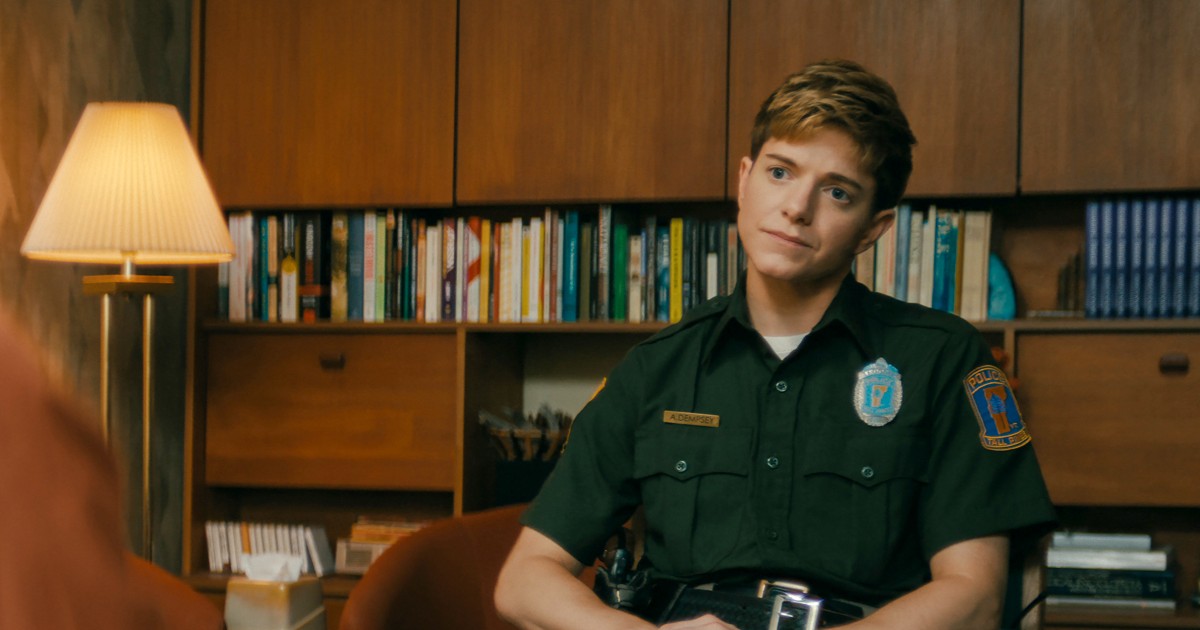
The new Netflix horror-comedy “Wayward” stars Mae Martin as a trans cop who has just moved to a seemingly picturesque small town with his pregnant wife.
Source link
Sept. 23, 2025, 2:00 PM EDTBy Max GaoCanadian comic Mae Martin knows their new Netflix limited series — which blends light-hearted comedic elements with the anxiety-inducing horror and thriller genres — may feel like a dramatic departure for anyone who is familiar with their stand-up routines and their semi-autobiographical show, “Feel Good.”“It’s funny because it doesn’t feel like a departure for me,” Martin, who identifies as nonbinary and uses they/them pronouns, told NBC News. “It feels thematically in the same universe as everything I do. It’s introspective, and there’s themes about processing adolescence and identity.”“Wayward,” which premieres Thursday, stars Martin as Alex Dempsey, a police officer who has just moved to the seemingly picturesque small town of Tall Pines with his pregnant wife, Laura (Sarah Gadon). During one of his first days in the city, where his wife grew up, Alex crosses paths with two students from the local academy for “troubled teens” who are desperately trying to plot their escape. As he begins investigating a series of unusual incidents, Alex suspects that Evelyn Wade (Toni Collette) — the school’s enigmatic leader who shares a troubling personal connection with Laura — might be at the center of all the town’s problems.“Alex is sort of the eyes of the audience and trying to piece it all together. It’s so seductive to be in a town that is so accepting and progressive on the surface and is offering him everything he’s always dreamed of,” Martin explained. But over the course of eight episodes, Alex, who is a transgender man, “is grappling with his moral compass and also his intense yearning to have that nuclear family and mainstream acceptance that he’s always wanted.”After Martin rose to fame internationally during the Covid-19 pandemic for co-creating the romantic dramedy series “Feel Good,” in which they played a fictionalized version of themselves, some viewers may have expected the writer to create a new project that would feel similarly autobiographical. But Martin said they have been wanting to make a show for decades set against the backdrop of the “troubled teen industry,” a term used for the broad range of controversial youth residential programs aimed at struggling teenagers.“My best friend Nicole got sent to a troubled teen institute in the States, and she was gone for about two years,” said Martin, who grew up in Toronto. “That sparked my interest in some of the shadier practices and the really strange origins of that industry, which all trace back to self-help cults in the 1970s and this really theatrical behavioral modification.”At first, Martin thought the series would be more of a classic, coming-of-age story in the vein of “Stand By Me” or “Holes.” But after hearing about their best friend’s harrowing experiences at one of those unregulated schools — where she recalled being starved, sleep deprived and forced to dig and stand in her own grave overnight — Martin could tell that a tale about troubled teens being held against their will would be much more in line with classic horror and thriller films such as “Fargo,” “Get Out” and “Rosemary’s Baby.”Over time, Martin said, they became more interested in looking “directly at how many young people are pathologized at such a young age, just for having a pretty normal reaction to a sick society.” “When you take kids who are in crisis and your reaction is punitive, you take away their opportunity to go through all the normal milestones of development, and you ascribe labels to them that really affect how they see their own potential,” they said. Mae Martin and Toni Collette in “Wayward.”Michael Gibson / NetflixMartin said they have found themselves increasingly thinking about “the state of the world that we’re passing down to young people, and about intergenerational conflict.”“As we get older, we suppress so much of our sensitivity and our critical thinking and even our empathy just in order to survive in the world,” Martin said. “So we can’t help but kind of gaslight young people out of their very correct observation that the world is insane, and that there’s a lot of hypocrisy out there.”From the outset, Martin said, they knew they wanted to play Alex. While his gender identity is only explored in passing, “a lot of his inner yearning is connected to that and how he sees himself and wants to be seen in the world,” especially as a husband and an expectant father, Martin explained.“The show’s set in 2003, and I think there wasn’t a lot of fluency around nonbinary identity then and not a lot of they/thems,” Martin noted, adding that playing a man “just made sense” to them. “Who knows where I’ll end up on that spectrum? But it felt pretty natural to me as an actor — more natural than it would’ve been to play a woman.”As the creator and co-showrunner of “Wayward,” Martin is one of the few LGBTQ writers in Hollywood who are shepherding their own mainstream projects. While they said they try not to think too much about their public profile when creating their projects, Martin said it is “scary” to be a queer creative at a time when President Donald Trump and conservatives have been actively targeting and rolling back legal protections for the queer community, especially trans and nonbinary people.Toni Collette and Joshua Close in “Wayward.”Netflix“What makes things difficult is when things are charged politically, like they are now, it makes it seem like even having a trans character or a gay character is a political statement and immediately puts your project in a niche category,” said Martin. “It’s crazy that your career can be affected by political swings like that.”Martin said they see their visibility as a prominent nonbinary comedian in the current climate as a double-edged sword. On the one hand, they want to tell stories that will reach the widest audience possible and, hopefully, in turn, create more empathy for the LGBTQ community. But at the same time, Martin said, they know that their mere existence can be seen as a kind of political statement.They said they would welcome an environment where an LGBTQ character’s identity was “just incidental,” rather than a defining feature of the project, “and the focus is actually on these hugely universal themes and storylines.”In “Wayward,” for instance, “there are nuances that are specific to the queer experience that I think queer people will pick up on and relate to, but those things are pretty relatable to anyone who’s experienced any kind of otherness,” Martin said.Martin speculated that the heightened backlash against the trans community is connected to depictions of trans people that have disproportionately focused on transphobia, bigotry and trauma. “It is a part of the trans experience, but it’s just one small part of a human experience,” they said. “The more we can have diverse characters who are flawed, funny, weird and relatable, who make mistakes, who have relationships — I think that would be more helpful.”Martin acknowledged there’s been a contraction in the output of diverse stories, but they plan to keep “sneaking subversive things” into more mainstream projects.“I’ll just keep my head down, keep inundating people with scripts, and hope to ride it out and do my part,” Martin said.Max GaoMax Gao is a freelance entertainment and sports journalist based in Toronto. He has written for NBC News, The New York Times, the Los Angeles Times, Sports Illustrated, The Daily Beast, Harper’s Bazaar, Elle, Men’s Health, Teen Vogue and W Magazine.