• Police seek suspects in deadly birthday party shooting
  • Lawmakers launch inquires into U.S. boat strike
  • Nov. 29, 2025, 10:07 PM EST / Updated Nov. 30, 2025,…
  • Mark Kelly says troops ‘can tell’ what orders…

Be that!

contact@bethat.ne.com


Be That ! Menu   ≡ ╳
  • Home
  • Travel
  • Culture
  • Lifestyle
  • Sport
  • Contact Us
  • Politics Politics
☰

Be that!

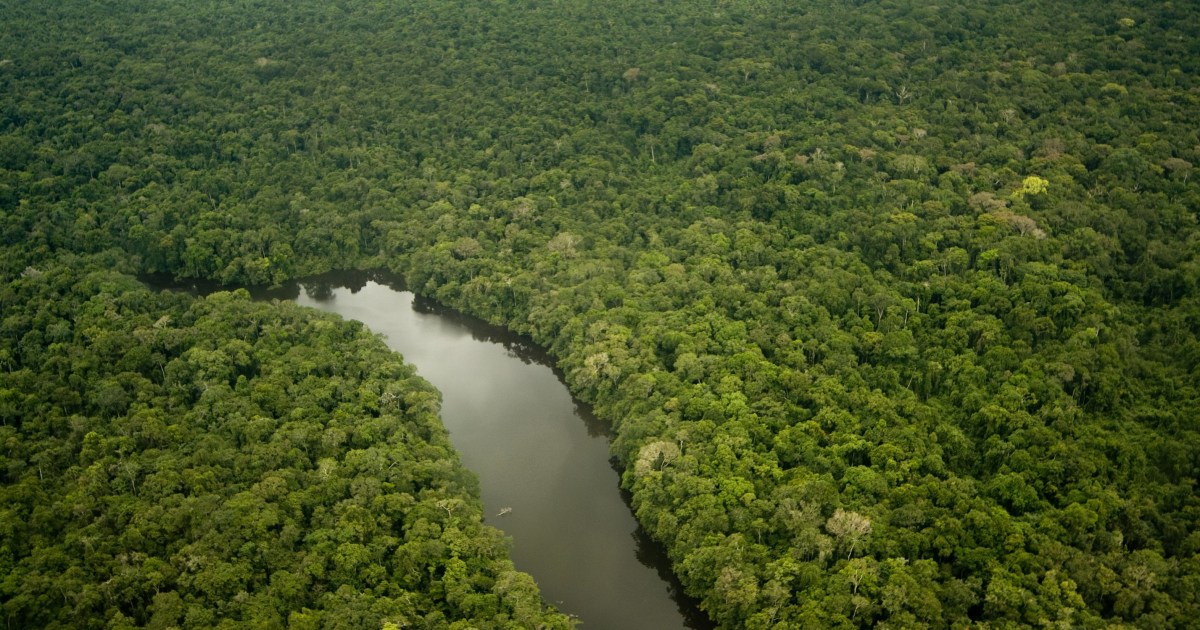
Sept. 27, 2025, 9:29 AM EDTBy Freddie ClaytonThe giants of the Amazon are getting even bigger. A sweeping new study has found the rainforest’s largest trees are not only holding their ground, they’re thriving — growing, multiplying in number and continue to play a major role in mitigating the impacts of climate change.There was a 3.3% expansion in big trees per decade, scientists found, after tracking changes in 188 intact forest plots across the Amazon over the past 30 years.Led by almost 100 researchers from 60 universities in Brazil, the U.K. and elsewhere, the findings were published on Thursday in the journal “Nature Plants.”The authors attributed the growth to the rising amount of carbon dioxide in the atmosphere from the burning of gas, oil and coal.The paper was welcomed as evidence of forest resilience in the face of climate change, but scientists warned these big trees remain vulnerable as droughts, lightning and fires are increasing in frequency, while deforestation continues to pose a serious threat.There was an understanding that big trees were “expected to be vulnerable to climate change,” Adriane Esquivel-Muelbert, one of the study’s lead authors told NBC News in a telephone interview Saturday. “What we see here is actually they seem to be showing quite a resilience.”“We’re not seeing signs of them dying off,” Esquivel-Muelbert, who co-authored the study while at Britain’s University of Birmingham, but who has since moved on to the nearby University of Cambridge. “They are increasing in size and number as well.”Scientists stressed that while protecting intact forest areas was essential to stabilizing the climate, the Amazon cannot on its own offset the vast amount of carbon dioxide produced worldwide by cars, factories and power stations — and it remains under threat.The rainforest is a carbon sink, meaning it stores more carbon than it produces. Pushing the rainforest past its limit could accelerate climate change and have terrible consequences for local communities, including Indigenous groups who depend on it. Esquivel-Muelbert stressed it was difficult to predict how worsening climate change would have an impact in the future, and hesitated to say that increased CO2 benefitted the forest, warning it may cause bigger trees to become more exposed to other factors like drought.”We don’t know the consequences in the long run,” she said. Other factors, including deforestation, remain a colossal risk to the health of the Amazon. Fattening trees is, in some ways, a “positive news story,” said Rebecca Banbury Morgan, a lead author of the study from the University of Bristol. But it also means that the forest is now “more vulnerable to losing those trees.” “Although we have shown that trees in intact forest are still increasing in size, any benefits of this in terms of the carbon sink can be quite easily negated by deforestation and logging impacts, so preserving these intact forests is really a priority,” she told NBC News. Wildfires, deforestation and global warming could permanently destroy the water cycle that sustains parts of the Amazon rainforest if action is not taken in the coming decades, according to a separate study published last year in Nature.The study suggested that 10% to 47% of the landscape is at risk of transitioning away from rainforest by 2050 if warming and rates of deforestation aren’t dramatically curbed.Brazil’s Congress approved a bill in 2023 to relax environmental licensing to pave a highway cutting through the heart of the Amazon, and close to one of the last regions that still has large areas of pristine forestLosing a large portion of the Amazon could turn a key carbon sink into a source of emissions, as wildfires burn and plants and animals decompose, no longer able to survive. Freddie ClaytonFreddie Clayton is a freelance journalist based in London. 
admin - Latest News - September 27, 2025
admin
35 views 13 secs 0 Comments


A new study has found the Amazon rainforest’s biggest trees are growing because of the amount of carbon dioxide in the atmosphere.


Source link

TAGS:
PREVIOUS
Sept. 27, 2025, 7:30 AM EDTBy Jared PerloNEW YORK — The United States clashed with world leaders over artificial intelligence at the United Nations General Assembly this week, rejecting calls for global oversight as many pushed for new collaborative frameworks.While many heads of state, corporate leaders and prominent figures endorsed a need for urgent international collaboration on AI, the U.S. delegation criticized the role of the U.N. and pushed back on the idea of centralized governance of AI.Representing the U.S. in Wednesday’s Security Council meeting on AI, Michael Kratsios, the director of the Office of Science and Technology Policy, said, “We totally reject all efforts by international bodies to assert centralized control and global governance of AI.”The path to a flourishing future powered by AI does not lie in “bureaucratic management,” Kratsios said, but instead in “the independence and sovereignty of nations.”While Kratsios shot down the idea of combined AI governance, President Donald Trump said in his speech to the General Assembly on Tuesday that the White House will be “pioneering an AI verification system that everyone can trust” to enforce the Biological Weapons Convention.“Hopefully, the U.N. can play a constructive role, and it will also be one of the early projects under AI,” Trump said. AI “could be one of the great things ever, but it also can be dangerous, but it can be put to tremendous use and tremendous good.”.In a statement to NBC News, a State Department spokesperson said, “The United States supports like-minded nations working together to encourage the development of AI in line with our shared values. The US position in international bodies is to vigorously advocate for international AI governance approaches that promote innovation, reflect American values, and counter authoritarian influence.”The comments rejecting collaborative efforts around AI governance stood in stark contrast to many of the initiatives being launched at the General Assembly.On Thursday, the U.N. introduced the Global Dialogue on AI Governance, the U.N.’s first body dedicated to AI governance involving all member states. U.N. Secretary-General António Guterres said the body would “lay the cornerstones of a global AI ecosystem that can keep pace with the fastest-moving technology in human history.” Speaking after Guterres, Nobel Prize recipient Daron Acemoglu outlined the growing stakes of AI’s rapid development, arguing that “AI is the biggest threat that humanity has faced.”But in an interview with NBC News, Amandeep Singh Gill, the U.N.’s special envoy for digital and emerging technologies, told NBC News that the United States’ critical perception of the U.N.’s role in international AI governance was misconstrued.“I think it’s a misrepresentation to say that the U.N. is somehow getting into the regulation of AI,” Gill said. “These are not top-down power grabs in terms of regulation. The regulation stays where regulation can be done in sovereign jurisdictions.”Instead, the U.N.’s mechanisms “will provide platforms for international cooperation on AI governance,” Gill said.In remarks immediately following Kratsios’ comments, China’s Vice Minister of Foreign Affairs Ma Zhaoxu said, “It is vital to jointly foster an open, inclusive, fair and nondiscriminatory environment for technological development and firmly oppose unilateralism and protectionism.”“We support the U.N. playing a central role in AI governance,” Ma said.One day after Kratsios’ remarks at the Security Council, Spanish Prime Minister Pedro Sánchez seemed to push back on Kratsios and gave full-throated support for international cooperation on AI and the U.N.’s role in AI governance.“We need to coordinate a shared vision of AI at a global level, with the U.N. as the legitimate and inclusive forum to forge consensus around common interests,” Sánchez said. “The time is now, when multilateralism is being most questioned and attacked, that we need to reaffirm how suitable it is in addressing challenges such as those represented by AI.”Reacting to the week’s developments, Renan Araujo, director of programs for the Washington, D.C.-based Institute for AI Policy and Strategy, told NBC News that “no one wants to see a burdensome, bureaucratic governance structure, and the U.S. has succeeded in starting bilateral and minilateral coalitions. At the same time, we should expect AI-related challenges to become more transnational in nature as AI capabilities become more advanced.”This is not the first time the U.N. has addressed AI, having passed the Global Digital Compact last year. The compact laid the foundation for the AI dialogue and for an independent international scientific panel to evaluate AI’s abilities, risks and pathways forward. Guterres announced that nominations to this panel are now open.While Thursday’s event marked the launch of the global dialogue and panel, the dialogue will have its first full meeting in Geneva in summer 2026, in tandem with the International Telecommunication Union’s annual AI for Good summit. The dialogue’s exact functions and first actions will be charted out over the coming months.Jared PerloJared Perlo is a writer and reporter at NBC News covering AI. He is currently supported by the Tarbell Center for AI Journalism.
NEXT
Savewith a NBCUniversal ProfileCreate your free profile or log in to save this articleBy Alexandra Marquez and Lindsey PipiaPresident Donald Trump on Saturday said that he was directing Defense Secretary Pete Hegseth to “provide all necessary Troops” to Portland.In a post on Truth Social, the president wrote that the troops would “protect War ravaged Portland” and protect ICE facilities that he claimed are “under siege from attack by Antifa and other domestic terrorists.”Trump added that he is “authorizing Full Force, if necessary,” but didn’t clarify what that meant.Over the last several days, the president has repeatedly spoken negatively about Portland, including saying on Thursday that “anarchy” is taking place in the West Coast city.”You go out to Portland, people die out there. Many people have died over the years in Portland. Portland is, I don’t know how anybody lives there. It’s amazing, but it’s, it’s anarchy out there. That’s what they want. They want anarchy,” Trump said during remarks in the Oval Office on Thursday.On Friday, in separate comments in the Oval Office, the president said people in Portland are “out of control.””Have you seen Portland at all? If you take a look what’s happening in Portland. It’s it has been going on for years. Just people out of control, crazy. We’re going to stop that very soon,” Trump said.Alexandra MarquezAlexandra Marquez is a politics reporter for NBC News.Lindsey PipiaLindsey Pipia is an Associate Producer for the 2024 Political Desk.
Related Post
October 18, 2025
Bill Nye slams NASA funding cuts at ‘No Kings’ rally
November 10, 2025
2 Cleveland Guardians players accused of rigging pitches in betting scheme
October 16, 2025
Journalists hand in credentials, walk out of Pentagon
November 18, 2025
Leonard Lauder's $400 million legacy comes up for auction
Comments are closed.
Scroll To Top
  • Home
  • Travel
  • Culture
  • Lifestyle
  • Sport
  • Contact Us
  • Politics
© Copyright 2025 - Be That ! . All Rights Reserved